VISIA Skin Analysis: How AI-Powered Complexion Imaging Transforms Your Treatment Plan
Most people assess their skin by looking in a mirror under bathroom lighting. But what you see on the surface is only a fraction of the story. Beneath the visible layer lies a complex map of UV damage, subsurface pigmentation, early wrinkle formation, bacterial activity, and pore congestion — all invisible to the naked eye, but all actively shaping how your skin will age.
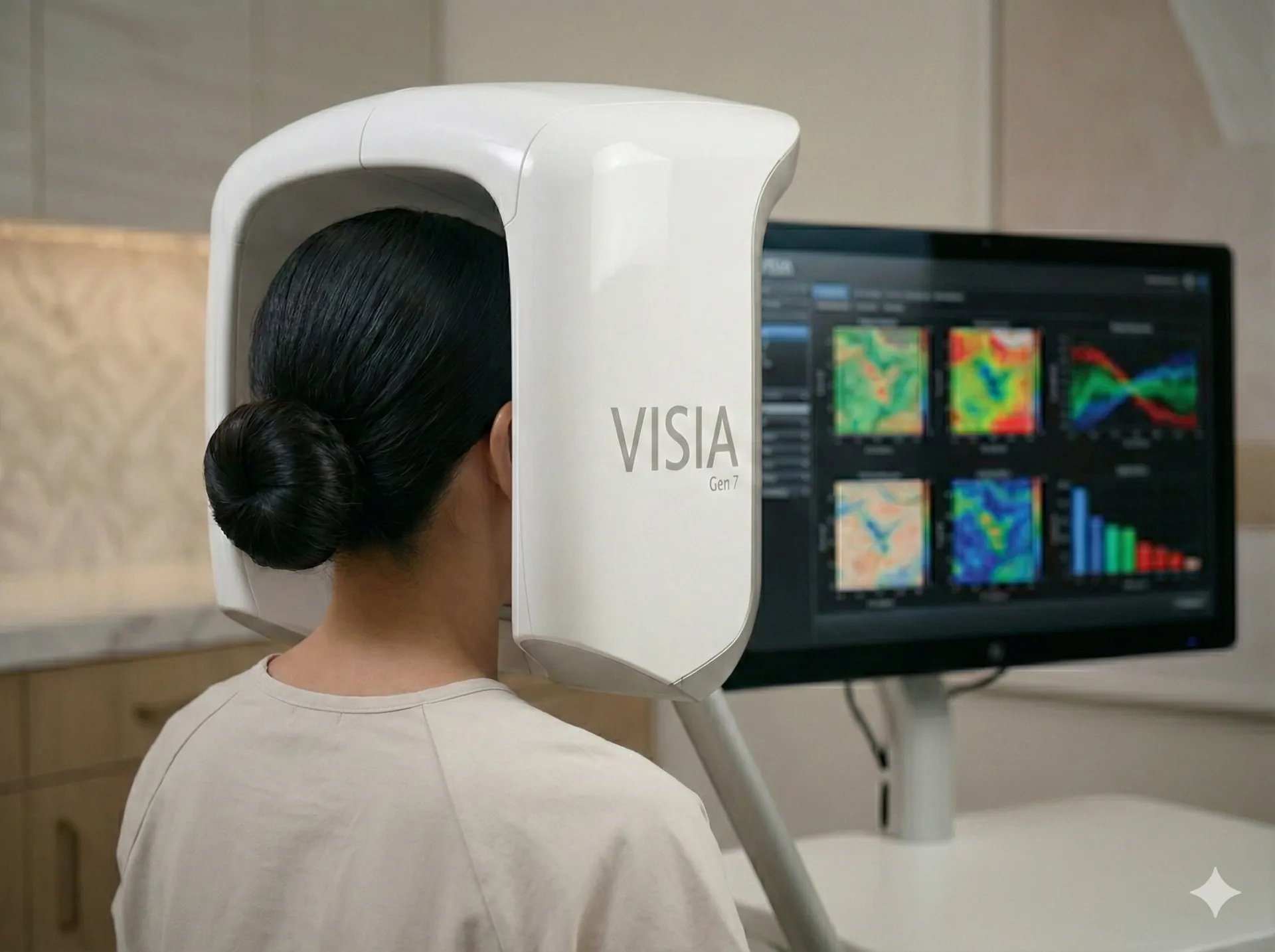
The VISIA Skin Analysis System uses clinical-grade multi-spectral imaging and artificial intelligence to reveal this hidden landscape, giving your physician a comprehensive, objective picture of your skin's true condition. At RAAC Richmond, we offer VISIA analysis as a complimentary service with any treatment consultation.
What Is VISIA Skin Analysis?
VISIA is a medical-grade imaging platform developed by Canfield Scientific, the global leader in clinical skin imaging. It captures high-resolution photographs of your face using multiple lighting modes — standard, UV, cross-polarized, and parallel-polarized light — to visualize different layers and features of the skin.
The system's AI then analyzes each image across eight key dimensions, comparing your results to a database of thousands of individuals matched by age, ethnicity, and skin type. This gives you both an absolute assessment and a percentile ranking — so you know not just where you are, but where you stand relative to peers.
The Eight Dimensions VISIA Measures
1. Spots (Visible Lesions)
VISIA identifies and maps all visible spots on the skin surface — including freckles, sunspots, age spots (solar lentigines), and post-inflammatory hyperpigmentation. The system quantifies spot count, distribution, and intensity to track changes over time.
2. Wrinkles
Using shadow analysis and texture mapping, VISIA detects fine lines and wrinkles across the face. This includes not just the obvious expression lines, but early, shallow creases that haven't yet become visible in a standard mirror. Tracking wrinkle depth and count over time helps assess whether your anti-aging treatments are actually working.
3. Texture
Skin texture refers to the overall smoothness and uniformity of the skin surface. VISIA measures micro-topography — subtle bumps, rough patches, and surface irregularities that affect how light reflects off your face. Poor texture is often the real reason skin looks "dull" even when tone is even.
4. Pores
VISIA uses cross-polarized imaging to visualize pore openings across the face. It maps pore density, size distribution, and areas of congestion. This data is particularly valuable for patients considering treatments like HydraFacial, microneedling, or the Longevity Peel — all of which target pore refinement.
5. UV Spots (Subsurface Damage)
This is perhaps the most eye-opening dimension. Using UV fluorescence photography, VISIA reveals sun damage that hasn't yet surfaced as visible spots. These UV spots represent melanin concentrations deep in the epidermis that will eventually become dark spots, uneven patches, or melasma. For many patients, this is the first time they see the cumulative effects of sun exposure — and it's a powerful motivator for SPF compliance and preventative treatment.
6. Brown Spots (Hyperpigmentation)
Distinct from visible surface spots, VISIA's cross-polarized imaging isolates melanin-related discoloration — including deeper pigmentation that blends with surrounding skin under normal lighting. This helps distinguish between treatable pigmentation and conditions requiring different approaches (like dermal melasma vs. epidermal sun spots).
7. Red Areas (Vascular Concerns)
VISIA highlights areas of redness, broken capillaries, rosacea, and inflammatory conditions. By filtering out pigment and focusing on hemoglobin, the system reveals vascular patterns that guide treatment decisions — whether that's topical management, vascular laser, or lifestyle modifications.
8. Porphyrins (Bacterial Activity)
Porphyrins are fluorescent metabolic byproducts produced by P. acnes bacteria living in pores and hair follicles. VISIA's UV imaging makes these glow, revealing areas of active bacterial colonization that may be contributing to acne, folliculitis, or skin inflammation — even when there are no visible breakouts.
Why VISIA Matters for Your Treatment Plan
Objective Baseline
Subjective assessments ("I think my skin looks better") are unreliable. VISIA provides a quantitative baseline — exact spot counts, wrinkle scores, pore measurements — that your physician uses to track real progress over weeks and months.
Personalized Treatment Selection
Different skin conditions require different approaches. VISIA data helps your physician at RAAC determine whether you would benefit most from:
- A Longevity Peel for texture and pigmentation
- Microneedling for collagen stimulation and scarring
- HydraFacial for pore congestion and hydration
- Combination protocols targeting multiple concerns simultaneously
Hidden Damage Detection
Many patients who think their skin is "fine" are surprised by what VISIA reveals beneath the surface — particularly UV damage. Early detection of subsurface damage allows proactive intervention before visible signs appear, which is always more effective (and less expensive) than reactive treatment.
Treatment Efficacy Tracking
Perhaps the most valuable use of VISIA is serial comparison. By repeating the analysis at regular intervals (every 3-6 months), you and your physician can objectively verify that treatments are producing measurable improvement — or adjust the plan if they're not.
Peer Comparison
VISIA's database allows comparison against age- and ethnicity-matched peers. You might score well on wrinkles but poorly on UV damage — indicating that sun protection should be prioritized even if wrinkle treatment isn't urgent yet.
What to Expect During Your VISIA Session
The entire VISIA analysis takes approximately 10-15 minutes and is completely non-invasive — no contact with the skin, no discomfort.
Step 1: Preparation
Arrive with a clean face — no makeup, sunscreen, or heavy moisturizer. If you're coming for a treatment consultation, our team will cleanse your face upon arrival.
Step 2: Imaging
You'll position your chin on a padded rest inside the VISIA booth. The system takes a series of photographs from three angles (left, center, right) using different lighting modes. You'll see brief flashes — similar to having a photo taken. The entire capture takes about 2 minutes.
Step 3: AI Analysis
The system processes your images in real-time, generating scores for each of the eight dimensions and comparing them to the peer database.
Step 4: Consultation Review
Your physician walks you through the results on a large screen, explaining what each measurement means for your skin health and treatment options. This is where the "aha moments" happen — especially when UV damage images are revealed.
Complimentary at RAAC Richmond
Unlike many clinics that charge competitive pricing (discussed at consultation) for VISIA analysis, RAAC offers it as a complimentary diagnostic tool with any treatment consultation. We believe that informed patients make better treatment decisions, and VISIA provides the objective data needed for truly informed consent.
Whether you're exploring chemical peels, microneedling, HydraFacial, or simply want an honest assessment of your skin's condition, VISIA analysis is included.
Who Should Get a VISIA Skin Analysis?
VISIA is valuable for virtually anyone concerned about their skin, but it's especially recommended for:
- First-time aesthetic patients: Establish a baseline before any treatments
- Patients considering multiple treatments: VISIA helps prioritize which concerns to address first
- Sun exposure concerns: Anyone wanting to understand their cumulative UV damage
- Pigmentation issues: To differentiate between types of hyperpigmentation for targeted treatment
- Treatment progress tracking: Patients mid-way through a treatment series who want to verify results
- Preventative skincare: Understanding your skin's current state to build a proactive long-term plan
Beyond the Numbers: The Human Element
While VISIA provides powerful objective data, it's a diagnostic tool — not a treatment plan by itself. At RAAC Richmond, the physician integrates VISIA findings with your medical history, lifestyle factors, treatment preferences, and budget to create a plan that makes sense for you as a whole person.
The technology informs the art of aesthetic medicine — it doesn't replace it.
Book Your Complimentary VISIA Analysis
Ready to see what's really going on beneath the surface? Book a complimentary consultation at RAAC Richmond, and your VISIA Skin Analysis is included. No obligation, no pressure — just data-driven insight into your skin's health.
RAAC Richmond Anti-Aging Clinic: 5811 Cooney Road, Suite 305, Richmond BC V6X 3M1. Serving Richmond, Vancouver, Burnaby, Surrey, and Metro Vancouver.