
Ultherapy Body in Richmond, BC
Ultrasound skin tightening for the body, serving Greater Vancouver
Ultherapy Body uses micro-focused ultrasound to deliver heat at set depths of 1.5, 3.0 and 4.5 mm, stimulating collagen in loose skin on the décolletage, upper arms, abdomen, thighs and knees, without incisions. A session typically takes 30–90 minutes, most people resume normal activities the same day, and change builds gradually over about 2–3 months. Results vary. For the face and neck, see our Ultherapy page.
- 30–90 min
- Typical Session
- Same day
- Back to routine
- 2–3 months
- Main Change Builds
- 30–90 min
- Typical Session
- Same day
- Back to routine
- 2–3 months
- Main Change Builds
What is Ultherapy Body and how does it lift skin?
Radiofrequency devices warm a broad volume of tissue. Ultherapy Body instead focuses ultrasound energy at set depths (1.5 mm, 3.0 mm and 4.5 mm) to stimulate collagen at the chosen layer while the skin surface is largely spared.
The 1.5 mm and 3.0 mm transducers work within the dermis; the 4.5 mm transducer reaches the deeper connective tissue beneath it. Ultherapy has been studied most on the face, neck and décolletage, so Dr. Jiang explains what is realistic for other body areas before you decide.
Depth-Targeted Lifting
Interchangeable micro-focused transducers place thermal energy at 1.5, 3.0 and 4.5 mm tissue planes to support structural lift.
No Surface Heating
Ultrasound focal points bypass the skin surface, so the surface stays cooler while deeper layers are stimulated.
Décolletage & Body Coverage
The shallow 1.5 mm transducer suits thinner skin such as the décolletage, where fine lines and crepey texture are common concerns.
How is Ultherapy Body different from RF body devices?
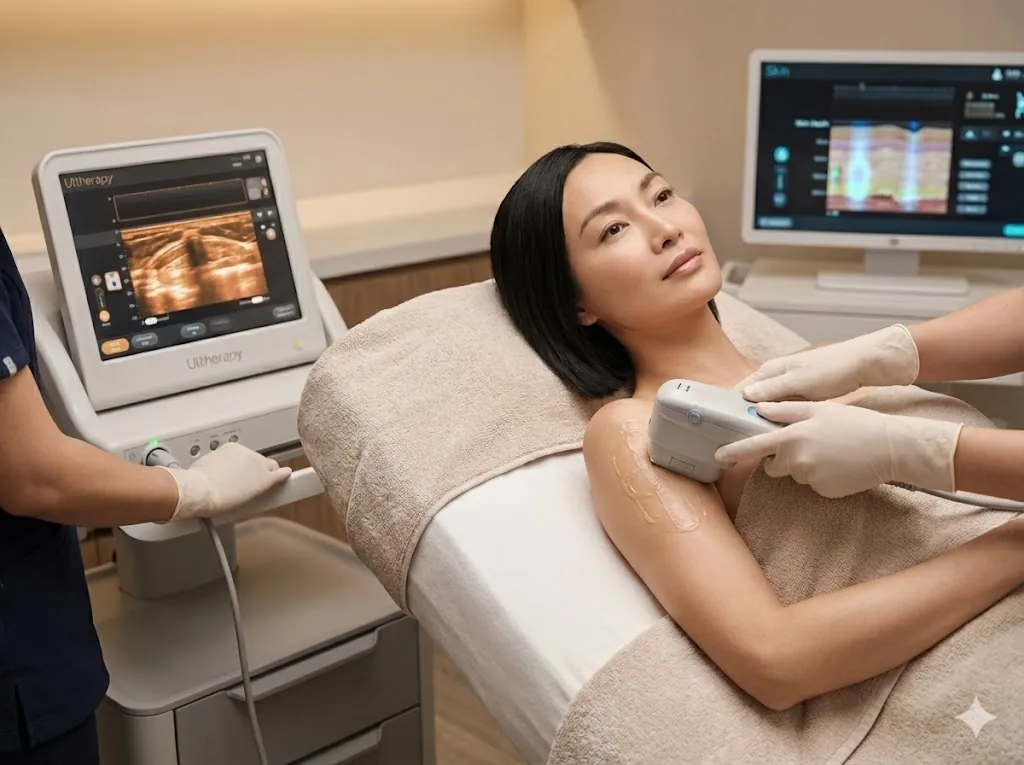
Ultherapy Body creates small, discrete heating points at set depths using micro-focused transducers. Monopolar RF works differently, warming a broader volume of tissue.
Three depth transducers
Interchangeable 1.5 mm, 3.0 mm and 4.5 mm heads target the superficial dermis, the deep dermis and the connective tissue beneath it.
Surface largely spared
The energy passes through the skin surface and concentrates at the focal point, so heating is focused below the surface.
Real-time ultrasound imaging
DeepSEE® visualization shows tissue layer depths before each pulse, so energy is placed at the intended plane.
HIFU collagen remodeling
Discrete heating points prompt new collagen over about 2–3 months, gradually firming treated skin.
Who is Ultherapy Body suitable for?
Our team will assess your needs to determine if this treatment is right for you.
Suitable Candidates
- +Individuals with mild to moderate skin laxity on the body or décolletage
- +Those seeking non-surgical depth-lifting without surface RF heating
- +People with post-pregnancy abdominal skin relaxation
- +Individuals with sagging skin on arms, thighs, or knees
- +Those who want collagen stimulation at specific tissue planes rather than broad surface warming
Not Recommended For
- –Pregnant or breastfeeding women
- –People with certain medical implants in treatment areas
- –Individuals with active infections or severe inflammation
- –Those expecting dramatic, surgery-like results
- –People with certain neuromuscular disorders
- –Take blood thinners or have a bleeding disorder (higher bruising risk); discuss it first
- –Have open wounds, severe acne or other skin lesions in the treatment area
Why have Ultherapy Body at our Richmond clinic?
Ultherapy Body at Richmond Anti-Aging Clinic is planned by Dr. Charles Jiang, with consultations in English, Mandarin and Cantonese.
Depth-calibrated transducer selection
Dr. Jiang selects the 1.5, 3.0 or 4.5 mm transducer for each body zone so energy reaches the intended tissue plane.
Physician-led MFU system
Genuine Ultherapy hardware with verified transducer heads and DeepSEE® imaging.
Décolletage-inclusive planning
Shallow-transducer protocols allow treatment planning for the upper chest and other thin-skin areas.
Complementary to RF and injectables
MFU addresses deep structural lifting while RF or neuromodulator treatments address surface texture — layered protocols available when clinically appropriate.
Which body areas can Ultherapy treat?
Ultherapy Body's interchangeable transducers allow depth-matched treatment across body zones, from delicate décolletage at 1.5 mm to the deeper abdominal dermis at 4.5 mm. For the face and neck, see our Ultherapy page.
Abdomen
The 4.5 mm transducer may address post-pregnancy or post-weight-loss laxity in the deep dermis and the connective tissue beneath it.
Upper Arms
Targets loose skin on the back of the upper arm at 3.0 mm depth to help firm it.
Inner Thighs
Shallow transducer protocols may improve skin tone and reduce laxity in thinner inner-thigh skin.
Outer Thighs
Depth-targeted MFU may gradually improve outer thigh firmness over 2-3 months.
Knees
The 1.5 mm transducer addresses crepey skin around the knees — a delicate zone well suited to focal ultrasound.
Flanks
Focused ultrasound at depth may help tighten loose flank skin.
Décolletage
Crepey texture and fine lines on the upper chest, usually with the shallower transducers.
What happens during an Ultherapy Body session?
Assessment, imaging-guided mapping, transducer selection, treatment and aftercare. A session typically takes 30–90 minutes, and comfort options such as topical numbing or an oral pain reliever are discussed beforehand.
Pre-Treatment Preparation
Comprehensive body assessment, photography, and tissue-depth mapping
Review of medical history, any implants, and current health status
Avoid blood-thinning medications for 5-7 days prior
Discontinue retinoids and exfoliants 3-5 days before
Arrive with clean, treatment-area skin free of lotions or oils
Treatment Session
Skin Preparation
Cleanse treatment area and apply ultrasound coupling gel to ensure clean transducer contact and accurate imaging.
Ultrasound Mapping
DeepSEE® real-time imaging confirms tissue layer depths before selecting the correct transducer head for each zone.
Energy Delivery
Focused ultrasound pulses deposited systematically at calibrated 1.5, 3.0, or 4.5 mm depths across all target zones.
Treatment Completion
Final imaging review and tailored post-treatment care instructions specific to each treated zone.
Recovery & Results
Most people resume normal activities the same day
Mild tenderness or redness is common; swelling, bruising or tingling can last several days
Use prescribed moisturizers and broad-spectrum sunscreen on treated areas
Avoid strenuous exercise and heavy lifting for 24-48 hours
No saunas, hot tubs, or intense heat exposure for 1 week
The main change builds over about 2–3 months and can continue to about 6 months; Dr. Jiang may suggest a review about once a year
**Individual results vary. A second session may be suggested for larger areas.
Ultherapy Body Questions Answered
How much does Ultherapy Body cost in Richmond, BC?+
Fees are not published online. Pricing depends on the number of body zones and transducer passes, and is confirmed after Dr. Charles Jiang assesses your concerns.
How is Ultherapy Body different from facial Ultherapy?+
The technology is the same micro-focused ultrasound, but the body version covers larger zones such as the abdomen, arms, thighs and knees, with different session lengths and planning. See our Ultherapy page for face and neck.
How long does an Ultherapy Body session take?+
Typically 30-90 minutes depending on the area and the number of depth passes. Using several transducers (1.5, 3.0 and 4.5 mm) lengthens the session.
Does Ultherapy Body hurt?+
Many people feel brief, sharp heat sensations as each focal point fires, different from the diffuse warmth of RF. Topical numbing or analgesics can be used beforehand to improve comfort.
How many Ultherapy Body sessions do I need?+
Many people have one session. Larger areas or more advanced laxity may benefit from a second session 3-6 months later. Dr. Jiang confirms the plan at your assessment. Results vary.
When will I see results from Ultherapy Body?+
New collagen forms gradually: early lift at about 4-6 weeks, peak improvement at 2-3 months, and continued change to about 6 months. Results vary.
Can Ultherapy Body be combined with other treatments?+
Often, yes. Ultrasound addresses deeper laxity, radiofrequency or other treatments can address surface texture, and fat or muscle treatments such as CoolSculpting or EMSculpt can be planned alongside it when clinically appropriate. Your assessment maps which combination, if any, suits you.
Is the clinic accessible from Vancouver, and is Mandarin spoken?+
We are at Unit 110, 5580 No. 3 Rd, Richmond, BC, about a 3-minute walk from Lansdowne Station on the Canada Line (building parking via Ackroyd Road), reachable from Vancouver and across Metro Vancouver. Consultations are available in English, Mandarin and Cantonese; open daily 9:00-18:00.
Is Ultherapy on the body as well studied as on the face?+
Not to the same extent. Ultherapy has been studied most for lifting the brow, the area under the chin and the neck, and for lines on the décolletage. There is less published evidence for the abdomen, arms, thighs and knees, and results there are harder to predict. Dr. Jiang explains what is realistic for your area before you decide.
What side effects are possible after Ultherapy Body?+
Temporary redness, swelling and tenderness are common and usually settle within hours to days. Some people have bruising, or tingling or numbness that can last several days, occasionally longer. Rarely, nerve irritation causes temporary weakness or altered sensation. Tell us if anything does not settle as expected.
How long do Ultherapy Body results last?+
Results build gradually and are not permanent, because skin keeps ageing. How long they last varies with age, skin quality and weight stability, and there is less long-term data for body areas than for the face and neck. Dr. Jiang may suggest a review about once a year to decide whether a touch-up makes sense.
Does Ultherapy Body remove fat?+
No. Ultherapy Body is aimed at loose skin, not fat reduction. If fat is the main concern, treatments such as CoolSculpting are designed for that purpose, and Dr. Jiang can discuss whether combining them makes sense for you.
Non-Surgical Body Lifting with Ultherapy
Find out whether micro-focused ultrasound is the right approach for your body concerns. Consult Dr. Charles Jiang, who has 29+ years of clinical experience, at Richmond Anti-Aging Clinic.
Related treatments
What our clinical team has written about this
How it works, who it suits, and what recovery looks like:
- Ultherapy Swelling and Recovery: A Day-by-Day Timeline
Redness, mild swelling and tenderness are common after Ultherapy, and most people resume normal activities the same day. Here is what each stage of recovery usually looks like.
- Ultherapy: Science, Evidence & Who It's For
A physician-authored deep-dive into how Ultherapy's micro-focused ultrasound triggers neocollagenesis, what the clinical trials show, and who is a strong candidate.
- Thermage FLX vs Ultherapy: Which Is Better for Skin Tightening?
Thermage FLX and Ultherapy are two widely used non-surgical skin tightening technologies. A Richmond physician compares mechanisms, results, comfort, cost, and ideal candidates to help you choose.
- Ultherapy Prime: The Complete Guide to Non-Surgical SMAS Lifting in Richmond BC
Ultherapy Prime focuses micro-ultrasound on the SMAS layer, the tissue surgeons address in a facelift. How it works, who suits it, recovery and when results appear.
Also offered at our Burnaby location
SkinArt MD offers the same treatment. If Burnaby is more convenient, our sister clinic can help.
#101 - 4378 Beresford St, Burnaby, BC V5H 0H6 · +1 (604) 639-2581