
VISIA® Skin Analysis Vancouver & Richmond, BC
A 10 to 15 minute facial scan that shows what is behind your pigmentation and skin ageing, so treatment decisions start from data.
VISIA® by Canfield Scientific is a diagnostic skin imaging system used in dermatology and aesthetic practices. Its 8-feature multi-spectral imaging captures surface and subsurface skin conditions and produces a TruScore percentile report. At Richmond Anti-Aging Clinic, Dr. Charles Jiang, Medical Director, reviews your results and builds a personalized plan, in English, Mandarin or Cantonese.
- 10–15 min
- Imaging Time
- Same visit
- Results Reviewed by Dr. Jiang
- 3–6 months
- Typical Re-scan Interval
- 10–15 min
- Imaging Time
- Same visit
- Results Reviewed by Dr. Jiang
- 3–6 months
- Typical Re-scan Interval
What is a VISIA® skin analysis, and what does it show?
VISIA® is a skin imaging system from Canfield Scientific. It photographs your face under standard, cross-polarized and UV light, scores 8 features such as spots, wrinkles, pores and redness, and compares you with an age-matched reference group. At RAAC in Richmond, BC, Dr. Charles Jiang reviews the report with you after a 10 to 15 minute scan.
VISIA® Skin Analysis is manufactured by Canfield Scientific, whose imaging systems have been used in published dermatology research. Using cross-polarized, UV and parallel-polarized lighting, the system captures consistently registered images that reveal conditions not visible to the naked eye. It evaluates 8 features: spots, wrinkles, texture, pores, UV spots, brown spots, red areas and porphyrins. Your TruScore places each metric in a percentile rank against a reference group, giving Dr. Charles Jiang an objective baseline to plan treatments such as HydraFacial, chemical peels, IPL, laser resurfacing and Sculptra, and to measure them later.
Objective Baseline Before Any Treatment
Records scores across 8 features before you begin any procedure, so later change can be measured rather than estimated.
Percentile Comparison (TruScore)
Your scores are compared with a reference group of people of similar age and skin type, which gives each number some context.
Immediate Results, Same Appointment
Results are available straight after the scan. Dr. Jiang reviews your report in the same visit and discusses which treatments, if any, suit your results.
How does VISIA® measure your skin?
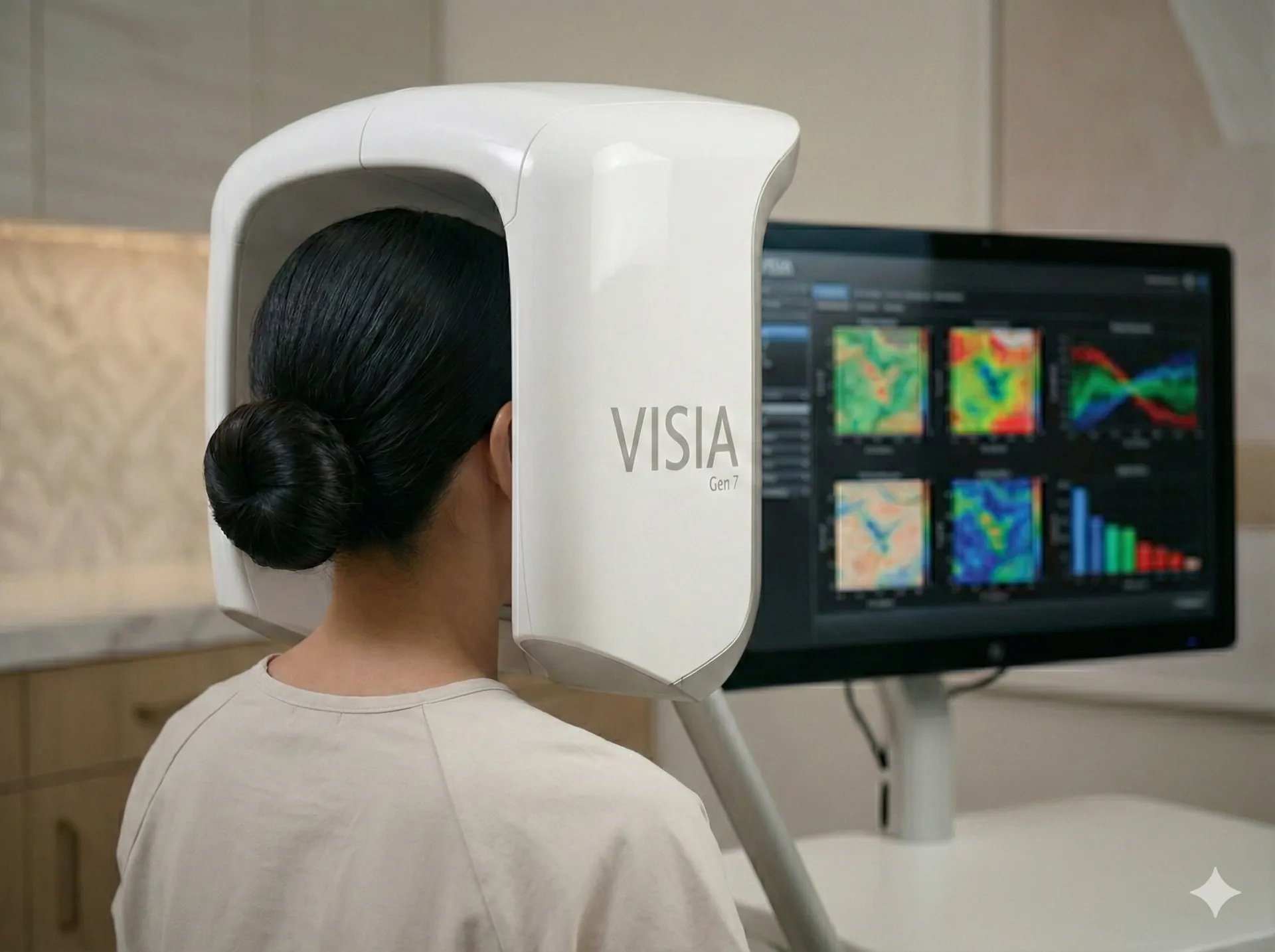
VISIA® uses three distinct lighting modes to capture skin data that standard photography cannot detect. The imaging dome positions the camera precisely for reproducible results at every re-scan.
IntelliFlash® Cross-Polarized Lighting
Removes surface glare to record texture, fine lines, wrinkles and pores, which change with photoaging and collagen loss.
UV Lighting — Subsurface Damage
Shows UV spots (sun damage not yet visible on the surface) and porphyrins, by-products of bacteria in pores that are linked to congestion and acne.
RBX® Technology — Vascular and Pigment Separation
Separates red signals (vascular: rosacea, visible vessels, inflammation) from brown signals (pigment: PIH, melasma, sun spots) so each can be assessed on its own.
TruScore Percentile Benchmarking
Each of the 8 features is ranked against a reference database. Dr. Jiang reads the percentiles together with your history and examination to decide which findings matter for you.
Who is a VISIA® scan suitable for?
VISIA® is suitable for most adults who want objective information about their skin. Dr. Charles Jiang uses it as a starting point for new comprehensive consultations at Richmond Anti-Aging Clinic.
Particularly Valuable If You
- +Are planning treatments for pigmentation, photoaging, or acne scarring and want objective before-and-after data
- +Have tried multiple skincare products without knowing which concerns to prioritize
- +Are beginning a course of IPL, laser resurfacing, chemical peels, or Sculptra and want a documented baseline
- +Want to see how your skin compares with a reference group of similar age, via TruScore percentiles
- +Are a new patient at RAAC and want a data-driven treatment plan rather than a generic consultation
Considerations and Contraindications
- –Active skin infection, open wounds, or severe inflammatory flare in the facial area — rebook once resolved
- –Unable to have all makeup, sunscreen, and skincare products removed before imaging — results will be inaccurate
- –Claustrophobia: the imaging dome encloses your face; patients with significant claustrophobia may find the position uncomfortable — let us know in advance
- –Recent dermal filler injections (within 2 weeks): swelling can change how the skin appears on the images, so a baseline scan is best taken once it settles
- –Severe active skin conditions requiring urgent medical treatment should be addressed before an elective diagnostic scan
Why have your scan reviewed by a physician?
A scan is only as useful as its interpretation. At Richmond Anti-Aging Clinic, Dr. Charles Jiang, Medical Director, reviews your report so that the findings translate into a sound treatment plan.
Physician-Interpreted
Dr. Charles Jiang reviews your VISIA® report. His medical training helps decide which findings matter and which treatments, such as HydraFacial, IPL, chemical peels, laser resurfacing or Sculptra, are an appropriate response to your scores.
Context for Asian Skin
Pigment concerns such as PIH (post-inflammatory hyperpigmentation), melasma and sun spots are common in Asian skin. The brown-spot and UV images help show them and track how they respond to treatment over time.
Objective Progress Tracking Every 3–6 Months
We suggest re-scanning every 3 to 6 months during an active treatment course. Side-by-side TruScore comparisons give you measured changes in pigmentation, texture and vascular metrics, not just an impression.
Multilingual Report Review
Dr. Jiang and the RAAC team conduct full VISIA® report reviews in English, Mandarin, and Cantonese. Patients can ask detailed questions about their scores and treatment rationale in their preferred language.
What does VISIA® measure across 8 features?
Each feature is captured under a specific lighting mode and scored via TruScore against a reference group of similar age.
Spots
Surface brown and red lesions: freckles, post-acne marks, and solar lentigines captured under cross-polarized light.
Wrinkles
Depth and distribution of fine lines and deeper creases — used to track collagen response to anti-aging treatments over time.
Texture
Surface irregularities affecting skin smoothness, including roughness from photodamage, scarring, or keratosis.
UV Spots
Subsurface sun damage not yet visible to the naked eye, useful for planning sun protection and early photoaging care.
Pores
Pore size and distribution, which relate to oil production and skin ageing.
Brown Spots
Deeper melanin deposits including melasma, age spots, and dermal pigmentation measured via RBX® brown channel analysis.
Red Areas
Vascular findings: rosacea, telangiectasia, post-procedure erythema, and diffuse inflammation mapped via RBX® red channel.
Porphyrins
Bacterial by-products that fluoresce under UV light within pores, linked to congestion and acne-prone skin.
What happens during a VISIA® session?
The full session — scan, results review, and treatment planning with Dr. Jiang — takes approximately 30–45 minutes. The imaging itself is 10–15 minutes.
Preparation
Arrive with clean skin with no makeup, sunscreen or topical products; we can help with removal at the clinic
Avoid heavy exercise or heat exposure (sauna, steam room) for 2 hours before your appointment, as flushing can temporarily elevate red area scores
If you have had dermal filler injections in the past 2 weeks, tell the team, as swelling can affect how the images compare over time
Bring a list of your current skincare products and any prescription topicals — Dr. Jiang will review them in the context of your scan results
Allow 30–45 minutes for the full session including results review and treatment discussion
During Your Session
Medical History and Skin Concerns
Dr. Jiang or a clinical team member reviews your skin history, current concerns, and any treatments you are considering — establishing the clinical questions the scan needs to answer.
Skin Preparation
All makeup, sunscreen, and skincare products are removed. The imaging dome positions your face reproducibly for accurate baseline capture.
VISIA® Multi-Spectral Imaging (10–15 minutes)
The Canfield VISIA® system captures images across all 8 modalities under cross-polarized, UV, and parallel-polarized lighting. Results are computed immediately.
Physician Results Review and Treatment Plan
Dr. Charles Jiang walks through your TruScore percentile rankings for all 8 metrics, explains the clinical significance of each finding, and recommends specific treatments matched to your priorities.
After Your Analysis
Receive a detailed digital report with your scores, percentile rankings, and annotated images — available to reference before your next appointment
Treatment suggestions (HydraFacial, chemical peels, IPL, laser resurfacing, Sculptra or others) are ranked by what matters most for your skin and goals
Book any recommended treatments or a follow-up diagnostic scan — re-scanning every 3–6 months during an active course gives objective progress data
Your VISIA® baseline images are stored on file; all future re-scans are automatically compared against this baseline for side-by-side TruScore delta tracking
A summary of your personalized skincare adjustments is provided in writing, in your preferred language
**VISIA® images are diagnostic tools used to guide treatment planning and track progress. Individual TruScore percentile results vary based on age, skin type, and prior sun exposure. VISIA® is a diagnostic imaging system — not a treatment.
Common Questions
What is a VISIA® skin analysis, and what does it measure?+
VISIA® is a skin imaging system from Canfield Scientific. It photographs your face under different lighting modes and scores 8 features: spots, wrinkles, texture, pores, UV spots, brown spots, red areas and porphyrins. TruScore ranks each against an age-matched reference group. Dr. Charles Jiang then explains what the results mean and which treatments, if any, make sense.
How long does the scan take, and do I need to remove makeup?+
The imaging takes 10 to 15 minutes, and the full session, including history, imaging and Dr. Jiang's review, runs about 30 to 45 minutes. Yes, makeup, sunscreen and skin products affect the optical measurements, so come with clean skin or we can help you remove them at the clinic.
How much does a VISIA® skin analysis cost in Richmond, BC?+
The cost depends on whether the scan is a stand-alone visit or part of a treatment consultation, whether Dr. Jiang's review of the results is included, and how re-scans during a treatment course are arranged. We do not publish VISIA® prices online; the clinic confirms the fee and what it includes when you book, before the scan. The team can also tell you how much time to allow.
How often should I repeat a VISIA® scan?+
During an active treatment course we suggest re-scanning every 3 to 6 months. That interval lets meaningful changes in your TruScore percentiles build up, so you and Dr. Jiang see measured results rather than relying on impression. The first scan, taken before treatment starts, is the baseline that later scans are compared with.
Is the VISIA® scan painful, and does the flash affect my eyes?+
The scan is non-contact and non-invasive: it takes digital photographs using different lighting modes, and you close your eyes as prompted. The imaging dome encloses your face, which most people find comfortable. If you have claustrophobia, tell us in advance and we will walk you through the positioning before we begin.
What treatments might Dr. Jiang suggest after a VISIA® scan?+
It depends on which of the 8 metrics stand out for you. For example: high UV spots and brown spots may point to an IPL/DPL photo facial or a PicoWay laser; low texture and wrinkle scores may point to Sylfirm X RF microneedling, HydraFacial or Sculptra; high porphyrins and enlarged pores may point to HydraFacial and a longevity peel. Plans are personalized, and the scan becomes your baseline for later re-scans.
Can I come from Vancouver for a VISIA® scan, and is Mandarin or Cantonese available?+
Yes. RAAC is at Unit 110, 5580 No. 3 Rd, Richmond, about a 3-minute walk from Lansdowne Station on the Canada Line, so clients from Vancouver and Burnaby can come by SkyTrain. Dr. Charles Jiang and the clinical team review VISIA® reports in English, Mandarin and Cantonese. The clinic is open every day 9:00 to 18:00; allow 30 to 45 minutes for the full visit.
Is VISIA® skin analysis accurate, and how is it different from apps?+
VISIA® is made by Canfield Scientific, whose imaging has been used in published dermatology research. It uses fixed positioning and lighting, so images are reproducible across visits; TruScore compares results with a reference group; and RBX® technology separates vascular and pigment signals, which consumer apps generally cannot do. Scores still vary with makeup, lighting and positioning, so a physician interprets them alongside an examination.
Can a VISIA® scan detect skin cancer?+
No. VISIA® photographs and scores how the skin looks; it is not a test for skin cancer and does not replace a skin examination. If Dr. Jiang notices a spot that needs a closer look during your visit, he will tell you and advise on assessment or referral. Any new, changing or bleeding spot should be checked by a doctor whether or not you have a scan.
Is there any downtime after a VISIA® scan?+
None. The scan is non-contact photography, so you can put your makeup and sunscreen back on and carry on with your day straight away. The only thing to plan for is time: about 10 to 15 minutes of imaging, and about 30 to 45 minutes for the full visit including Dr. Jiang's review of your results.
Is VISIA® useful for Asian or darker skin tones?+
Yes, it can be. Pigment concerns such as post-inflammatory hyperpigmentation, melasma and sun spots are common in Asian and darker skin, and the brown-spot and UV images help show them. Scores are compared with a reference group, and Dr. Jiang interprets them alongside your skin type and history, because a number alone does not decide treatment.
Do I need a VISIA® scan before starting treatment?+
It is not required, but it can help. A scan before treatment gives a measured baseline, so later scans can show what has changed in pigment, redness, texture or pores. It is also useful when you are unsure which concern to address first. Many treatments can still be planned from a consultation and examination alone.
Know your skin before you treat it.
Book a VISIA® skin analysis with Dr. Charles Jiang at Richmond Anti-Aging Clinic. Consultations in English, Mandarin and Cantonese, open daily 9:00 to 18:00.
Related treatments
What our clinical team has written about this
How it works, who it suits, and what recovery looks like:
- VISIA Skin Analysis: The Eight Measurements and How They Guide Treatment
VISIA Skin Analysis uses advanced imaging and AI to measure wrinkles, spots, pores, UV damage, texture, and bacteria beneath your skin's surface. Learn how this diagnostic tool at RAAC Richmond helps physicians create precise, data-driven treatment plans.
- Why Your Skincare Isn't Working: What a VISIA Skin Analysis Shows
Using products that don't seem to work? What a VISIA skin analysis reveals below the surface, how long the scan takes, how often to repeat it and how it shapes a treatment plan.
Also offered at our Burnaby location
SkinArt MD offers the same treatment. If Burnaby is more convenient, our sister clinic can help.
#101 - 4378 Beresford St, Burnaby, BC V5H 0H6 · +1 (604) 639-2581