
PicoWay® Body & Tattoo Removal in Richmond, BC
Picosecond laser for tattoos, body pigmentation and scars, serving Greater Vancouver
PicoWay Body is a picosecond laser used for tattoo removal and for pigmentation and scars on the hands, arms, chest and back. Ultra-short pulses break ink and pigment into fragments the body clears naturally. Tattoos typically need 4-8 or more sessions spaced 6-8 weeks apart; pigmentation often needs fewer. Results vary.
- 6–8 weeks
- Between Tattoo Sessions
- 30-60 min
- Typical Session
- 4-8+
- Typical Tattoo Sessions
- 6–8 weeks
- Between Tattoo Sessions
- 30-60 min
- Typical Session
- 4-8+
- Typical Tattoo Sessions
How does PicoWay treat tattoos and body pigmentation?
Body skin heals differently than facial skin. PicoWay's short-pulse 'photoacoustic' effect is designed to limit heat in surrounding skin, which is intended to limit the risk of burns or pigment change.
Body skin heals differently than facial skin. PicoWay's short-pulse 'photoacoustic' effect is designed to limit heat in surrounding skin, which is intended to limit the risk of burns or pigment change. Dr. Jiang plans settings by area, skin tone and ink or pigment type. For facial pigment and melasma, see our PicoWay page; for a full tattoo-removal guide, see our Tattoo Removal page.
Pigmentation & Sun Spots
Targets age spots and sun spots on the hands, arms and décolletage (chest).
Body Scars & Texture
May improve the look of surgical scars, stretch marks and acne scars on the back and shoulders.
Tattoo Removal
Breaks up many ink colours on a range of skin types; stubborn blues and greens may need more sessions.
Shatter, not burn: how does a picosecond laser work?
PicoWay delivers picosecond pulses that act mainly through a photoacoustic (pressure) effect, breaking ink and pigment into tiny particles that the body clears over time.
Picosecond Pulses
Each pulse lasts trillionths of a second, creating a photoacoustic effect on pigment while limiting heat build-up in the skin.
LIOB Effect (Resolve™)
The Resolve™ handpiece creates tiny zones of Laser-Induced Optical Breakdown (LIOB) beneath the surface, intended to stimulate collagen without breaking the skin.
Natural Pigment Clearance
Fragmented pigment particles are small enough for the body's immune system to clear over the following weeks.
Wavelength Selection
Our PicoWay has 1064 nm and 532 nm wavelengths plus 785 nm and 730 nm handpieces. Your physician chooses the one that suits the ink colour or pigment depth.
Who is PicoWay Body suitable for?
PicoWay Body suits people seeking body skin improvement or tattoo removal with a short recovery time. Suitability is confirmed at your assessment.
Suitable Candidates
- +Individuals with body pigmentation (age spots, sun spots on hands/arms)
- +Those seeking tattoo removal
- +People with acne scars or surgical scars on body
- +Individuals with stretch marks seeking improvement
- +Those who want to fade a tattoo before a cover-up design
Not Recommended For
- –Pregnant or breastfeeding women
- –Individuals with active infections or skin conditions
- –Those expecting complete scar erasure
- –Have a recent tan or sunburn on the area (treatment is usually postponed)
- –Have taken isotretinoin recently or take a medication that makes skin light-sensitive; tell us at booking
- –Have a history of keloid or raised scarring
Is PicoWay suitable for darker skin tones?
Treating the body takes planning. We customise protocols to protect pigment-sensitive, melanin-rich or reactive skin that is more prone to PIH. No laser is risk-free.
Pigment-Aware Protocols
For darker skin we often use the 1064 nm wavelength, which is absorbed less by the skin's own pigment. Every setting still carries some risk.
Scar Treatment Planning
Dr. Jiang's team may combine PicoWay with other modalities for C-section or trauma scars.
Efficient Treatment
Large spot sizes let us treat large areas such as the back or arms in a reasonable time.
Aftercare Support
We recommend post-care products for body skin recovery.
Which body areas can PicoWay treat?
PicoWay can treat delicate areas such as the chest as well as tougher skin on the back.
Hands & Arms
Sun spots and age spots on the hands and arms.
Back & Chest
Pigmentation and depressed scars left by acne on the back and chest; results vary.
Décolletage
Sun-related spots and uneven tone on the upper chest.
Tattoo Areas
Anywhere on the body. Black, red, blue and green inks are commonly treated; the number of sessions varies.
Scar Tissue
Can be used to soften the texture of some surgical scars and stretch marks; results vary.
What happens during a PicoWay Body session?
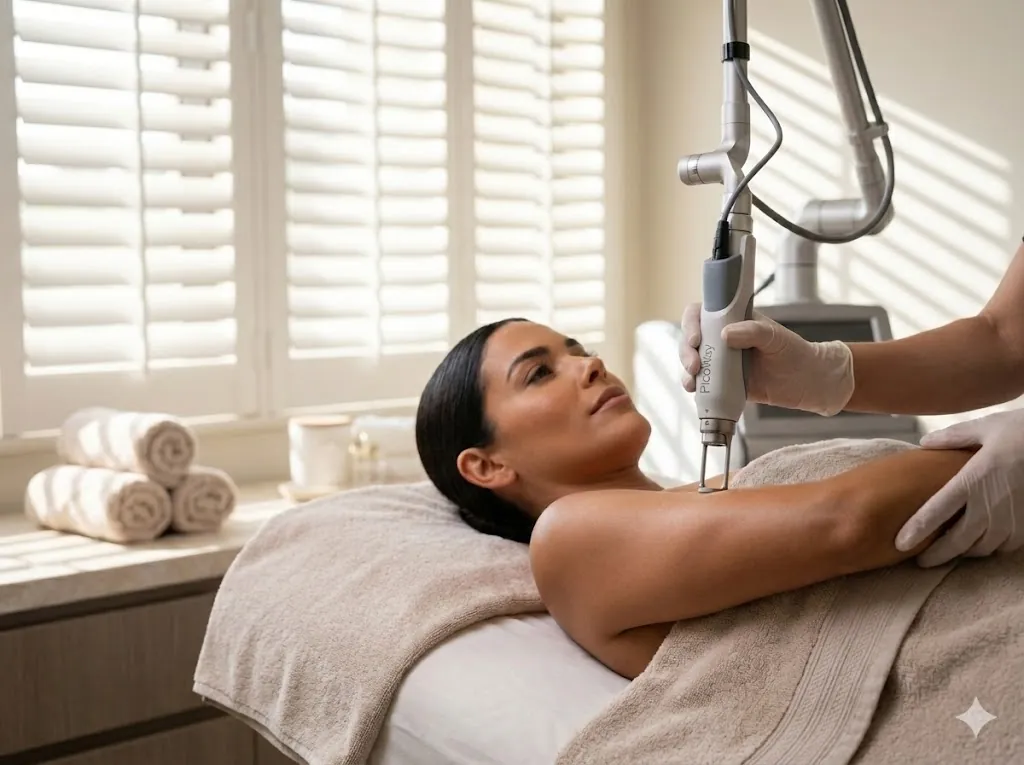
PicoWay Body sessions typically take 30-60 minutes depending on area size. Topical numbing cream is applied before tattoo removal, and tattoo sessions are usually spaced 6–8 weeks apart.
Before Treatment
Avoid sun exposure and tanning for 2-4 weeks prior
Discontinue retinoids or exfoliants 1 week before
Shave treatment area if needed (for pigmentation/tattoo removal)
Arrive with clean skin, free of lotion, oil or self-tanner on the area
During Treatment
Preparation
Protective eyewear is provided and treatment area is cleaned.
Treatment
Laser handpiece delivers precise pulses to target pigmentation or tattoo ink.
Cooling
Built-in cooling keeps skin comfortable throughout the procedure.
Dressing & Next Visit
A soothing ointment or dressing is applied. For tattoos, the next session is usually booked about 6–8 weeks later so the skin can heal and ink can clear.
After Treatment
Apply prescribed healing ointment for tattoo removal
Avoid sun exposure and use SPF 50+ for 4-6 weeks
Keep area clean and avoid picking at scabs (tattoo removal)
Results develop over 4-8 weeks with progressive improvement
After tattoo removal, frosting, blisters or scabs can appear and usually heal within about 1–2 weeks; avoid swimming, hot tubs and intense workouts for about 48–72 hours
Temporary lightening or darkening of the treated skin can occur, more often in darker skin; it usually fades over months but can rarely persist
**Tattoo removal typically requires 4-8+ sessions. Pigmentation may require fewer. Individual results vary.
PicoWay Body Questions Answered
How many PicoWay sessions are needed for tattoo removal?+
It varies with ink depth, age and colour. Typically 4-8 or more sessions spaced 6-8 weeks apart. Dr. Jiang estimates your range at assessment. Complete removal cannot be guaranteed.
Does PicoWay hurt?+
For pigmentation or scars it feels like mild prickling. Tattoo removal is more intense, often described as a rubber-band snap; we apply topical numbing cream first.
Is PicoWay suitable for dark or melanin-rich skin on the body?+
It is often chosen for these skin types because its photoacoustic effect uses less heat, which can lower the risk of burns and post-inflammatory hyperpigmentation (PIH). No laser is risk-free; settings are individualised.
How much does a PicoWay body treatment cost in Richmond, BC?+
Fees are not published online because the cost depends on the plan: what is treated (sun spots on the hands or arms, pigment on the chest or back, scars, or a tattoo), the size of the area and the number of sessions. Sun spots often need fewer sessions than scars or tattoos. A physician assesses the area first and you receive a quote for the whole plan. For tattoo-specific pricing factors, see our Tattoo Removal page.
Can PicoWay treat sun spots on hands and arms?+
Yes, PicoWay is used for sun spots (lentigines) and age spots on the hands, arms and décolletage, and these often need fewer sessions than tattoos.
Can PicoWay improve stretch marks or surgical scars?+
It may improve their texture and appearance by stimulating new collagen, though complete erasure should not be expected and results vary.
What is the downtime after a PicoWay body treatment?+
Downtime is short and most people return to normal activities the same day. After pigment or scar treatment, redness may last 12-24 hours and spots can darken and flake over about a week. After tattoo removal the area may frost, blister or scab for several days. Keep the area clean, do not pick crusts, avoid hot tubs and hard workouts for about 48-72 hours, and protect it with SPF 50+ for several weeks.
Do you offer PicoSure in Richmond?+
Our Richmond clinic uses the PicoWay picosecond laser. PicoWay and PicoSure are different devices; Dr. Jiang can explain what PicoWay can do for your tattoo or pigmentation at consultation.
How do I get to your Richmond clinic from Vancouver or Burnaby?+
We are at Unit 110, 5580 No. 3 Rd, Richmond, BC, about a 3-minute walk from Lansdowne Station on the Canada Line, so patients from Vancouver, Burnaby and across Greater Vancouver can come by SkyTrain. Treatment is by appointment, open daily 9:00-18:00, with consultations in English, Mandarin and Cantonese.
Is pico laser worth the money for body pigment or scars?+
It can be, when the concern suits a picosecond laser. Sun spots and age spots on the hands, arms and chest often respond within a few sessions, while scars and stretch marks improve more modestly and tattoos need a longer series. Pigment can return with sun exposure, so ongoing sun protection matters. A physician assessment and a written session plan help you judge whether the expected change is worth it for you.
What are the downsides and side effects of pico laser on the body?+
The main downsides are that most concerns need several sessions, results are gradual, and some pigment or ink fades only partly. Side effects include redness, swelling and light crusting; after tattoo removal also frosting, pinpoint bleeding and blisters, which usually heal within about 1–2 weeks. Less often the skin becomes temporarily lighter or darker, and rarely a texture change or scar develops. Aftercare and sun avoidance lower these risks.
Is pico laser better than BBL or IPL for body spots?+
Neither is better in general; they work differently. BBL and IPL are broadband light devices that heat pigment and redness through a filtered flash, and are often used for sun damage and redness over larger areas. A picosecond laser such as PicoWay delivers single wavelengths in very short pulses that break up pigment mainly through pressure, and can also treat tattoo ink, which light devices do not. RAAC offers PicoWay and DPL; Dr. Jiang advises which fits your skin.
Concerns this treatment is used for
Each of these has its own page explaining the cause, the options, and what recovery looks like:
Ready to Plan Your Tattoo or Pigmentation Treatment?
Book a consultation with Dr. Charles Jiang to map your body pigmentation or tattoo removal plan. Dr. Jiang has 29+ years of clinical experience. English, Mandarin, and Cantonese consultations available.
Related treatments
What our clinical team has written about this
How it works, who it suits, and what recovery looks like:
- PicoWay Laser for Sun Spots, Freckles and Pigmentation in Richmond, BC
How PicoWay's picosecond pulses break up sun spots, age spots, freckles and post-inflammatory pigmentation, how many sessions are typical and what the weeks after treatment look like.
- PIH After Pico Laser: Can It Make Pigmentation Worse?
PIH after pico laser is possible with any laser, though PicoWay is generally considered lower risk. Here is how to tell normal darkening from PIH, how many sessions it takes, and aftercare.
- PicoSure vs PicoWay: How the Two Picosecond Lasers Differ
PicoSure and PicoWay are both picosecond lasers, made by different manufacturers. How they differ in wavelengths and handpieces, what they are used for, and how a physician chooses settings for your skin type. RAAC uses PicoWay.
- PicoWay Picosecond Laser: How It Works, Sessions and Downtime
How PicoWay's photoacoustic picosecond pulses break up pigment, how many sessions pigment and tattoos usually take, what it feels like, the downtime and why melasma needs care.