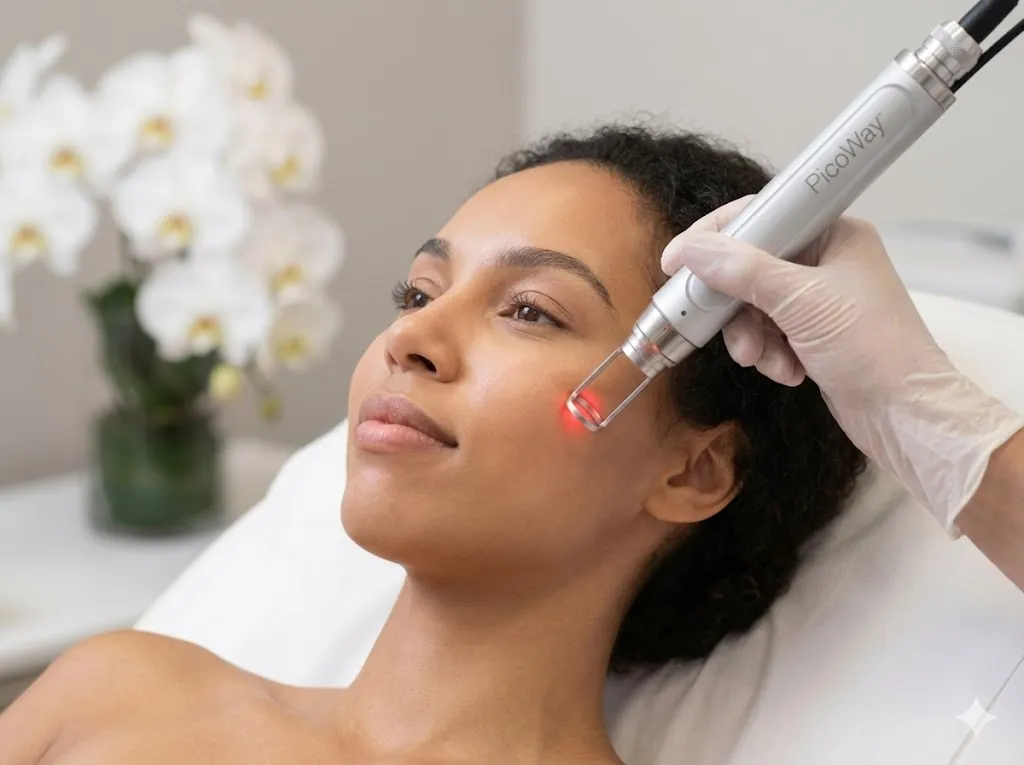
Many people in Greater Vancouver are interested in pico laser for pigmentation but hold back for one reason: they have heard that laser can leave spots darker than before. Medically, that darkening is post-inflammatory hyperpigmentation (PIH). This guide explains why PIH happens after laser, how the risk is lowered, how many PicoWay sessions pigmentation usually takes, and how to care for your skin afterwards, based on how PicoWay works and the treatment information on our PicoWay page. Your own plan is confirmed at consultation.
Can pico laser make pigmentation worse?
It can, but the risk can be lowered with careful assessment and aftercare. Any laser can trigger PIH, and skin types common in Asian patients (Fitzpatrick III to IV) are more prone to it. Picosecond pulses are extremely short and work mainly by a photomechanical (photoacoustic) effect that shatters pigment with less heat build-up, so pico lasers are generally considered lower risk for PIH than older long-pulse lasers. Lower risk still means some risk: settings, intervals, sun protection and aftercare all matter.
Why does PIH happen? When skin is exposed to heat, inflammation or friction, pigment cells (melanocytes) become more active and produce extra pigment. In darker or more reactive skin that response is stronger.
Things that raise the risk:
- High energy or repeated passes over the same spot, which build heat and inflammation.
- Sessions too close together, before the last round of inflammation has settled.
- Sun exposure after treatment, which directly stimulates pigment cells.
- Picking crusts, rubbing, or restarting acids too early.
- A recent tan, which means pigment cells are already active.
- Existing melasma, which reacts strongly to irritation and can worsen with aggressive treatment.
How do I tell normal darkening from PIH?
In the first few days, treated spots often look darker and form a very thin crust. That is usually the shattered pigment working its way out and is expected; the crust flakes off on its own after a few days. PIH tends to show up weeks later as a diffuse brown patch across the treated area, with blurred edges, rather than in the shape of the original spot. If you are not sure, send the clinic a photo.
Put simply: a spot that darkens and then flakes away is usually a good sign. A whole area that slowly turns brown after the flaking is what to watch for.
PIH is usually temporary and fades gradually with strict sun protection, often over months, and individual timelines vary. If it appears, your physician may lower the energy, lengthen the interval, or pause treatment until the skin settles.
Does pico laser work the same on every kind of pigmentation?
No. Identifying the pigment matters more than choosing the laser:
- Sun spots and age spots (solar lentigines): well-defined pigment in the upper skin. They often need fewer sessions, but new ones can form with ongoing sun exposure.
- Freckles: also superficial, and they tend to return with sun.
- Melasma: needs the most care. It is linked to hormones, sun, blood vessels and inflammation, and aggressive treatment can make it worse. We take a low-energy, gradual approach. Melasma is a chronic condition that can recur even after it fades, so long-term sun protection and maintenance matter.
- Hori's macules and other deeper (dermal) pigment: sit deeper and usually need more sessions at longer intervals.
- Cosmetic tattoos such as brows: results depend on ink depth and colour, and need assessment.
Any spot that is new, irregular in shape or colour, or changing quickly should be examined by a physician first, and referred if needed, rather than treated as an ordinary spot.
How many PicoWay sessions does pigmentation take?
Our PicoWay page notes that melasma typically takes 3 to 6 sessions spaced about 4 weeks apart, and other pigment concerns usually also need several sessions, spaced 4 to 8 weeks apart and adjusted to how your skin responds. Well-defined sun spots sometimes need fewer; deeper pigment needs more. Your physician sets the plan after assessment.
Why not speed things up with shorter gaps? Because treating skin that has not fully calmed down raises the PIH risk. For skin that darkens easily, slower is usually the safer route. Before each session your physician reviews how your skin reacted last time and adjusts settings and coverage.
How should I care for my skin after pico laser?
Our aftercare notes: mild redness and swelling are common and usually settle within hours to days; avoid hot showers, saunas and strenuous exercise for 24 to 48 hours; keep the area clean and moisturized; use any soothing products your physician recommends; and protect the skin from the sun. Most people can wear makeup the next day.
Details people often miss:
- Do not pick or rub. Let crusts fall off naturally. Wash with fingertips and pat dry rather than wiping.
- Sun protection comes first. Use sunscreen every day and add a hat outdoors. Vancouver's grey winters still carry UV.
- Pause irritating products such as acids, retinoids and scrubs until your physician says to restart.
- Keep skincare simple: a gentle cleanser and a barrier-repair moisturizer. Do not start several new products at once.
- Track with photos taken at each visit, which are more reliable than daily mirror checks.
Who should not have pico laser for pigmentation?
PicoWay is generally not advised, or needs a physician's assessment first, during pregnancy or breastfeeding, with an active infection or open wound in the area, while taking photosensitizing medication, with a history of keloid scarring, with a recent tan, with certain medical conditions assessed individually, or for any suspicious, undiagnosed pigmented spot.
If you have developed noticeable darkening after a laser before, say so at your consultation; it changes how the plan is built.
How should I prepare for my PicoWay appointment?
- Arrive without makeup so your physician can assess the type, depth and spread of pigment.
- Our pre-care notes: avoid sun exposure and tanning for 4 weeks beforehand.
- List your medications, especially any that cause sun sensitivity. Your physician decides whether anything should change; do not stop a medication on your own.
- Mention recent acids, retinoids, peels or other lasers.
- Think back: have you ever darkened after a laser or sunburn, and how long did it take to fade?
- Take a few photos in natural light as a baseline.
How does RAAC approach pico laser for pigmentation?
At RAAC, a medical team led by Dr. Charles Jiang, a licensed physician in British Columbia, first identifies the type and depth of pigment, using VISIA skin analysis where helpful, and then decides whether PicoWay suits you and which wavelength and settings to use. PicoWay offers 1064 nm and 532 nm wavelengths, among others, to target pigment at different depths and colours. Each session is photographed, and the next is adjusted to how your skin responded. Pricing depends on the area and concern and is explained after consultation. Consultations are available in English, Mandarin and Cantonese.
The clinic is on No. 3 Road in Richmond, BC, a short walk from Lansdowne Station on the Canada Line.
Frequently asked questions
Can one session clear my pigmentation? Usually not. Several sessions are typical, and melasma and freckles can recur, so sun protection and maintenance continue after the course.
Can I have pico laser in summer? Yes, but sun protection is harder. If you spend a lot of time outdoors in summer, consider planning the course for the darker months.
Can I wear makeup afterwards? Our PicoWay page notes most people can wear makeup the next day. Be gentle over crusted spots and do not scrub when removing it.
Further reading
This article is for educational purposes only and does not constitute medical advice. Please consult with a qualified healthcare professional before undergoing any treatment.