PicoWay® Laser Tattoo Removal Richmond, BC
Picosecond laser tattoo removal with a physician-led assessment.
Laser tattoo removal uses very short pulses of light to break ink into tiny particles that your body clears over time. At our Richmond, BC clinic we use PicoWay®, a picosecond laser, after a physician-led assessment. Most tattoos need multiple sessions several weeks apart, and results depend on ink colour, depth and skin type.
- 6–8 wks
- Typical gap between sessions, sometimes longer
- Several
- Sessions are typical; your physician estimates after assessment
- 24–48 hrs
- Keep the area clean and dry after a session
- 6–8 wks
- Typical gap between sessions, sometimes longer
- Several
- Sessions are typical; your physician estimates after assessment
- 24–48 hrs
- Keep the area clean and dry after a session
How Does Laser Tattoo Removal Work?
PicoWay delivers energy in trillionths of a second. These ultra-short pulses break ink mainly through pressure (a photoacoustic effect) rather than by heating it, which is designed to limit heat in the surrounding skin.
Nanosecond lasers rely more on heat, while picosecond pulses act mainly through pressure. Smaller ink fragments can be cleared by the body's immune system, but fading still happens gradually over the weeks between sessions.
Picosecond Pulses
PicoWay uses picosecond pulses to break ink into fine particles.
Matched to Ink Colour
Four PicoWay wavelengths (1064, 532, 785 and 730 nm) are used for dark and coloured inks; some colours still fade more slowly than others.
Skin Protection
PicoWay works mainly through pressure rather than heat, which is designed to limit heat in nearby skin. Burns, scarring and pigment change are still possible.
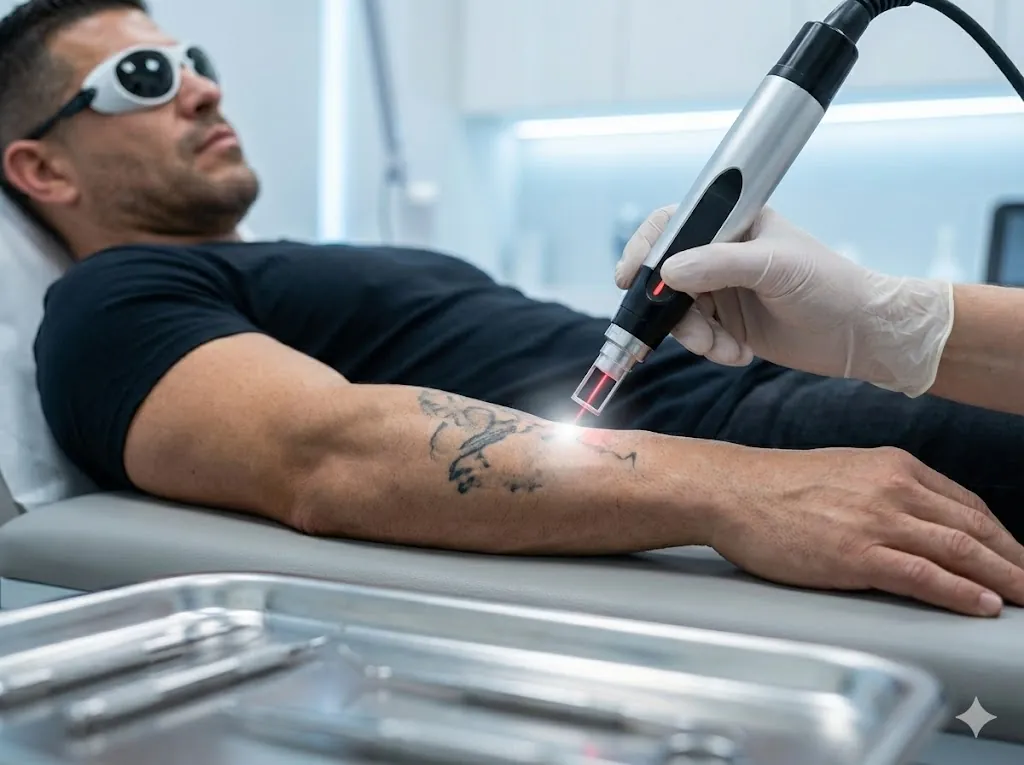
What Happens to the Ink After the Laser?
PicoWay uses ultra-short pulses to break ink into tiny particles your body can gradually remove.
Picosecond Speed
Pulses last trillionths of a second, so they act mainly through a pressure wave rather than relying on heat.
Ink Shattering
Ink is broken into fine fragments.
Immune Clearance
Immune cells (macrophages) take up these tiny particles and carry them away through the lymphatic system.
Healing
Follow the aftercare plan to lower the risk of scarring and pigment change.
Who Can Have Tattoo Removal?
Many adults can have laser tattoo removal, but we assess each tattoo and your skin first for safety and a realistic plan.
Good Candidates Include
- +Adults over 18 years old
- +Individuals with realistic expectations about the process
- +People in good overall health
- +Those committed to following aftercare instructions
- +Individuals with tattoos that are not too deep or extensive
Reasons to Wait or Reconsider
- –Are pregnant or breastfeeding
- –Have an active skin infection or skin condition in the area
- –Take isotretinoin or medicines that make skin sensitive to light, or have a weakened immune system (the physician may advise waiting)
- –Expect a tattoo to disappear in one or two sessions, or need it gone by a fixed date
- –Have a very deep or extensive tattoo that would need many sessions
- –Have a recent tan or sunburn on the area
Why Have Tattoo Removal at a Medical Clinic?
Tattoo removal is a medical laser procedure. At RAAC, a physician-led team plans your treatment and aftercare.
Pain Management
Topical numbing cream and air cooling to help with comfort.
Dr. Jiang's Oversight
Dr. Jiang's team chooses settings with the risk of burns and pigment change in mind.
Scar Revision
If your tattoo already has needle scarring, we can discuss whether the laser may also help the texture.
Honest Assessments
We give realistic estimates on the number of sessions based on your ink depth and color.
Which Tattoo Locations Can Be Treated?
Tattoos on most parts of the body can be treated; the location affects how many sessions are needed.
Arms & Shoulders
A common location; response varies by ink and skin.
Legs & Feet
Dark or dense ink may need more sessions.
Back & Chest
Large areas may need many sessions.
Face & Neck
Needs extra caution; we plan these carefully and discuss risks first.
Hands & Fingers
Thinner skin makes these areas more challenging; PicoWay can still be used.
What Happens During Tattoo Removal?
The steps from assessment to aftercare.
Pre-Treatment Preparation
Tattoo assessment and consultation with a physician-led team
Medical history review, including medications and pregnancy, to screen for reasons to wait
Photographs of the tattoo to track progress
Discussion of realistic expectations and likely number of sessions
Avoid sun exposure and tanning on the area beforehand, and shave the area if advised
Treatment Session
Numbing & Comfort
Medical-grade numbing cream is applied about 30–45 minutes before treatment, and cold air cooling is used during the laser pass. Most people describe a rubber-band snap.
Eye Protection
Protective eyewear provided for both patient and practitioner.
Laser Treatment
The PicoWay laser delivers ultra-short pulses over the tattoo. The laser time itself is usually short and depends on the size of the tattoo.
Immediate Aftercare
Cooling and healing ointment applied immediately post-treatment.
Post-Treatment Care
Keep the area clean and dry for 24–48 hours, and apply the healing ointment as directed
Whitening, redness, swelling, pinpoint bleeding, blisters or crusting can occur in the first days and are usually part of healing; do not pick scabs
Avoid sun and tanning, use SPF 30+ outdoors, and wear loose, breathable clothing over the area
Avoid swimming, saunas and strenuous exercise for 1 week
Sessions are typically spaced about 6–8 weeks apart, sometimes longer, because fading continues between visits; many tattoos need several sessions
**Number of sessions varies by ink colour, depth and skin type. Professional tattoos usually take longer than amateur ones. Individual results vary.
Tattoo Removal Questions in Richmond, BC
How many tattoo removal sessions will I need, and how far apart are they?+
It varies. Amateur tattoos often need fewer sessions than professional ones, and dense, dark or multi-coloured tattoos usually need more. Sessions are typically spaced about 6–8 weeks apart, sometimes longer, so the body can clear the ink. We give an estimate after seeing your tattoo, and the final number depends on how your skin and ink respond.
Does laser tattoo removal hurt?+
Most people describe a rubber band snapping against the skin. It is uncomfortable but quick, and the level varies by area. We offer topical numbing cream and use cold air cooling to help. Sensation varies by person, so tell your team if it feels like too much.
Will tattoo removal leave a scar or other side effects?+
Scarring is a risk with any laser procedure, and following your aftercare instructions helps reduce it. PicoWay works mainly through pressure rather than heat, but scarring cannot be ruled out. Other possible effects include temporary redness, swelling, blistering, crusting, and lighter or darker skin patches. The physician explains the risks at your assessment.
Can all ink colours be removed?+
Black and dark inks usually respond most predictably. Red, orange and purple often need a wavelength matched to the colour, and green, light blue and turquoise tend to fade the slowest. White, flesh-tone and some cosmetic pigments can darken before they fade. Colour response varies, so the physician chooses the settings for your tattoo after seeing it.
How much does tattoo removal cost in Richmond, BC?+
The cost depends on the size, colours and age of the tattoo and how many sessions it needs. We do not list prices online; after an in-person assessment we give you a quote and treatment plan for your specific tattoo, so you know what to expect before committing to a course.
What should I do before and after a laser tattoo removal session?+
Before: avoid sun and tanning, shave the area if advised, and tell us about your medications. After: keep the area clean and dry for 24–48 hours, apply the healing ointment, use SPF 30+, wear loose clothing, do not pick scabs, and avoid swimming, saunas and strenuous exercise for a week. Whitening, redness, swelling, blistering and crusting can be part of normal healing. Contact us if you notice signs of infection.
Can a tattoo be faded for a cover-up, and what are the other options?+
Often, yes. Lightening a tattoo with a few sessions can give your tattoo artist more room to design a cover-up, and how much fading is needed depends on the new design. Other options include keeping the tattoo, a cover-up without fading, or surgical excision for small tattoos. The physician can talk through what suits your tattoo.
Can eyebrow, microblading or lip-blush tattoos be removed?+
Cosmetic tattoos such as microbladed brows can often be treated with laser. A small test spot comes first, because some cosmetic pigments, especially lighter or flesh-toned ones, can darken before they fade. The physician advises at the assessment whether removal suits your skin and pigment.
Is laser tattoo removal suitable for darker skin tones?+
Many skin tones can be treated, but darker skin carries more natural pigment that can react to laser energy, so temporary or lasting lightening or darkening is more likely. The physician chooses wavelength and energy with this in mind and decides at the assessment whether treatment suits you.
Can I have tattoo removal while pregnant or breastfeeding?+
Treatment is usually deferred during pregnancy and breastfeeding. The physician asks about this at your assessment and can discuss timing once you are able to start. You can still book an assessment beforehand to look at your tattoo and plan ahead.
Will my tattoo be completely gone, and why might it stop fading?+
Many tattoos fade substantially, but complete removal cannot be promised; some leave a faint shadow or texture change. Fading can slow with dense, deep or stubborn-coloured ink, or after earlier laser treatment that did not suit the ink. Bring any details of previous treatment to your assessment. Results vary.
What affects how quickly a tattoo fades?+
Ink colour, density and depth, the age of the tattoo, whether it was professional or amateur work, its location on the body, your skin tone and general health all play a part. Tattoos further from the heart, such as on the lower legs, may fade more slowly. Smoking can also affect healing. The physician assesses these factors before estimating.
Concerns this treatment is used for
Each of these has its own page explaining the cause, the options, and what recovery looks like:
Start With an Assessment
Book an assessment with Dr. Charles Jiang's team to get a quote and treatment plan. Dr. Jiang has 29+ years of clinical experience. Find us at Unit 110, 5580 No. 3 Rd, Richmond, BC, a 3-minute walk from Lansdowne Station (Canada Line), open daily 9:00-18:00. Consultations in English, Mandarin and Cantonese.