
Medical Cryotherapy Skin Tag & Wart Removal, Richmond, BC
Liquid nitrogen for skin tags, warts and sun spots, after a doctor checks the spot
A short medical procedure that uses liquid nitrogen to freeze selected benign skin growths. This is localized cryotherapy applied to a single spot, not a whole-body cold chamber. Dr. Jiang's medical team examines every lesion first.
- About 15 min
- Typical Visit
- Doctor-checked
- Every Spot Assessed First
- 1–2 weeks
- Typical Healing
- About 15 min
- Typical Visit
- Doctor-checked
- Every Spot Assessed First
- 1–2 weeks
- Typical Healing
What is medical cryotherapy and what can it treat?
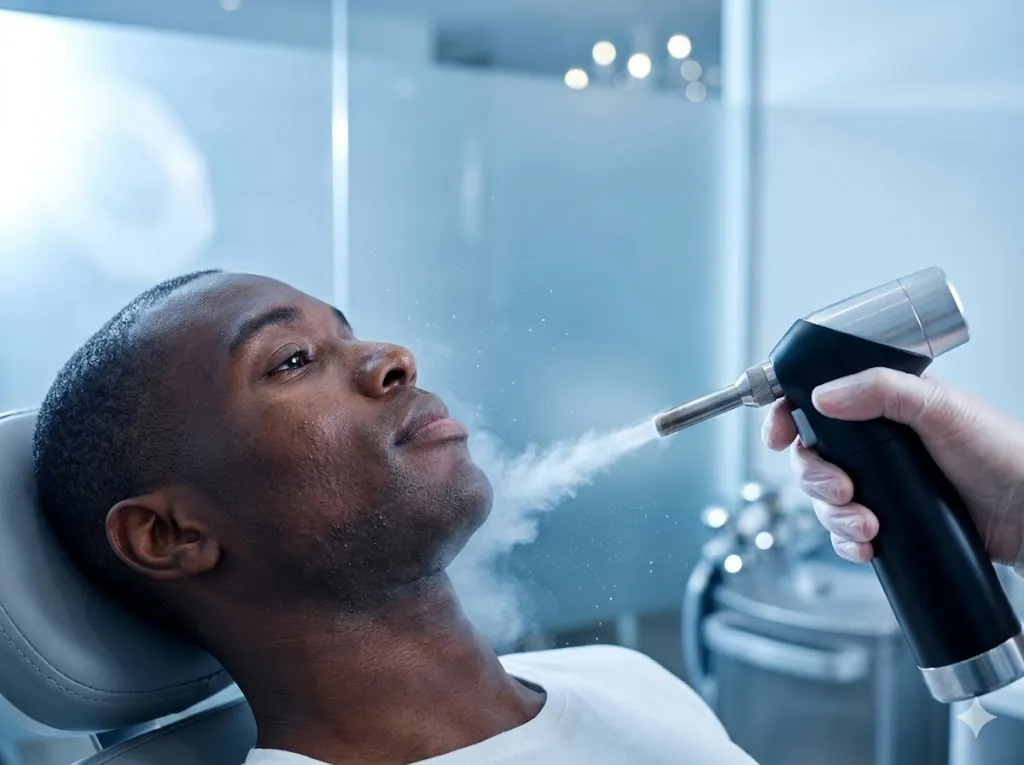
Medical cryotherapy at RAAC is localized: liquid nitrogen is applied to one benign skin growth, such as a skin tag, wart, seborrheic keratosis or sun spot, to freeze and destroy it without cutting. A doctor must assess the spot first, because moles and changing or suspicious spots are not suitable for freezing.
Medical cryotherapy applies extreme cold to a targeted skin growth. This freezes the water inside the abnormal cells and destroys them without cutting or stitches. The treated area forms a scab that usually falls off naturally, leaving new skin underneath. A small pale mark can sometimes remain.
Several Common Growths
Used for skin tags, warts, seborrheic keratosis (the waxy "barnacles of aging") and sun spots, once a doctor has confirmed they are benign.
Precision Application
We use precision spray tips or probes to target only the lesion, sparing the surrounding healthy skin.
Natural Healing
The treated area forms a scab that usually falls off by itself, leaving new skin underneath.
How does liquid nitrogen treat a skin growth?
Cryotherapy uses liquid nitrogen at extremely low temperatures (-196°C) to freeze and destroy abnormal skin cells.
Cell Freezing
Liquid nitrogen rapidly freezes the water inside abnormal cells, causing ice crystals to form and rupture cell membranes.
Cell Death
The frozen cells die, and the treatment is applied precisely to limit the effect on the surrounding healthy skin.
Natural Removal
The body clears the dead cells, and the area forms a scab that usually falls off within 7 to 14 days.
Clear Skin
New skin replaces the treated area. A small pale or darker mark can sometimes remain, and it usually fades over time.
Who can have cryotherapy, and who needs a check first?
Cryotherapy suits many people with benign skin growths, but a medical assessment always comes first. Any spot that is new, changing, bleeding, irregular or dark should be examined by a doctor before any treatment.
Suitable Candidates
- +Individuals with skin tags, warts, or seborrheic keratosis
- +Those with sun spots or age spots
- +People seeking non-surgical removal of benign lesions
- +Those wanting a quick treatment with a short healing period
- +Individuals with multiple small lesions that can be treated in one session
Not Recommended
- –Pregnant or breastfeeding women without medical clearance
- –Individuals with active skin infections or open wounds
- –Those with cold urticaria (allergy to cold)
- –People with compromised immune systems without medical approval
- –Moles, or any spot that is new, changing, bleeding, irregular or very dark: these are assessed first and not frozen for cosmetic reasons; a biopsy or referral may be advised
Why have it done by a doctor?
Removing a spot starts with knowing what it is.
Diagnosis First
Some spots can be skin cancer, including melanoma. Dr. Jiang only treats lesions he judges to be benign with cryotherapy.
Careful Technique
Precise application limits damage to the surrounding tissue, which lowers the risk of pale marks or scars, though they can still occur.
Efficient
Treat multiple lesions in a single short visit.
Medical-Grade Delivery
Medical-grade liquid nitrogen delivery tools help keep temperature and depth consistent.
Which skin growths can be treated?
Selected benign growths on the face and body, once assessed by a doctor.
Skin Tags (Acrochordon)
Common on neck, armpits, and eyelids.
Seborrheic Keratosis
Brown, waxy, 'stuck-on' growths often called 'barnacles of aging'.
Warts (Verruca)
Viral infections on hands or feet.
Sun Spots
Flat brown spots caused by sun damage.
Actinic Keratosis
Rough, scaly patches that can be pre-cancerous. These need medical assessment, and a doctor decides the right treatment.
What happens at a cryotherapy visit?
The visit usually takes about 15 minutes. Dr. Jiang examines each spot first, and only growths he judges to be benign are frozen. Freezing takes seconds per spot and stings briefly; numbing is not usually needed. The area turns white, then red, and may blister within hours. A scab forms and falls off in about 7 to 14 days, and most people return to normal activities the same day. Warts and thicker growths may need more than one treatment.
Pre-Treatment
No special preparation needed
Inform Dr. Jiang of any medications or skin conditions
Avoid applying creams or makeup to the treatment area on the day
Arrive 10 minutes early for paperwork
Wear comfortable, loose-fitting clothing
During Treatment
Medical Assessment
Dr. Jiang examines the spot to decide whether it is a benign growth suitable for freezing. If it looks suspicious, treatment is not done and you are advised on next steps such as a biopsy or specialist referral.
Freezing
Liquid nitrogen is sprayed or applied. You will feel a cold sensation followed by a brief stinging or burning.
Healing
The treated area may turn white and form a small blister. This is normal and part of the healing process.
Post-Treatment Care Instructions
Receive detailed aftercare instructions from our medical team.
After Treatment
Keep the area clean and dry
Avoid picking or scratching the treated area
Apply gentle moisturizer if needed
Protect from sun exposure during healing
The scab will naturally fall off in 7-14 days
**Results vary. They depend on the size, location and type of growth treated. Some growths, such as warts, may need more than one treatment.
Common Questions
Is this whole-body cryotherapy?+
No. At RAAC, cryotherapy means localized medical cryotherapy: a doctor applies liquid nitrogen to a single skin growth such as a skin tag, wart or sun spot. We do not offer whole-body cold chambers or cryotherapy for recovery or wellness. If you were searching for a cold chamber, this page is about removing small skin growths after a medical assessment.
Can you remove any spot or mole with cryotherapy?+
No. Cryotherapy is only used for growths that Dr. Jiang judges to be benign after examining them. Moles, and any spot that is new, changing, bleeding, irregular or dark, need medical assessment first and may need a biopsy or referral instead of freezing.
Does it hurt, and will it leave a scar?+
Most people tolerate it well. You feel a cold shock followed by stinging that lasts a few minutes, and anesthesia is not usually needed. Scarring risk is generally lower than with surgical excision, but a small pale or darker mark can sometimes remain and usually fades over time.
How long does it take to heal?+
For most skin tags and age spots, the crust falls off in about 7 to 10 days on the face and 10 to 14 days on the body. A pink or slightly pale patch can remain for some weeks after that and usually fades. Warts may need a second treatment, and Dr. Jiang checks the area once it has healed.
Is it covered by MSP, and how much does it cost in Richmond?+
Cosmetic removals such as skin tags and age spots are not covered by MSP. Medically necessary treatment may be, and Dr. Jiang will tell you at your assessment. We do not publish prices online at the moment, so please contact the clinic for current pricing.
Can I wash my face afterwards?+
Yes, you can shower and wash gently from the same day. Pat the area dry, and avoid scrubbing the treated spot or picking at the blister or scab, which can cause scarring or infection. A plain moisturizer or petroleum jelly can help if the area feels dry. Contact the clinic if it becomes very painful, hot or swollen.
How many cryotherapy treatments will I need?+
Many skin tags and sun spots clear after one treatment. Warts and thicker seborrheic keratoses more often need a second or further treatment, because the freeze has to reach the whole growth while sparing the skin around it. Dr. Jiang reviews the area once it has healed and advises whether to repeat. The outcome depends on the size, type and location of the growth.
What does the spot look like while it heals?+
Right after freezing, the spot turns white, then red and slightly swollen. Within hours a small blister can form, sometimes with clear or slightly bloody fluid. Over the following days it dries into a scab that falls off by itself, usually in about 7 to 10 days on the face and 10 to 14 days on the body. Do not pop the blister or pick the scab.
Can I go back to work and normal activities afterwards?+
Yes. Most people return to work and normal activities the same day. Keep the area clean and dry, avoid rubbing it with tight clothing, straps or jewellery, and cover it with a small bandage if it sits where friction occurs. Protect healing skin from the sun. If the spot is on a hand or foot, ask the doctor how to protect it during exercise.
What happens if the doctor thinks a spot looks suspicious?+
It is not frozen. Cosmetic cryotherapy is only used on growths Dr. Jiang judges to be benign. If a spot is new, changing, bleeding, irregular or unusually dark, he explains why it needs further assessment. That may mean a biopsy, so the tissue can be examined in a lab, or a referral to a specialist. Freezing a suspicious spot would destroy the tissue needed for a diagnosis.
Is cryotherapy suitable for darker skin tones?+
It can be used, but the doctor discusses one risk first: freezing can leave a pale (lighter) mark, and a pale or darker mark is more noticeable on darker or Asian skin. Careful, targeted application helps limit the risk but cannot remove it entirely. For some spots on darker skin, the doctor may suggest another approach or a test of one spot first.
Can several spots be treated in one visit?+
Often, yes. Several small skin tags or sun spots can usually be treated in the same visit once each one has been checked. For a large number of growths, or spots in sensitive areas such as near the eyes, the doctor may suggest treating them over more than one visit. Tell us at booking roughly how many spots you want assessed.
Concerns this treatment is used for
Each of these has its own page explaining the cause, the options, and what recovery looks like:
Book a Skin Growth Assessment
Book an assessment with Dr. Charles Jiang to find out whether your skin growth can be treated with cryotherapy. Dr. Jiang has 29+ years of clinical experience.