DPL/IPL Photofacial: Your Complete Guide to Light-Based Skin Rejuvenation
Sun damage, rosacea, broken capillaries, age spots, and uneven skin tone are among the most common skin concerns we treat at RAAC Richmond. While topical products can help, they often cannot fully address these issues. DPL (Dynamic Pulsed Light) and IPL (Intense Pulsed Light) photofacials offer a proven, non-invasive solution that targets the root causes of these concerns using broad-spectrum light energy.
What Is a DPL/IPL Photofacial?
A photofacial uses broad-spectrum light (not a laser — lasers use a single wavelength) to penetrate the skin and target specific chromophores: melanin (pigment) and hemoglobin (blood). The light energy is absorbed by these targets, converting to heat that selectively destroys pigmented lesions and abnormal blood vessels without damaging the surrounding skin.
DPL vs IPL: What's the Difference?
IPL (Intense Pulsed Light) is the original broadband light technology. DPL (Dynamic Pulsed Light) is its next-generation evolution:
| Feature | Traditional IPL | DPL (Dynamic Pulsed Light) |
|---|---|---|
| Light delivery | Single pulse | Rapid sequential micro-pulses |
| Energy distribution | Uneven (peak at start) | Uniform throughout pulse |
| Skin heating pattern | Sharp spike, then rapid drop | Gradual, controlled heating |
| Comfort | Moderate (rubber band snap) | Improved (gentler sensation) |
| Risk of burns | Low-moderate | Very low |
| Efficacy per session | Good | Enhanced (more consistent energy delivery) |
| Suitable skin tones | Fitzpatrick I-IV | Fitzpatrick I-IV (safer for III-IV) |
At RAAC Richmond, we primarily use DPL technology for its superior safety profile and more consistent results, though both DPL and IPL refer to the same fundamental treatment principle.
What Does a DPL/IPL Photofacial Treat?
Pigmentation Concerns:
- Sun spots (solar lentigines) — brown spots caused by cumulative UV exposure
- Age spots — flat brown patches common on the face, hands, and chest
- Freckle lightening — reducing the intensity of sun-induced freckling
- Post-inflammatory hyperpigmentation (PIH) — dark marks left after acne or injury
- Melasma — (requires careful assessment; not all melasma responds well to light therapy)
Vascular Concerns:
- Rosacea — diffuse facial redness, flushing, and visible blood vessels
- Broken capillaries (telangiectasia) — fine red or purple veins on the nose, cheeks, or chin
- Spider veins on the face
- Generalized redness — overall skin redness and flushing tendency
- Port wine stains — some respond well to photofacial treatments
Skin Quality:
- Uneven skin tone — blotchy, mottled complexion
- Rough texture — photofacials stimulate mild collagen remodeling
- Fine lines — subtle improvement through collagen stimulation
- Enlarged pores — mild improvement with a series of treatments
The DPL Photofacial Procedure at RAAC
Before Your Treatment:
- Avoid direct sun exposure and tanning for 2 weeks before treatment
- Discontinue retinoids and exfoliating acids 3–5 days before
- Arrive with clean skin (no makeup, sunscreen, or moisturizer on treatment areas)
- Inform your provider of any medications, especially photosensitizing drugs
During the Treatment:
- Skin assessment: Your provider evaluates your skin and selects appropriate wavelength filters and energy settings
- Eye protection: Opaque goggles are placed to protect your eyes
- Cooling gel: A clear gel is applied to the treatment area to enhance light transmission and protect the skin surface
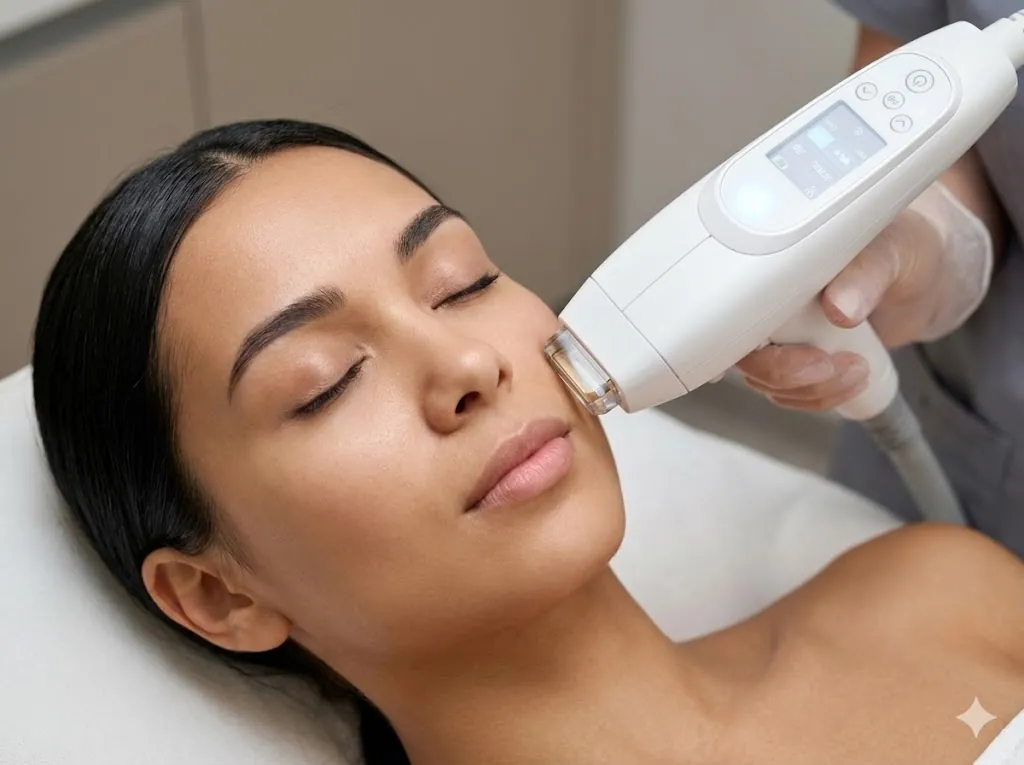
- Light pulses: The DPL handpiece delivers controlled pulses of light across the treatment area. You'll feel a warm sensation with each pulse — often described as a gentle "snap" or warm tingling
- Duration: A full-face treatment takes approximately 20–30 minutes
- Immediate after: Mild redness and warmth, similar to a light sunburn
After Your Treatment:
- Apply SPF 30+ religiously for at least 2 weeks (and ideally always)
- Pigmented spots will initially darken — this is expected and a sign the treatment is working
- Dark spots typically form a micro-crust that flakes off naturally within 5–10 days, revealing clearer skin beneath
- Redness from vascular treatments typically improves progressively over 1–2 weeks
- Avoid direct sun, hot baths, saunas, and intense exercise for 24–48 hours
- Avoid retinoids and active skincare for 3–5 days post-treatment
How Many Sessions Do I Need?
Most patients achieve optimal results with 3–5 sessions, spaced 3–4 weeks apart:
| Session | What to Expect |
|---|---|
| Session 1 | Most noticeable improvement in dark spots; 40–60% of superficial pigment responds |
| Session 2 | Deeper pigmentation addressed; vascular improvements become apparent |
| Session 3 | Skin tone significantly more even; redness markedly reduced |
| Sessions 4–5 | Refinement and optimization; addressing any remaining concerns |
After completing an initial series, annual maintenance sessions (1–2 per year) help maintain results, especially if you have ongoing sun exposure.
DPL Photofacial Cost in Richmond BC
At RAAC Richmond, DPL/IPL photofacial treatments are priced competitively with details at consultation. Ask about our treatment packages during your consultation.
Who Is a Good Candidate?
Ideal Candidates:
- Fitzpatrick skin types I–IV (fair to medium complexion)
- Concerns about sun spots, redness, broken capillaries, or uneven skin tone
- Willing to commit to sun protection before and after treatment
- Realistic expectations — photofacials improve but don't eliminate all pigmentation in one session
- Good general health with no active skin infections in the treatment area
Caution or Not Recommended:
- Very dark skin tones (Fitzpatrick V–VI): Higher risk of post-inflammatory hyperpigmentation; alternative treatments may be safer (discuss with your provider)
- Active tan or recent sun exposure: Must wait 2+ weeks
- Pregnancy or breastfeeding: Postpone treatment
- Active cold sores: Prophylactic antiviral medication may be recommended
- Photosensitizing medications: Certain antibiotics, acne medications, and supplements increase burn risk
- Melasma: Requires specialized assessment — light therapy can sometimes worsen melasma
DPL Photofacial vs. Other Treatments
| Treatment | Best For | Downtime | Sessions |
|---|---|---|---|
| DPL/IPL Photofacial | Redness, sun spots, vessels | 1–2 days | 3–5 |
| PicoWay Laser | Deep pigment, tattoo removal | 3–7 days | 2–4 |
| Sylfirm X | Melasma, rosacea, skin quality | 1–3 days | 3–4 |
| Chemical peel | Texture, mild pigment | 3–7 days | 3–6 |
| Microneedling | Texture, scars, pores | 2–3 days | 3–6 |
When to Choose DPL/IPL:
- Your primary concerns are sun damage, redness, or visible blood vessels
- You want minimal downtime (can return to work the next day)
- You prefer a gentler treatment with progressive improvement
- You want to address multiple concerns simultaneously (pigment + redness)
Combining DPL with Other Treatments
At RAAC, we often combine photofacials with complementary treatments for superior results:
- DPL + Hydrafacial: Light therapy followed by deep cleansing and hydration for an immediate glow
- DPL + Microneedling: Address pigment/redness with DPL, then stimulate collagen with microneedling (spaced 2 weeks apart)
- DPL + Sylfirm X: Combined approach for complex rosacea or melasma management
- DPL + medical-grade skincare: Vitamin C, retinoids, and SPF dramatically extend and enhance photofacial results
Frequently Asked Questions
Q: Does DPL/IPL hurt? A: Most patients describe the sensation as a warm "snap" — brief and tolerable. DPL's micro-pulse technology is gentler than traditional IPL. Cooling gel and the handpiece's built-in cooling further enhance comfort.
Q: Is there visible downtime? A: Minimal. Mild redness for a few hours is common. Pigmented spots will darken and flake off over 5–10 days, but this is usually concealable with makeup.
Q: When will I see results? A: Pigmented spots begin to darken within 24–48 hours and clear over 1–2 weeks. Vascular improvements are progressive over 2–4 weeks. Cumulative improvement with each session.
Q: Can I get a DPL photofacial in summer? A: Yes, but sun protection is critical. Avoid treatment if you have an active tan. We recommend scheduling sessions during months when your sun exposure is most controlled.
Q: How is DPL different from laser treatment? A: Lasers use a single, precise wavelength; DPL/IPL uses a broad spectrum of wavelengths. This makes DPL excellent for treating multiple concerns simultaneously but less targeted for specific deep lesions. Your provider will recommend the right technology for your concerns.
Book Your DPL Photofacial Consultation
Ready to address sun damage, redness, or uneven skin tone? Book a complimentary skin consultation at RAAC Richmond. We'll assess your skin, recommend the right treatment approach, and create a personalized plan for clearer, more radiant skin.
RAAC Richmond Anti-Aging Clinic: 5811 Cooney Road, Suite 305, Richmond BC V6X 3M1. Serving Richmond, Vancouver, Burnaby, Surrey, and Metro Vancouver.