A DPL (Dye Pulsed Light) photo facial is a narrow-spectrum refinement of IPL that targets redness and sun-related pigment such as sunspots. A series of 3 to 5 sessions about 4 weeks apart is generally recommended; most people return to normal activities right away, though temporary redness and darkening of spots before they flake off are common.
In the evolving landscape of medical aesthetics in 2026, patients in Richmond and the Greater Vancouver area are increasingly seeking treatments backed by rigorous clinical data. The DPL Photo Facial is one of the light-based therapies available. Standing for Dye Pulsed Light, DPL represents a refined evolution of traditional Intense Pulsed Light (IPL), offering a more targeted approach to treating vascular and pigmented lesions. At Richmond Anti-Aging Clinic (RAAC), our approach is rooted in physician-led care. Learn more about DPL Photo Facial to understand how this technology integrates into our comprehensive skin health protocols. Under the guidance of Dr. Charles Jiang, a licensed physician with over 29 years of clinical experience, we prioritize the physiological mechanism of action to support safety and efficacy for every patient.
How does a DPL photo facial work?
DPL filters light into a narrow band that is absorbed mainly by pigment and blood vessels, so heat builds in those targets while surrounding skin is largely spared, which is how it addresses redness and sun damage.
To understand DPL, one must first understand the principle of selective photothermolysis. This biochemical process involves the use of specific wavelengths of light to target 'chromophores' in the skin—primarily melanin (pigment) and hemoglobin (blood). When the light energy is absorbed by these targets, it is converted into thermal energy, targeting the intended area while minimizing impact on the surrounding tissue. Traditional IPL systems utilize a broad spectrum of light, typically ranging from 400nm to 1200nm. While effective, this broad range can sometimes lead to unnecessary heating of surrounding tissues. DPL technology utilizes a specialized 'dye' filter to narrow the spectrum of light to a precise 100nm window (typically 500nm to 600nm or 550nm to 650nm). This narrow-spectrum light is critical because it concentrates energy precisely where oxyhemoglobin and melanin have their peak absorption levels. By narrowing the pulse, DPL increases the 'optical power' directed at the target, allowing for more effective treatment of stubborn redness (rosacea) and sun damage (lentigines) with lower overall energy levels compared to traditional IPL.
What does the research say about narrow-spectrum pulsed light?
Published studies suggest narrow-spectrum pulsed light can clear fine facial vessels with fewer side effects than broad-spectrum IPL, and that careful pulse settings matter for treating darker skin types safely.
The efficacy of narrow-spectrum pulsed light is well-documented in dermatological literature. Clinical practitioners often look to these studies to validate the transition from broad-spectrum to narrow-spectrum technologies.
- Journal of Cosmetic and Laser Therapy: This study compared narrow-spectrum pulsed light to traditional IPL for the treatment of facial telangiectasia. The narrow-spectrum approach may target the 500-600nm range more precisely, which for some patients may support clearance of vascular lesions; results vary.
- Dermatologic Surgery: In a comprehensive review of light-based systems, it was highlighted that the refinement of pulse duration and spectral output is essential for treating darker skin types safely. DPL’s ability to control the 'thermal relaxation time'—the time it takes for the target to lose 50% of its heat—is a key safety feature.
- Dermatologic Clinics: Pulsed light has been discussed in the literature regarding its long-term use in photorejuvenation. Research suggests that regular maintenance with targeted light therapies may support the appearance of aged skin cells for some patients. At Richmond Anti-Aging Clinic (RAAC), we utilize these clinical foundations to inform our treatment parameters. Book a Consultation with our medical team to discuss how these scientific principles apply to your unique skin profile.
What is the difference between DPL and IPL?
Both are photo facials, but IPL uses a broad light spectrum while DPL narrows it to a band aimed at pigment and blood vessels, which generally allows lower energy and a more comfortable treatment.
When evaluating light-based therapies, it is important to distinguish between the different modalities available. While both DPL and IPL fall under the umbrella of 'photo facials,' their technical execution differs significantly.
| Feature | Traditional IPL | DPL (Dye Pulsed Light) |
|---|---|---|
| Spectrum Range | Broad (400nm - 1200nm) | Narrow (500nm - 600nm) |
| Target Precision | Moderate | High (Selective for Hemoglobin/Melanin) |
| Energy Efficiency | Requires higher fluence for results | High efficacy at lower fluence |
| Comfort Level | Can be intense/hot | Generally more comfortable |
| Vascular Clearance | Good | May be suitable for fine telangiectasia in some patients |
Who is a good candidate for DPL?
DPL generally suits people with facial redness or rosacea, sunspots, or mixed redness and brown pigment on the neck and chest; active skin infection, photosensitivity or certain medications may mean waiting.
Not every patient is an ideal candidate for DPL. A thorough candidate evaluation is the most critical step in ensuring a safe outcome. At RAAC, Dr. Charles Jiang oversees the clinical protocols for all light-based treatments. As a licensed physician, Dr. Jiang ensures that we strictly adhere to safety standards, particularly when assessing patients with higher Fitzpatrick skin types (darker skin). Ideal candidates include those experiencing:
- Erythema and Rosacea: The 500-600nm range is commonly regarded as a reference range for targeting the redness associated with dilated capillaries.
- Solar Lentigines: Commonly known as sunspots or age spots, these respond exceptionally well to the targeted melanin absorption of DPL.
- Poikiloderma of Civatte: A combination of redness and brown pigment often found on the neck and chest. Contraindications: Patients with active skin infections, a history of photosensitivity, or those currently taking certain medications (like isotretinoin) may need to delay treatment. During your assessment, we perform a detailed medical history review to mitigate risks. Book a Consultation to receive a professional skin analysis and safety screening.
What happens during a DPL treatment, and what is recovery like?
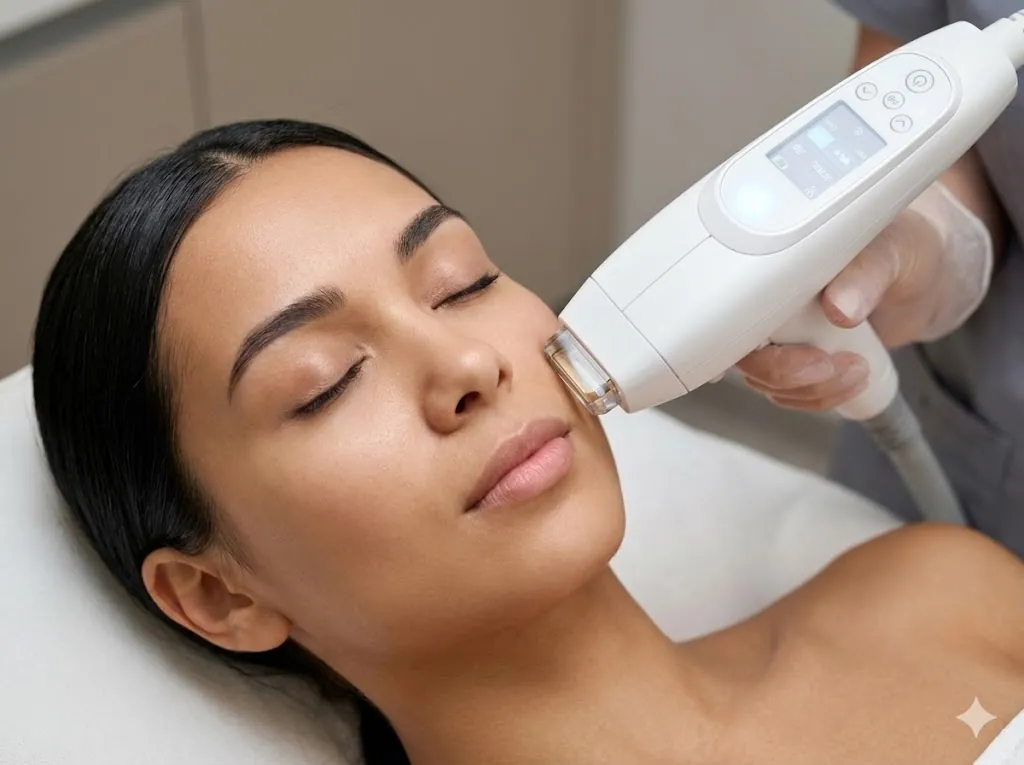
The skin is cleansed and gelled, the handpiece delivers quick flashes that feel like a rubber-band snap, and afterwards redness usually settles within a day or two while dark spots may flake off over about a week.
The process at our Richmond clinic follows a structured medical protocol:
- Preparation: The skin is thoroughly cleansed. A cool conductive gel is applied to the treatment area to facilitate light transmission and protect the epidermis.
- The Procedure: The DPL handpiece is applied to the skin. You may feel a sensation often described as a 'rubber band snap' accompanied by a bright flash of light. Due to the narrow-spectrum technology, some people find this more tolerable than older IPL systems.
- Immediate Post-Care: A soothing serum and broad-spectrum SPF are applied. You may notice a slight 'sunburned' feeling for a few hours.
- The Recovery Phase: Pigmented spots may darken (the 'coffee ground' effect) before naturally sloughing off within 7-10 days. Redness typically subsides within 24-48 hours.
Why Choose Richmond Anti-Aging Clinic (RAAC)?
Choosing a clinic for DPL in Richmond, BC, requires looking beyond the technology itself. The expertise of the operator and the oversight of the physician are paramount.
- Physician-Led Care: Your practitioner provides clinical judgment that helps support treatment planning.
- Advanced Technology: We invest in DPL systems to provide treatment for our patients.
- Personalized Treatment Plans: We do not believe in a one-size-fits-all approach. Your DPL settings are customized based on your skin’s specific chromophore density.
- Bilingual Service: To serve our diverse Richmond community, our staff is fully bilingual in English and Chinese, ensuring clear communication regarding your medical care.
Frequently Asked Questions
How many sessions are typically required? While some improvement is often visible after one session, a series of 3 to 5 treatments spaced 4 weeks apart is generally recommended for optimal clinical results. Is there downtime after a DPL Photo Facial? Minimal. Most patients return to work or social activities immediately. We advise avoiding direct sun exposure and intense heat (saunas/hot tubs) for 48 hours. How does DPL feel during the treatment? The sensation is often described as a quick, hot pinch. Our systems include integrated cooling to enhance comfort throughout the procedure. Can DPL treat melasma? Melasma is a complex hormonal pigment condition. While DPL can help with some components, it must be used with extreme caution. Dr. Jiang may recommend alternative lasers or topical protocols for melasma patients. What is the cost of DPL? Contact us for current pricing, as costs vary based on the treatment area and the number of sessions required for your specific goals.
Next Steps
Understanding the science behind your skincare is the first step toward achieving lasting results. If you are ready to address redness, sun damage, or uneven skin tone with a clinically-proven approach, we invite you to take the next step in your aesthetic journey. Ready to See What DPL Photo Facial Can Do for You? Our medical team at Richmond Anti-Aging Clinic (RAAC) in Richmond is ready to create your personalized treatment plan. Book a consultation — available in English and Chinese.
This article is for educational purposes only and does not constitute medical advice. Please consult with a qualified healthcare professional before undergoing any treatment.