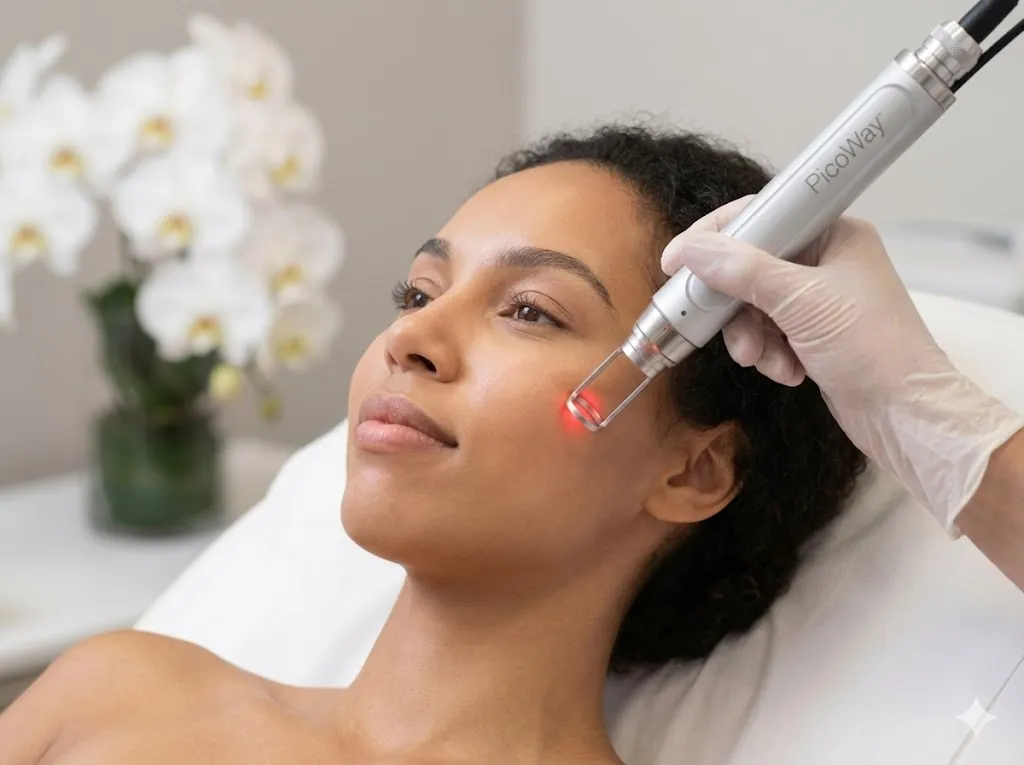
Picosecond lasers, such as PicoSure (made by Cynosure) and PicoWay (made by Candela), deliver energy in trillionths of a second and break up pigment and tattoo ink mainly with a pressure wave rather than heat. On the body they are used for sun spots, freckles and tattoos. Several sessions are usual and results vary. Richmond Anti-Aging Clinic (RAAC) uses PicoWay; we do not offer PicoSure.
This article explains, in general terms, how picosecond lasers work on body skin, how they compare with older lasers, and what to expect. It is not specific to one brand of device. For treatment at our clinic, see PicoWay for body pigmentation and tattoo removal.
How does a picosecond laser work?
A picosecond laser delivers energy in trillionths of a second, creating a pressure wave that breaks pigment or ink into tiny particles the body can clear, with less heat reaching the surrounding skin than older nanosecond lasers.
Pulse duration is the key idea. Traditional Q-switched lasers work in nanoseconds (billionths of a second) and rely more on heat to break down pigment. Heat can spread to the surrounding tissue, which may lengthen recovery and raise the risk of post-inflammatory hyperpigmentation (PIH), especially in skin that tans easily. Picosecond lasers work about a thousand times faster, which is shorter than the time most pigment particles take to release heat.
Photomechanical vs. Photothermal
Instead of mainly heating the target, the picosecond pulse breaks a tattoo ink particle or a cluster of melanin into smaller fragments. This is called a photomechanical effect. The body's immune and lymphatic systems then clear the fragments over the following weeks. Because less heat is generated, the risk of heat-related side effects may be lower for some patients, though it is not zero.
How do texture handpieces work?
Both picosecond systems have a handpiece for skin texture: PicoSure's Focus Lens Array and PicoWay's Resolve handpiece. They concentrate energy into tiny zones beneath an intact skin surface, which is thought to prompt the skin to produce new collagen.
These tiny zones are called laser-induced optical breakdowns (LIOBs). The skin surface stays intact, so recovery is usually shorter than with ablative resurfacing. On the body, texture handpieces are mainly discussed for areas such as the chest or back, for example for some acne scars. Improvement tends to be gradual and modest, and several sessions are usually needed.
What does the research say about picosecond lasers?
Published studies have compared picosecond and nanosecond lasers for tattoo ink and pigment, and studied fractional picosecond handpieces for texture. Findings vary with ink colour, skin type and protocol.
- Tattoos: Studies have reported that picosecond lasers may clear some ink colours, including some blue and green inks, in fewer sessions than nanosecond lasers. Multicoloured, dense or older professional tattoos often still need many sessions, and complete clearance cannot be promised.
- Pigmentation: Picosecond lasers are studied for sun spots, freckles and other pigment. Melasma is harder to treat and often recurs, so it is treated cautiously.
- Texture: Studies of fractional and lens-array handpieces have reported some improvement in fine lines and acne scars, with results that vary between people.
How do picosecond lasers compare with Q-switched and CO2 lasers?
Picosecond lasers rely more on pressure than heat, so recovery is often shorter than with Q-switched or ablative CO2 lasers. CO2 resurfacing is a different tool, used mainly for deeper wrinkles and resurfacing rather than pigment or tattoos.
| Feature | Picosecond | Q-Switched (Nanosecond) | CO2 (Ablative) |
|---|---|---|---|
| Primary Mechanism | Mainly photomechanical (pressure) | Mainly photothermal (heat) | Thermal ablation (vaporization) |
| Typical Recovery | Redness for hours to a few days; tattoo areas may crust | Several days of redness or crusting | One to two weeks of healing |
| Risk of PIH | Lower heat, but PIH is still possible | Moderate | Higher, especially on darker skin |
| Typical Uses | Pigment, tattoos, some texture concerns | Tattoos, pigment | Deeper wrinkles, resurfacing |
Who may be a candidate for body pigmentation or tattoo treatment?
Picosecond lasers may suit people with sun spots or freckles on the body, or with tattoos they want to fade. Active infection, some medical conditions, a recent tan and photosensitising medication may rule treatment out or delay it.
At Richmond Anti-Aging Clinic (RAAC), suitability is a medical assessment. Licensed physician Dr. Charles Jiang reviews your skin type using the Fitzpatrick scale, your medical history and your goals before settings are chosen.
Who may consider it?
- Body pigment: Sun spots and freckles on the shoulders, upper back, chest, arms and hands.
- Tattoo removal: Fading or removing tattoos, or lightening a tattoo before a cover-up.
- A range of skin types: Picosecond lasers are used on Fitzpatrick types I-VI, with more conservative settings for skin that tans easily. Pigment changes, including PIH and lighter patches, can still happen.
Limitations & Contraindications
Body skin, especially on the lower legs, tends to heal more slowly than facial skin. Treatment may not be suitable during an active skin infection, with certain autoimmune or light-sensitive conditions, or soon after taking photosensitising medication. Tanned skin is usually treated only after the tan fades. For body pigment, several sessions are common; tattoos often need more sessions spaced 6-8 weeks apart. Book a Consultation at our Richmond clinic to receive a personalized assessment.
Does treatment hurt, and what is recovery like?
Most people describe a quick rubber-band snap, and numbing cream may be used. Redness and swelling usually settle within hours to a few days; pigment may darken before flaking off, and tattoo areas may blister or crust.
- Preparation: The skin is cleansed, and in some cases a topical numbing cream is applied.
- The Procedure: The handpiece is moved across the treatment area. You may feel a sensation similar to the snap of a small rubber band.
- Immediate Aftercare: Mild redness and swelling, similar to a mild sunburn, are common. Tattoo areas may show a white frosting that fades within minutes, followed by pinpoint bleeding, blistering or crusting over the next days.
- The Timeline: Pigment often darkens slightly before flaking off. Tattoo ink fades gradually over the weeks after each session. Protect treated areas from the sun.
Which picosecond laser does RAAC use?
RAAC uses PicoWay; we do not offer PicoSure. At our Richmond clinic:
- Physician-Led Care: Licensed physician Dr. Charles Jiang oversees treatment plans.
- PicoWay: We use PicoWay's 1064 nm and 532 nm wavelengths, its 785 nm and 730 nm handpieces and its Resolve handpiece, chosen according to the target and skin type.
- Personalized Treatment Plans: Settings and session spacing are chosen for your skin type and the area treated.
- Bilingual Service: Our staff serve the Richmond community in English and Chinese.
Read more about PicoWay for body pigmentation and tattoo removal.
Frequently Asked Questions
Does RAAC offer PicoSure? No. RAAC uses PicoWay; we do not offer PicoSure. Both are picosecond lasers, and a PicoWay consultation can tell you whether a picosecond laser suits your concern.
Does it hurt? Most people describe a quick snapping feeling. The sensation is brief, and cooling or a topical numbing cream may be used. Tattoo sessions are often more uncomfortable than pigment sessions.
How many sessions will I need? For body pigment, several sessions spaced about 4-6 weeks apart are common. Tattoos usually need more sessions, spaced about 6-8 weeks apart, depending on ink colour, depth and age.
What is the difference between PicoSure and other picosecond lasers? PicoSure is built around a 755 nm wavelength, which is strongly absorbed by melanin, and has a Focus Lens Array for texture. PicoWay is built around 1064 nm and 532 nm wavelengths with additional 785 nm and 730 nm handpieces and a Resolve handpiece. Both are picosecond lasers; the choice of wavelength and settings for your skin usually matters more than the device brand.
Is there downtime? Redness after pigment treatment usually lasts hours to a few days. Tattoo areas can take one to two weeks to heal on the surface. Many people return to normal activities soon after, with sun protection.
Can picosecond lasers be used on darker skin? Yes, they are used on darker skin types with adjusted settings, but any laser can cause pigment changes, including PIH. A consultation is needed to decide suitability and settings.
Next Steps
If you are considering treatment for body pigment or a tattoo, the next step is a physician assessment. Book a consultation — available in English and Chinese.
Disclaimer: This article is for educational purposes only and does not constitute medical advice. Please consult with a qualified healthcare professional before undergoing any treatment. Individual results depend on various factors and may vary.