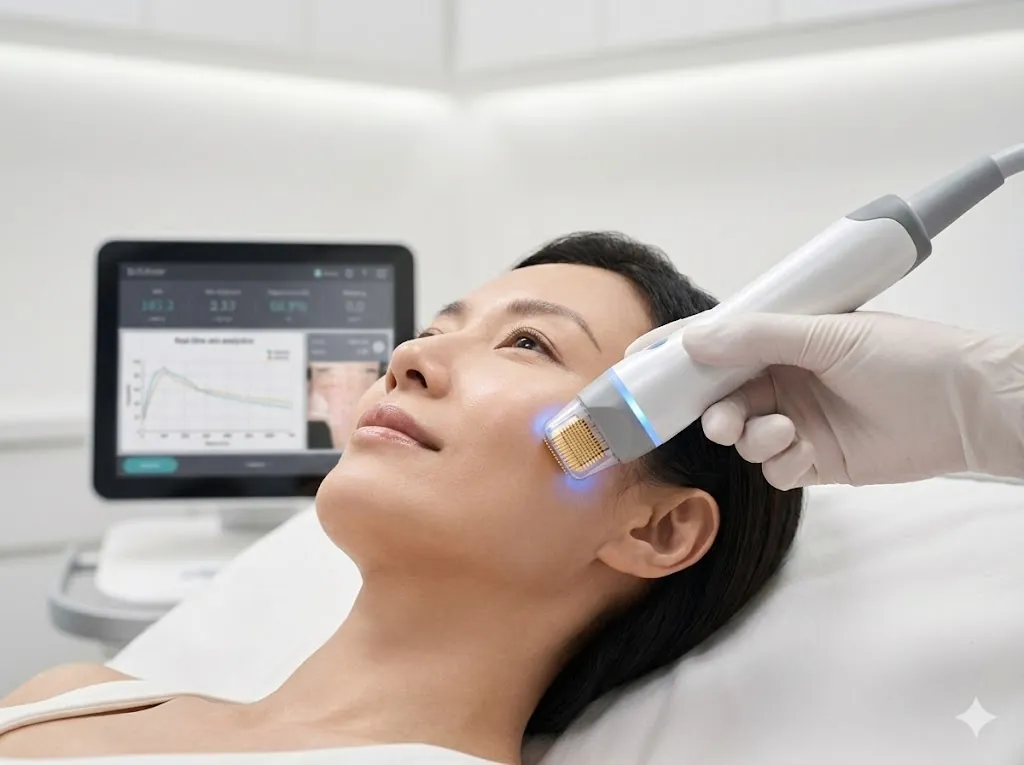

This article explains what Radiesse is and how it works: a calcium hydroxylapatite injectable (known in Chinese as 微晶瓷) that gives immediate support, then prompts the skin's own collagen over the following months. It covers how it differs from hyaluronic acid filler, who it tends to suit and who should not have it; a physician assessment decides. See our Radiesse page. If you are interested in Radiesse for the backs of the hands, and what a hand treatment and recovery involve, see Radiesse for hands.
In medical aesthetics, attention has shifted from simple volume replacement toward biostimulation. Radiesse is one such injectable: it adds volume and also prompts the skin's own collagen. At Richmond Anti-Aging Clinic (RAAC) in Richmond, BC, our approach is rooted in clinical practice and an understanding of the biochemical pathways that govern skin aging. Learn more about Radiesse to understand how this versatile treatment can be tailored to your specific aesthetic goals.
How does Radiesse work?
Radiesse works in two phases: its gel carrier gives immediate volume and support, and as the gel is absorbed over several months, the calcium hydroxylapatite microspheres stimulate the skin to produce new collagen and elastin.
Unlike traditional hyaluronic acid (HA) fillers, which primarily function by binding to water molecules to create a volumizing effect, Radiesse is composed of Calcium Hydroxylapatite (CaHA) microspheres suspended in a water-based carboxymethylcellulose (CMC) gel carrier. The mechanism of action is biphasic.
Phase 1: Immediate Structural Support
Upon injection, the CMC gel provides immediate physical volume and structural support. This allows for the instant correction of deep folds, such as the nasolabial folds, or the augmentation of bony landmarks like the jawline and chin. This initial phase provides immediate improvement for some patients in Richmond.
Phase 2: Neocollagenesis and Neoclastogenesis
The second phase is what distinguishes Radiesse. The CaHA microspheres, which are typically between 25 and 45 microns in diameter, act as a scaffold for cellular infiltration. As the CMC gel is naturally metabolized by the body over several months, the microspheres remain in place, triggering a controlled inflammatory response that activates fibroblasts. Fibroblasts are the primary cells responsible for the production of the extracellular matrix (ECM). Research indicates that Radiesse stimulates these cells to produce Type I and Type III collagen, as well as elastin. This process, known as neocollagenesis, results in a gradual thickening of the dermis and an improvement in skin elasticity that can persist after the carrier gel has dissipated; results vary. Book a Consultation to discuss whether this approach suits your skin quality.
What does the research say about Radiesse?
Published studies suggest Radiesse leads to new collagen formation around its microspheres, that its correction lasts around 12 to 18 months in many patients, and that its firm texture may suit lifting and defining the lower face for some patients.
Radiesse has been studied in an extensive body of peer-reviewed literature. At Richmond Anti-Aging Clinic (RAAC), our treatment planning draws on these findings; results vary.
- Journal of Cosmetic and Laser Therapy: This study utilized histologic analysis to show that CaHA injections may lead to new collagen formation around the microspheres. The study demonstrated that the collagen produced was structurally sound and integrated naturally into the surrounding tissue.
- Dermatologic Surgery: This research focused on the long-term safety profile and patient satisfaction levels. The findings highlighted that Radiesse maintains its corrective effects for 12 to 18 months in many patients, while results with first-generation HA fillers vary.
- Journal of Drugs in Dermatology: This study compared the rheological properties of CaHA to other injectable agents. It concluded that Radiesse has a high G' (elastic modulus) and high viscosity, which is why it is often used to support heavier tissue and define areas like the lower face. These studies help explain how Radiesse works for our medical team in Richmond when addressing moderate to severe age-related volume loss.
How is Radiesse different from hyaluronic acid fillers?
Radiesse mainly stimulates your own collagen, while hyaluronic acid fillers mainly bind water, may suit lips and under-eyes for some patients, and can be dissolved with hyaluronidase if needed.
Choosing the right injectable requires a nuanced understanding of how different materials interact with human anatomy. Below is a comparison to help you understand where Radiesse fits in your treatment plan.
| Feature | Radiesse (CaHA) | Hyaluronic Acid (HA) |
|---|---|---|
| Primary Function | Biostimulation & Volumization | Hydration & Volumization |
| Mechanism | Stimulates natural collagen | Binds to water |
| Duration | Typically 12–18 months | Typically 6–12 months |
| Reversibility | Not immediately reversible | Reversible with Hyaluronidase |
| Commonly Used For | Jawline, Chin, Hand Rejuvenation | Lips, Under-eye, Fine Lines |
| Skin Quality | Improves thickness and elasticity | Primarily improves hydration |
Who is a good candidate for Radiesse?
After a medical assessment, Radiesse generally suits people with a softening jawline, a deepening pre-jowl area, volume loss in the mid-face, temples or backs of the hands, or laxity that needs structural support.
At Richmond Anti-Aging Clinic (RAAC), every patient journey begins with a comprehensive medical assessment. Dr. Charles Jiang, a licensed physician in BC, oversees the evaluation process to determine whether Radiesse is an appropriate option for your concerns.
Who is an Ideal Candidate?
Radiesse may suit patients who have:
- Loss of definition along the mandibular line (jawline).
- Deepening of the pre-jowl sulcus.
- Volume depletion in the mid-face or temples.
- Dorsal hand volume loss (showing prominent veins and tendons).
- Skin laxity that requires structural support.
Managing PIH Risk in Asian Skin
Because melanocytes in Asian skin tend to be more active, Dr. Jiang pays particular attention to PIH risk (post-inflammatory hyperpigmentation) in clinical practice. By carefully controlling injection depth and using a blunt-cannula technique, we aim to keep the risk of PIH low; results vary.
What is hyper-diluted Radiesse?
Rather than adding volume, it is spread through the lower dermis to stimulate collagen, and is commonly used for neck lines and skin laxity on the upper arms and abdomen.
In 2026, the use of Radiesse is no longer limited to structural lifting. Diluted with saline in a specific ratio, it can be used as a skin-quality treatment.
Who should not have Radiesse?
People who are allergic to its ingredients, have an infection or inflammation at the injection site, are prone to keloids, or have a bleeding disorder or take blood thinners should avoid it or be assessed by a physician first; thin-skinned areas such as the lips and under-eyes are generally not recommended.
Radiesse is not suitable for everyone. Contraindications include:
- Allergy to any ingredient in the product.
- Acute infection or inflammation at the injection site.
- A tendency to form keloids.
- A bleeding disorder or current use of blood thinners (requires physician assessment).
- It is not recommended for areas with very thin skin, such as the lips or under-eyes (these areas are usually better suited to hyaluronic acid fillers of a specific molecular weight).
Frequently Asked Questions (FAQ)
Q1: Does a Radiesse injection hurt? At RAAC, we prioritize patient comfort. Radiesse is usually pre-mixed with lidocaine (a local anesthetic), and Dr. Jiang may also apply a topical numbing agent or a cold compress before injecting to help reduce discomfort. Q2: Is there a long recovery period after treatment? Most patients resume daily activities right after treatment. Mild swelling or bruising may occur and usually resolves within 3–7 days. We suggest avoiding supplements that may increase bruising, such as fish oil or aspirin, for one week before treatment (if aspirin has been prescribed for you, check with your physician first). Q3: When will I see results? You can see the improvement from the physical filling right away. Because collagen regeneration takes time, the improvement in skin texture and firmness usually peaks 3 to 4 months after injection. Q4: Will Radiesse make my face look stiff? It shouldn't. Radiesse works by stimulating your own collagen. When it is injected correctly into the appropriate anatomical layer by an experienced physician such as Dr. Jiang, results generally look natural and move naturally, without restricting facial expression. Q5: Is PIH after treatment difficult to manage? At RAAC, we use strict aseptic technique and minimally invasive methods to help keep the risk of PIH low. If you are prone to pigmentation, Dr. Jiang will create a dedicated aftercare plan to help reduce the chance of PIH.
Conclusion: Beginning Your Regenerative Aesthetic Journey
Radiesse brings together modern regenerative science and aesthetics. By harnessing calcium hydroxylapatite, we can help reshape facial contours while supporting skin quality through your own collagen. At Richmond Anti-Aging Clinic (RAAC), we aim for a natural-looking result, and how long it lasts varies from person to person. Book your private consultation and let Dr. Jiang create a Radiesse treatment plan tailored to you.
This article is for educational purposes only and does not constitute medical advice. Please consult with a qualified healthcare professional before undergoing any treatment.