EMFace cost depends on your facial areas, number of sessions in your course and who performs the treatment, so RAAC provides a personalized quote only after a physician-overseen assessment of your goals and facial anatomy. There is no single set price because treatment plans are tailored to each person's needs and response.
How much does EMFace cost?
RAAC quotes EMFace after an in-person assessment because pricing reflects your specific treatment plan rather than a flat rate.
EMFace tones and rejuvenates the face without a single needle. At RAAC in Richmond, the treatment delivers synchronized radiofrequency and HIFES energy to work on both the skin and the facial muscles beneath it, with assessment and planning carried out under physician oversight led by Dr. Charles Jiang.
Because EMFace is needle-free and combines radiofrequency heating with muscle stimulation, the number of areas treated, the number of sessions planned over a course, and how your face responds over time all shape the final plan. A course is typically spaced across several weekly visits, and the specifics depend on your facial anatomy and goals as reviewed during your consultation.
This is why a quote cannot be given from a general price list alone. Two people with different treatment areas, session counts, or combined therapies may receive different plans, which naturally affects the total. Booking an assessment allows your practitioner to outline exactly what your course would involve before any pricing is discussed, so you understand what you are paying for and why.
What factors influence EMFace treatment cost?
Cost is shaped by how many facial areas are treated, how many sessions your course requires, and the energy settings used for your plan.
Each EMFace session runs for about 30 minutes when covering one to two areas, and treating additional areas extends the visit time, which can affect the overall cost of a session (F5).
A full course is typically planned as 4–6 weekly sessions, with the exact number depending on how your skin and muscle tone respond over the course of treatment (F6). A shorter course naturally costs less than a longer one, so this is one of the first things discussed when a plan is drawn up.
The areas selected also matter. Applicators can be placed on the cheeks, brow, jawline, under-eye region, neck, or combined for broader facial toning, and your plan is built around your anatomy and goals rather than a fixed package (F55, F56).
Finally, a course is usually spaced about a week apart, with changes building gradually over roughly three months (F85, F86, F87). Because the number of areas, sessions, and the specific settings used all vary by individual, your clinician will outline these details before confirming your plan.
Why do EMFace price quotes differ between clinics?
Quotes vary because clinics differ in practitioner training, applicator protocols, number of areas included per session, and whether follow-up or maintenance planning is built into the course.
At RAAC, EMFace is used by our physicians, with assessment and treatment planning overseen by Dr. Charles Jiang, a licensed physician in British Columbia. This oversight shapes how a quote is built, since it reflects time spent reviewing facial anatomy, medical history and realistic goals before a plan is set.
Treatment plans are also tailored to each person's facial anatomy and aesthetic goals, which means the number of areas treated per session, and the overall number of sessions in a course, can shift the total differently from one clinic to another. A plan built around the cheeks and jawline, for example, is not priced the same as one that also includes the brow or neck.
Other variables that commonly affect how clinics quote EMFace include:
- Whether a consultation and physician assessment are included in the quoted course
- How many facial areas are treated per visit
- Whether maintenance session planning is discussed as part of the initial course
None of this means one clinic's approach is better than another's, only that the inputs behind a quote differ, which is why asking what is included matters more than comparing a single number.
What should an EMFace consultation quote itemise?
A clear quote should break down the areas being treated, the number of sessions in the course, and whether follow-up or maintenance visits are included.
On areas, the quote should specify which applicators are planned and where—cheeks, brow, jawline, or a combination—since treatment is planned around individual facial anatomy and goals rather than applied uniformly to everyone.
On sessions, a typical course runs 4–6 weekly sessions, depending on how the face responds over that time. The quote should state exactly how many sessions are included in the stated price, and whether that number could change if your practitioner recommends adjusting the plan partway through.
On follow-up, ask whether the quote covers only the initial course or also includes a review visit afterward. EMFace results build gradually over about 3 months and are not permanent, so maintenance sessions are commonly discussed once the course is complete. A written quote should make clear whether:
- The stated number of sessions is firm or an estimate
- A post-course check-in is included
- Maintenance visits are priced separately
Having these items spelled out in writing before you book helps you compare quotes meaningfully and avoid surprises partway through a course.
What happens during an EMFace visit?
Each session involves cleansing the skin, placing applicators on the chosen areas, and delivering synchronized radiofrequency and muscle stimulation for about thirty minutes.
Before the applicators go on, your clinician will usually confirm a few details:
- Any blood thinners or other medications you are taking
- Your medical history, including implants or a pacemaker
- That skin arrives clean and free of makeup
- Metal jewellery removed from the face and ears
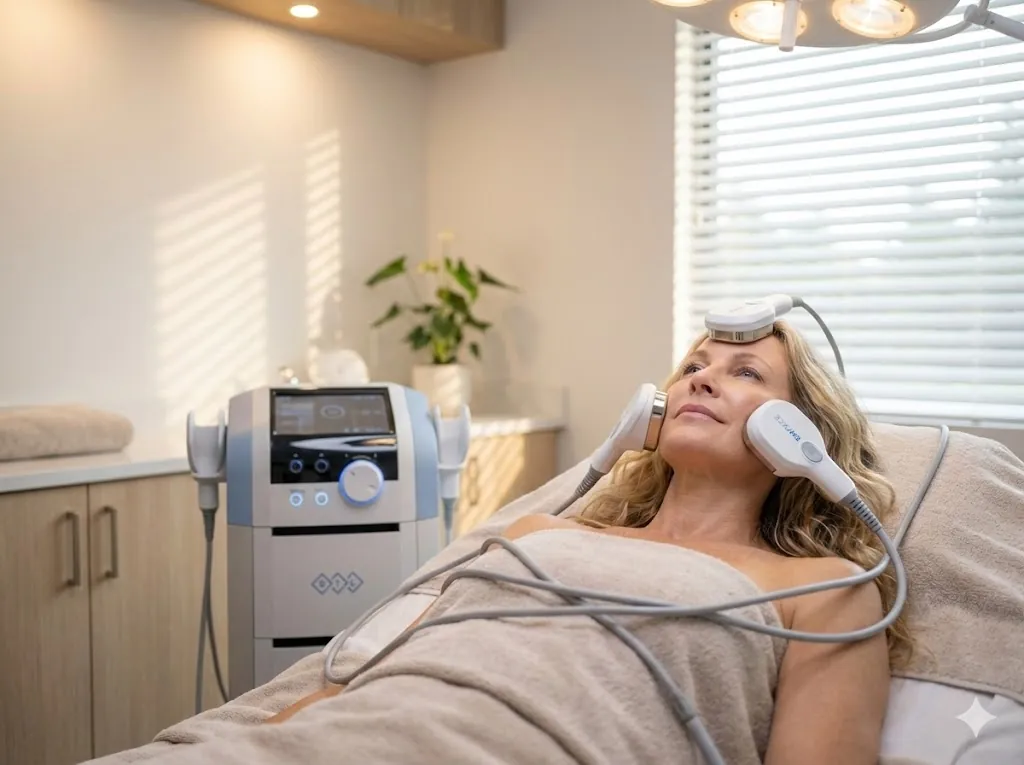
During treatment, conductive gel is applied, applicators are positioned on the target areas, and RF heating and HIFES muscle stimulation run together through the same applicator. One or two areas take about thirty minutes; adding more areas roughly doubles that time. The sensation is typically described as warm with a tingling, pulsing muscle contraction, and energy levels can be adjusted for comfort. Numbing is not typically needed.
Once the session ends, gel is removed and a soothing product may be applied if needed. Afterward, sunscreen and gentle skincare are advised, along with staying hydrated and limiting direct sun exposure. Temporary redness or warmth in the treated area is possible but usually settles on its own. Sessions are generally spaced about a week apart, with change building gradually over the course of the plan.
Who is a good candidate for EMFace, and who should check first?
Suitability depends on facial goals and medical history, which is why Dr. Charles Jiang oversees assessment and treatment planning at RAAC. EMFace is generally considered for people exploring non-surgical facial toning rather than surgical options. It may suit:
- Individuals with mild to moderate facial sagging
- Those seeking non-surgical facial rejuvenation
- People wanting to improve facial muscle tone
- Individuals looking to reduce the appearance of fine lines and wrinkles
- Those interested in a gradual, natural-looking change to facial contour
Some circumstances call for a closer review before booking, including pregnancy or breastfeeding, active skin infections or open wounds in the treatment area, a pacemaker, defibrillator, or certain medical or metal implants, a history of epilepsy or seizures, and severe medical conditions generally. These do not automatically rule EMFace out in every case, but they do mean the physician should weigh the specifics with you first.
Because facial anatomy, skin condition and medical background vary from person to person, a short consultation is the most reliable way to confirm whether EMFace fits your situation, or whether another approach, or a combination of treatments, may be more appropriate for your goals.
How does EMFace compare with Ultherapy when weighing options?
EMFace combines radiofrequency with muscle stimulation while Ultherapy uses focused ultrasound on skin alone, so the right choice depends on your goals and the areas you want addressed.
EMFace is a needle-free treatment that pairs radiofrequency heating with HIFES muscle stimulation. It is designed to tone the muscles beneath the skin while also supporting collagen in the skin itself, in areas such as the cheeks, jawline and brow. A course is typically 4–6 sessions spaced about a week apart, with same-day return to normal activities for many people.
Ultherapy, by contrast, relies on focused ultrasound energy directed at the skin and underlying connective tissue, without the muscle-stimulation component. It addresses a different mechanism and is not combined with RF or HIFES.
The practical distinction comes down to what each treatment is working on:
- EMFace: skin and underlying muscle, dual-action
- Ultherapy: skin and connective tissue, ultrasound-based
Because EMFace works on both skin and muscle, it is designed to support gradual, natural-looking change rather than a single dramatic shift. Deciding between the two—or whether one complements the other—depends on your facial anatomy and goals, which is something to work through with your practitioner during assessment and planning.
What should you ask before booking EMFace?
Before booking, ask how many areas and sessions your plan includes, how results are tracked over the course, and how maintenance timing is typically discussed.
A typical course runs 4–6 treatments spaced about 1 week apart, with the exact number depending on how your facial muscles and skin respond. It helps to ask upfront how many sessions are planned for your specific areas, since cheeks, jawline, and brow may each be assessed differently.
It's also worth asking how progress is reviewed during the course. Initial changes are often noticed within 2–4 weeks, with further change building over about 3 months, so your plan should account for attending sessions on schedule to support that timeline.
Since EMFace results are not permanent, ask when maintenance sessions are usually discussed and what that follow-up conversation looks like after your course ends.
A few other questions worth raising at consultation:
- Does the plan combine EMFace with other treatments, such as injectables or skincare, where appropriate for your goals?
- How is my plan customized to my facial anatomy rather than a standard package?
These questions help clarify what your specific plan involves before you commit to a course.
Frequently asked questions
How much does EMFace cost?
At Richmond Anti-Aging Clinic (RAAC), EMFace pricing is personalized after a physician-led assessment that looks at the areas treated, the number of sessions in your course and who performs the treatment, so a specific fee is not quoted without that discussion.
How much is EMFace treatment overall?
The overall cost of an EMFace course depends on how many of the typical 4-6 sessions you need and which facial areas, such as cheeks, jawline or brow, are included, so an amount is determined during your consultation.
How much does EMFace cost per session?
Per-session cost can vary with how many areas are treated in that visit, since one to two areas take about 30 minutes while more areas take longer, so this is reviewed with you before any quote is given.
What factors decide the cost of EMFace treatments?
Cost is generally shaped by the number of facial areas planned, how many sessions make up your course, whether maintenance sessions are discussed afterward, and the fact that treatment planning is overseen by Dr. Charles Jiang.
Why do EMFace quotes differ between clinics?
Quotes can differ because clinics may plan a different number of areas or sessions, follow different protocols, or offer different levels of physician oversight, so it helps to ask exactly what is included in any quote you receive.
Why choose one treatment when you can combine for better results?
Where appropriate, EMFace can be combined with other treatments such as injectables or skincare in one plan tailored to your facial anatomy and goals, and your consultation quote should itemise each area and session so options are easy to compare.
Next steps
If you are weighing EMFace, a physician-led assessment at Richmond Anti-Aging Clinic (RAAC) in Richmond can clarify whether it suits you. Book a consultation — available in English and Chinese. You can also read more on the EMFace treatment page.
This article is for educational purposes only and does not constitute medical advice. Please consult with a qualified healthcare professional before undergoing any treatment.