Laser hair removal uses light absorbed by the pigment in hair follicles to damage their growth centres, giving long-term hair reduction rather than removing every hair for good. Because only actively growing hairs respond, most areas need a series of sessions spaced weeks apart, and dark hair responds better than blonde, grey or white hair. Settings are chosen for your skin type, including Asian skin.
Laser hair removal remains one of the most popular aesthetic procedures worldwide — and for good reason. It offers a long-term solution to unwanted hair. At RAAC Richmond, we use advanced diode and alexandrite laser technology optimized for all skin types, including the Asian skin tones common in our community.
How does laser hair removal work?
Laser hair removal works through a principle called selective photothermolysis:
- The laser emits a specific wavelength of light
- Melanin (the pigment in hair follicles) absorbs this light energy
- The absorbed energy converts to heat, damaging the follicle's growth center (the dermal papilla)
- The damaged follicle can no longer produce hair — or produces much finer, lighter hair
Why Multiple Sessions Are Needed
Hair grows in three phases:
- Anagen (active growth) — the laser is only effective during this phase
- Catagen (regression)
- Telogen (resting)
At any given time, only 20-30% of hairs are in the anagen phase. This is why 6-8 sessions are typically required to catch all follicles in their active growth cycle.
Which lasers are used for hair removal at RAAC?
RAAC uses a diode laser, which suits a broad range of skin types and large areas, and an alexandrite laser, which works well on lighter skin and finer hair; the physician chooses between them for each patient.
Diode Laser (810nm)
- Widely used for hair removal across a broad range of skin types
- Deep penetration reaches the follicle effectively
- Built-in cooling for patient comfort
- Safe for Fitzpatrick skin types I through V
- Ideal for large treatment areas (legs, back, chest)
Alexandrite Laser (755nm)
- Exceptional for lighter skin types (Fitzpatrick I-III)
- Fastest treatment speed — covers large areas quickly
- Excellent for fine or lighter-colored hair
- May help reduce facial hair
Choosing the Right Laser
Your RAAC physician selects the optimal laser based on your:
- Skin tone and Fitzpatrick type
- Hair color and thickness
- Treatment area
- Medical history
How many laser hair removal sessions does each area need?
Most face and body areas listed below need about 6-8 sessions, spaced every few weeks depending on the area; the exact number depends on hair colour, thickness and hormones, and pricing is quoted at consultation.
Face
| Area | Sessions | Interval | Approximate Cost |
|---|---|---|---|
| Upper lip | 6-8 | Every 4-6 weeks | Quoted at consultation |
| Chin | 6-8 | Every 4-6 weeks | Quoted at consultation |
| Full face | 6-8 | Every 4-6 weeks | Quoted at consultation |
| Sideburns | 6-8 | Every 4-6 weeks | Quoted at consultation |
Body
| Area | Sessions | Interval | Approximate Cost |
|---|---|---|---|
| Underarms | 6-8 | Every 4-6 weeks | Quoted at consultation |
| Bikini line | 6-8 | Every 4-6 weeks | Quoted at consultation |
| Brazilian | 6-8 | Every 4-6 weeks | Quoted at consultation |
| Full legs | 6-8 | Every 6-8 weeks | Quoted at consultation |
| Half legs (lower) | 6-8 | Every 6-8 weeks | Quoted at consultation |
| Full arms | 6-8 | Every 6-8 weeks | Quoted at consultation |
| Back (full) | 6-8 | Every 6-8 weeks | Quoted at consultation |
| Chest | 6-8 | Every 6-8 weeks | Quoted at consultation |
| Abdomen | 6-8 | Every 6-8 weeks | Quoted at consultation |
Pricing for a 6-session series is quoted at consultation.
Is laser hair removal suitable for Asian skin?
It can be, with the right approach: Asian skin holds more melanin near the surface, which raises the risk of burns and pigment changes, so wavelength choice, cooling and careful settings matter more than usual.
Richmond's population is richly diverse, with a large Asian community. Treating Asian skin (typically Fitzpatrick types III-V) requires specific expertise and technology because:
The Challenge
- Asian skin has more melanin in the epidermis
- The laser can potentially target epidermal melanin instead of (or in addition to) follicular melanin
- This increases the risk of burns, hyperpigmentation, and hypopigmentation
The Solution at RAAC
- Proper wavelength selection — our diode laser (810nm) penetrates deeper than alexandrite, bypassing epidermal melanin to reach the follicle safely
- Appropriate energy settings — we use conservative fluence with adequate cooling for darker skin types
- Longer pulse durations — slower energy delivery protects the epidermis while still targeting the hair
- Integrated cooling technology — contact cooling and cryogen spray protect the skin surface
- Patch testing — for patients with concerns, we perform a test patch at the first visit and evaluate the response before proceeding with full treatment
- Experienced practitioners — our team has extensive experience with Asian skin and understands the unique parameters required
Common Concerns for Asian Patients
Q: Is laser hair removal safe for my skin tone? A: Yes — with the right laser, settings, and practitioner. The diode laser at 810nm is specifically designed to safely treat darker skin types. We adjust parameters carefully and always perform thorough skin assessments.
Q: Will it cause dark spots? A: When performed correctly, the risk is very low. Strict sun avoidance before and after treatment, combined with proper technique, minimizes the risk of post-inflammatory hyperpigmentation.
Q: Does it work on fine Asian hair? A: Laser works best on hair with sufficient melanin contrast against the skin. Very fine, light "peach fuzz" may require more sessions. Coarser hair (underarms, bikini, legs) responds excellently.
What happens during a laser hair removal session?
You shave beforehand, wear protective eyewear and feel a warm snapping sensation that most people find tolerable; mild redness and small bumps are common afterward, and strict sun protection is needed for the following weeks.
Before Your Session
- Shave the treatment area 24-48 hours before (do NOT wax, pluck, or thread — the follicle must be intact)
- Avoid sun exposure for 2-4 weeks prior
- Discontinue self-tanning products 2 weeks before
- No retinoids on the treatment area for 5-7 days prior
- Arrive with clean skin — no lotion, deodorant, or makeup on the treatment area
During Treatment
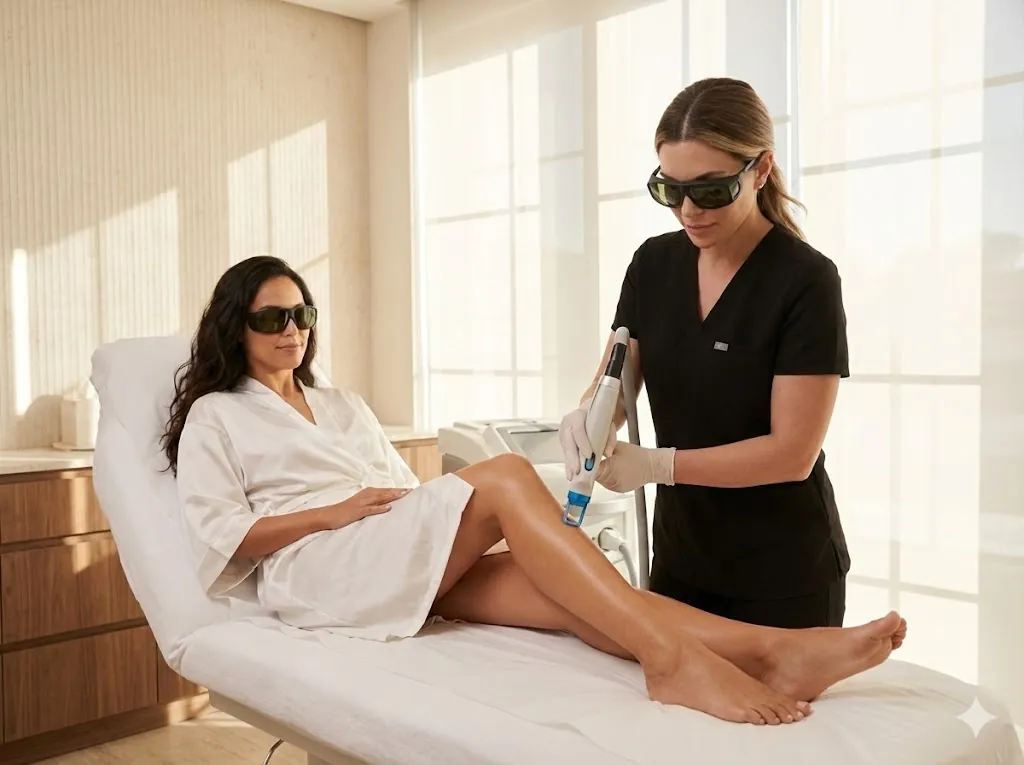
- Protective eyewear for both patient and practitioner
- The laser handpiece is applied to the skin with contact cooling
- You may feel a warm snapping sensation
- Treatment time varies: upper lip takes 5 minutes; full legs may take 45-60 minutes
- The cooling system significantly reduces discomfort
After Treatment
- Mild redness and slight bumps (perifollicular edema) are normal — they resolve within hours
- Apply aloe vera gel or a gentle moisturizer
- Strict sun protection (SPF 50+) for at least 2 weeks
- Avoid hot baths, saunas, and intense exercise for 24-48 hours
- Treated hair will shed naturally over 1-3 weeks — this is not new growth
How effective is laser hair removal?
Laser hair removal gives long-term hair reduction, not complete removal; hair thins progressively with each session, and occasional maintenance visits may be needed for new growth triggered by hormones.
| After Sessions | Expected Outcome |
|---|---|
| 1-2 sessions | 20-30% reduction; finer regrowth |
| 3-4 sessions | 50-60% reduction; patchy regrowth |
| 5-6 sessions | 70-80% reduction; very fine remaining hair |
| 7-8 sessions | 80-90% reduction; may need annual touch-ups |
Important: Laser hair removal provides long-term hair reduction, not 100% permanent hair removal. Most patients achieve 80-90% reduction with occasional maintenance sessions (1-2 per year) to catch any hormonally-triggered new growth.
How does laser compare with shaving, waxing and electrolysis?
Compared with shaving and waxing, laser gives longer-lasting reduction and fewer ingrown hairs with mild to moderate discomfort, while electrolysis tends to be more painful and more costly over time, as the table shows.
| Method | Permanence | Pain | Ingrown Hairs | Cost (Long-term) |
|---|---|---|---|---|
| Laser | Long-term reduction | Mild-moderate | Reduced | — |
| Shaving | Temporary (1-3 days) | None | Common | Moderate (lifetime) |
| Waxing | Temporary (3-6 weeks) | Moderate-high | Common | High (lifetime) |
| Electrolysis | Permanent | Moderate-high | Rare | Very high |
| IPL (home devices) | Semi-permanent | Mild | Reduced | Moderate |
What treatments pair well with laser hair removal?
Some patients add treatments for issues that often come with hair removal, such as skin texture, pigmentation left by shaving or waxing irritation, overall tone, or scarring from ingrown hairs.
Laser hair removal may also be combined with:
- Sylfirm X RF Microneedling for skin texture and tone
- PicoWay Laser for pigmentation from previous shaving or waxing irritation
- DPL Photo Facial for overall skin rejuvenation
- Microneedling for ingrown hair scarring
Frequently Asked Questions
Q: How many sessions do I really need? A: Most patients need 6-8 sessions for optimal results. The exact number depends on your hair color, thickness, treatment area, and hormonal factors. Facial hair may require additional sessions due to hormonal influence.
Q: Can I get laser hair removal while pregnant? A: We recommend waiting until after pregnancy and breastfeeding, as hormonal changes can affect results and safety data during pregnancy is limited.
Q: What about blonde or grey hair? A: Laser works best on dark hair. Very blonde, red, grey, or white hair lacks sufficient melanin for the laser to target effectively. Electrolysis may be a better option for these hair colors.
Q: Is it worth it? A: That depends on your goals. Laser hair removal can reduce the time spent on years of shaving or waxing; results vary.
Book Your Laser Hair Removal Consultation
Ready to say goodbye to unwanted hair? Book your consultation at RAAC Richmond. We'll assess your skin and hair type, recommend the ideal laser protocol, and provide transparent pricing for your treatment plan.
RAAC Richmond Anti-Aging Clinic: 5580 No. 3 Rd Unit 110, Richmond BC V6X 2C8. Serving Richmond, Vancouver, Burnaby, Surrey, and Metro Vancouver.