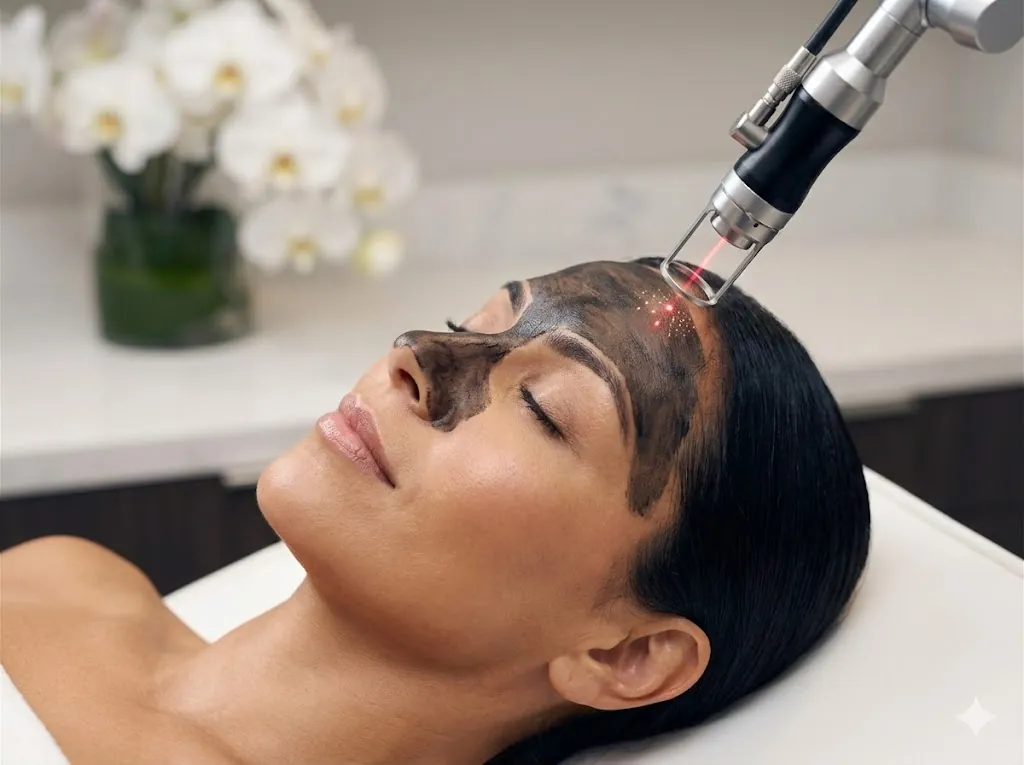
V-Carbon is a non-laser carbon peel: a film of activated vegetable carbon with mandelic, ferulic and citric acids is applied, activated with a spray, then neutralized and removed after 5 to 10 minutes. It is designed to clean pores, gently exfoliate and brighten dull, oily or acne-prone skin. Redness usually fades within 1 to 2 hours and mild flaking, if any, settles in 2 to 3 days, so most people return to their routine the same day. A series of sessions is usually suggested for texture and pores.
In the evolving landscape of medical aesthetics, the quest for treatments that deliver immediate results with minimal downtime has led to significant innovations in chemical and enzymatic peeling systems. Among these, the v-carbon system—often referred to as a non-laser carbon peel—has emerged as a sophisticated tool for physicians to address a spectrum of skin concerns from acne to photoaging. At Richmond Anti-Aging Clinic (RAAC) in Richmond, BC, our approach to skin health is rooted in clinical evidence and physician oversight. Under the leadership of Dr. Charles Jiang, a licensed physician with over 29 years of clinical experience, we prioritize understanding the cellular mechanisms that drive aesthetic outcomes. This article provides a science-heavy exploration of how the V-Carbon system functions at a biochemical level and why it has become a cornerstone of our rejuvenation protocols. Learn more about V-Carbon Peel to see how this technology integrates into our broader treatment menu.
How does the V-Carbon carbon peel work?
V-Carbon uses no laser at any step: activated carbon draws out oil and impurities from pores, mild acids loosen dead surface cells, and a spray activates the film before the skin is neutralized and the film removed.
The laser carbon facial known as the "Black Face Doll" or Hollywood peel passes a laser over carbon on the skin. V-Carbon is a different product: a carbon and acid peel made in Italy by Promoitalia that combines vegetable carbon, organic acids and the antioxidant ferulic acid, with no laser energy and no laser heat. The process can be broken down into three phases: adsorption, acid exfoliation, and activation and neutralization.
1. Carbon Adsorption and Detoxification
The primary component of the mask is activated vegetable carbon. At a molecular level, activated carbon possesses an incredibly high surface-area-to-volume ratio. This allows it to act as a molecular sieve, utilizing Van der Waals forces to adsorb (bind to the surface) excess sebum from within the follicular ostia (pores). For our patients in Richmond, this provides a profound "detox" effect that is particularly beneficial for those exposed to urban pollutants.
2. Acid-Mediated Keratolysis
The V-Carbon film contains a curated blend of acids that facilitate controlled keratolysis (the breakdown of the outer layer of the skin):
- Mandelic Acid: An alpha-hydroxy acid (AHA) with a larger molecular weight, allowing for slower, more uniform penetration. This reduces the risk of post-inflammatory hyperpigmentation (PIH), making it safer for diverse skin types.
- Ferulic Acid: A potent phenolic antioxidant that neutralizes reactive oxygen species (ROS). Ferulic acid is known to stabilize other antioxidants and provide significant photoprotection.
- Citric Acid: Part of the acid complex that helps loosen dead cells and exfoliate the surface.
3. Spray Activation and Neutralization
The V-Carbon spray is misted over the film to activate the ingredients, and it lets the clinician control how deep the peel works. After about 5 to 10 minutes the film is removed and the skin is neutralized and calmed. No laser is used at any step. Book a Consultation to have our medical team assess if this biochemical approach suits your skin’s unique physiology.
Is there evidence that V-Carbon ingredients work?
The V-Carbon system itself is still relatively new, but its main ingredients, such as mandelic acid, ferulic acid and carbon-based pore cleansing, have been studied in peer-reviewed dermatology journals.
The efficacy of the components found within the V-Carbon system is well-documented in dermatological literature. While the specific V-Carbon brand continues to gain traction in clinical settings, the individual active ingredients have undergone rigorous peer-reviewed scrutiny.
- Mandelic Acid in Acne Management: Mandelic acid may be helpful in managing inflammatory acne and hyperpigmentation, and for some patients it may be associated with a lower incidence of side effects compared to glycolic acid. This makes the V-Carbon system particularly suitable for sensitive or darker skin tones common in the Greater Vancouver area.
- Antioxidant Synergy: Ferulic acid may increase the photoprotective effect of skin-applied actives. This supports the use of V-Carbon as a preventative anti-aging treatment against UV-induced damage.
- Carbon-Based Pore Cleansing: Carbon particles may penetrate the sebaceous glands, and through physical adsorption this may help support a reduction in pore size and sebum production for some patients. At Richmond Anti-Aging Clinic (RAAC), Dr. Charles Jiang reviews these clinical frameworks to ensure that every treatment protocol—including the V-Carbon peel—is optimized for safety and efficacy. As a licensed physician, Dr. Jiang ensures that our clinical standards meet the expectations of medical care in British Columbia.
What is the difference between V-Carbon and a carbon laser facial?
Both use carbon, but V-Carbon at RAAC uses no laser: it works with a carbon film, an acid complex and an activating spray, while a carbon laser facial passes a laser over carbon on the skin.
Many patients ask about the difference between a carbon laser facial and the V-Carbon peel. While both utilize carbon to purify the skin, their delivery systems differ significantly. The following table compares the two approaches to help you understand which may be more appropriate for your needs.
| Feature | V-Carbon Peel (No Laser) | Carbon Laser Facial |
|---|---|---|
| Primary Mechanism | Carbon film + mandelic, ferulic and citric acids, activated by a spray | Laser passed over carbon on the skin |
| Laser Heat | None | Yes |
| Typical Recovery | Redness usually fades in 1 to 2 hours; mild flaking, if any, for 2 to 3 days | Varies with settings |
| Sensation | Slight warmth or tingling when the spray is applied; no numbing needed | Often described as a snapping sensation |
| Skin Types | Peel depth chosen for your skin, conservatively for pigment-prone skin | Laser settings adjusted for skin type |
| Treatment Time | About 15 to 20 minutes | Varies by device |
Candidate Evaluation: Is V-Carbon Right for You?
As with any medical aesthetic procedure, candidate selection is paramount. At Richmond Anti-Aging Clinic (RAAC), we perform a comprehensive skin analysis before proceeding.
Ideal Candidates
- Individuals with "City Skin": Those experiencing dullness due to environmental pollutants in Richmond and Vancouver.
- Acne-Prone Skin: Patients dealing with comedonal acne or oily skin types who need deep follicular cleansing.
- Pre-Event Patients: Redness usually fades within 1 to 2 hours, so it is often booked before an event.
- Fine Lines & Texture: Those noticing early signs of aging who want a non-invasive "refresh."
Limitations and Contraindications
V-Carbon may not be suitable for:
- Patients with active cold sores or open wounds in the treatment area.
- Individuals with an allergy to any of the component acids (e.g., Mandelic acid).
- Those currently using high-dose prescription retinoids (may require a brief washout period).
- Pregnant or breastfeeding individuals (as a standard medical precaution). Dr. Charles Jiang oversees all candidate evaluations to ensure that the treatment plan aligns with your medical history and aesthetic goals.
Why Choose Richmond Anti-Aging Clinic (RAAC)?
Choosing a clinic for your V-Carbon treatment means choosing the team behind the technology. At RAAC in Richmond, we offer:
- Physician-Led Care: Your skin health is managed with medical precision by our team.
- Genuine Products: We use Promoitalia V Carbon products, applied by trained clinical staff.
- Personalized Treatment Plans: We don't believe in one-size-fits-all. Your V-Carbon session may be combined with other modalities for optimal results.
- Bilingual Service: To better serve our Richmond community, our staff is fully fluent in both English and Chinese. The V-Carbon peel pairs medical-grade exfoliation with typically shorter recovery than more aggressive lasers; results vary.
Frequently Asked Questions
Is the V-Carbon peel painful? The treatment may cause a mild tingling or warming sensation. It may feel more comfortable than traditional high-concentration chemical peels for some patients. How many sessions are required for best results? While a single session provides an immediate glow, we typically recommend a series of 4 to 6 treatments spaced 2 to 4 weeks apart for cumulative improvements in skin texture and pore size. Can I wear makeup after the treatment? Most people return to their routine the same day, but avoid heavy makeup for 24 hours if possible and apply SPF 30+ daily to protect your newly exfoliated skin. How does V-Carbon differ from a regular chemical peel? The addition of activated carbon may help purify the pores in a way that acids alone do not. The activating spray also lets the clinician adjust how deep the peel works, and no laser is used at any step. What is the cost of the treatment? Contact us for current pricing.
Next Steps
If you are looking for a scientifically-backed method to revitalize your skin, the V-Carbon peel offers a compelling combination of detoxification and anti-aging benefits. Our team is ready to guide you through the process and help you work toward the results you want. Book a consultation — available in English and Chinese. Ready to See What V-Carbon Peel Can Do for You? Our medical team at Richmond Anti-Aging Clinic (RAAC) in Richmond is ready to create your personalized treatment plan. Book a skin assessment to begin your journey to healthier skin. Disclaimer: This article is for educational purposes only and does not constitute medical advice. Please consult with a qualified healthcare professional before undergoing any treatment.