Neuromodulator injections use botulinum toxin type A to temporarily relax the small muscles behind expression lines, while Sylfirm X is a non-injectable radiofrequency microneedling treatment that works on the skin itself. They address different layers of the face, so suitability depends on your wrinkle type, goals and how your skin responds.
What are neuromodulator injections, and is neuromodulator a neuromodulator?
Neuromodulator injections are physician-planned treatments using botulinum toxin type A to temporarily calm overactive facial muscles. At Richmond Anti-Aging Clinic (RAAC) in Richmond, British Columbia, Canada, Neuromodulator Injections are assessed and planned by a physician.
The mechanism is straightforward. Botulinum toxin type A temporarily blocks acetylcholine release, calming overactive muscles while preserving nearby function. In practical terms, it temporarily interrupts the nerve-muscle signal so the muscle rests, softening the overlying skin. Dose is customized to each muscle's strength to avoid heaviness or asymmetry, and results typically start in 3–5 days, peak at about 2 weeks, and last 3–4 months.
Because injections are a medical procedure, physician oversight matters. Dr. Charles Jiang, a licensed physician in British Columbia and RAAC's lead physician, maps muscles precisely to stay safe around the eyelids and smile. Products are sourced through Canadian suppliers, and it is worth asking at consultation which product is used for your plan.
How do anti-wrinkle injections work?
They temporarily interrupt the nerve-muscle signal so the treated muscle rests, which softens the skin crease above it. The product is a form of botulinum toxin type A, a neuromodulator that temporarily blocks acetylcholine release at the junction between nerve and muscle. With the signal quieted, an overactive muscle can no longer pull the skin into a fold, and the line above it relaxes while nearby function is preserved.
Dose is mapped to each muscle's strength rather than sold as a fixed unit package, which helps avoid heaviness or asymmetry. When dosed with care, the aim is targeted muscle relaxation that softens wrinkles while keeping expression and definition — a rested look rather than a frozen one. Results typically start in 3–5 days, reach full effect at about 2 weeks, and last 3–4 months, so maintenance is part of the plan.
Because this is a medical procedure near the eyelids and smile, physician oversight matters. At Richmond Anti-Aging Clinic (RAAC) in Richmond, BC, Dr. Charles Jiang, a licensed physician in British Columbia and the clinic's lead physician, reviews your expressions and muscle pattern before any treatment is planned.
What are neuromodulator injections used for, and what does Sylfirm X address?
Neuromodulators target dynamic lines and muscle-related concerns, while Sylfirm X is a non-injectable option aimed at skin quality and texture.
Neuromodulator injections are used for dynamic wrinkle softening — forehead lines, frown lines (11s) and crow's feet that appear with expression — and are dosed to smooth without a frozen look. They also address muscle-related concerns: masseter relaxation for jawline slimming and clenching-related discomfort, subtle relaxation for a lip flip, gummy smile or chin dimpling, Nefertiti-style lifting for neck bands or early jowl descent, and underarm, palm or sole sweating. Early, low-dose treatment may help slow how deeply lines etch over time. Every plan at RAAC in Richmond, BC is assessed by a physician; Dr. Charles Jiang, a licensed physician in British Columbia and the clinic's lead physician, maps muscles precisely to stay safe around the eyelids and smile.
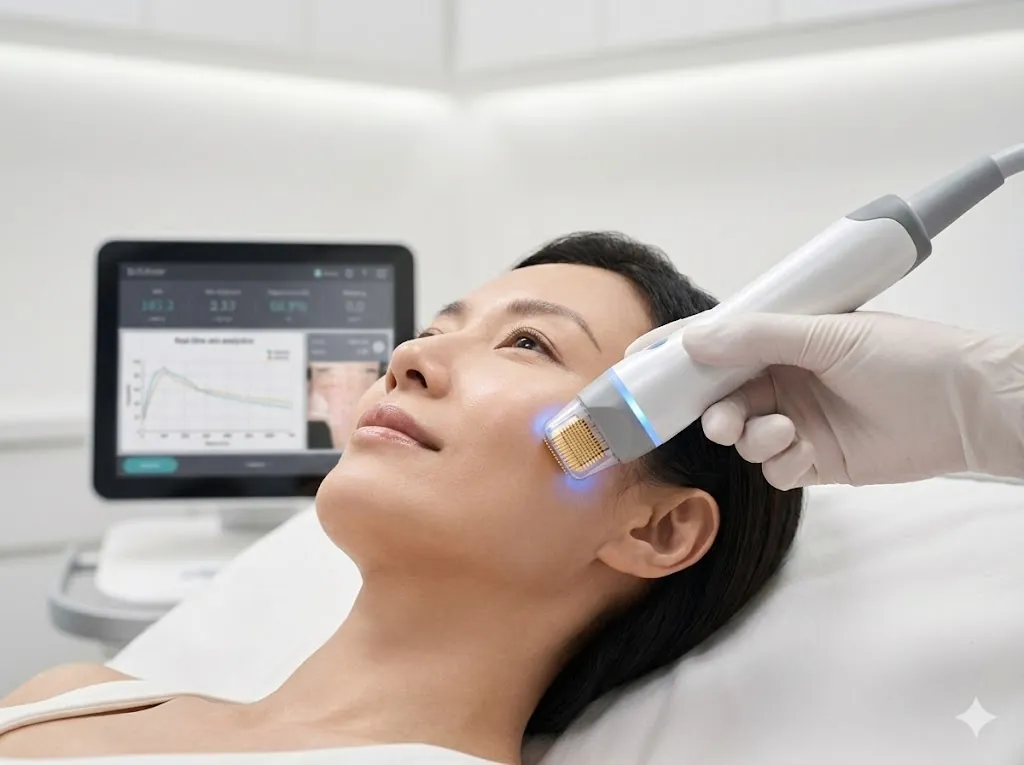
Sylfirm X is not an injection. It is used for skin quality and texture — the surface and tone of the skin rather than the muscle beneath it. Courses are typically 3-6 sessions, so it is a gradual, planned approach rather than a single visit.
In short: neuromodulators work on movement and muscle; Sylfirm X works on the skin itself. Which fits your concern depends on what your clinician sees at assessment.
How do the two compare side by side?
The table below sets out how each option works, what it addresses, session patterns and downtime, without comparing one above the other.
| Neuromodulator injections | Sylfirm X | |
|---|---|---|
| Mechanism | Botulinum toxin type A temporarily relaxes the small muscles behind frown lines, forehead lines and crow's feet | Non-injectable radiofrequency microneedling works on skin rather than muscle |
| What it addresses | Dynamic lines from expression, and an enlarged jaw muscle | Skin texture and quality concerns, including fine lines |
| Onset | Results start in 3–5 days, with full effect at about 2 weeks | Changes typically build across a course |
| Session pattern | Repeat visits as effect fades, typically every 3–4 months | Courses are typically 3–6 sessions |
| Visit and downtime | A physician-led visit of about 15 minutes; most resume normal activities the same day, with tiny bumps fading within 15–20 minutes | A course-based series rather than a single visit |
The distinction is essentially muscle versus skin: neuromodulators calm movement that folds the skin, while Sylfirm X treats the skin surface itself. Because they act on different tissue, the two are not direct substitutes, and suitability depends on what is driving the lines. At RAAC in Richmond, BC, assessment and planning are physician-led, with Dr. Charles Jiang, a licensed physician in British Columbia, overseeing candidate evaluation.
What does a visit involve, and what is recovery like?
A physician-led neuromodulator visit is brief, with most people returning to normal activities the same day; Sylfirm X is non-injectable and typically planned as a course.
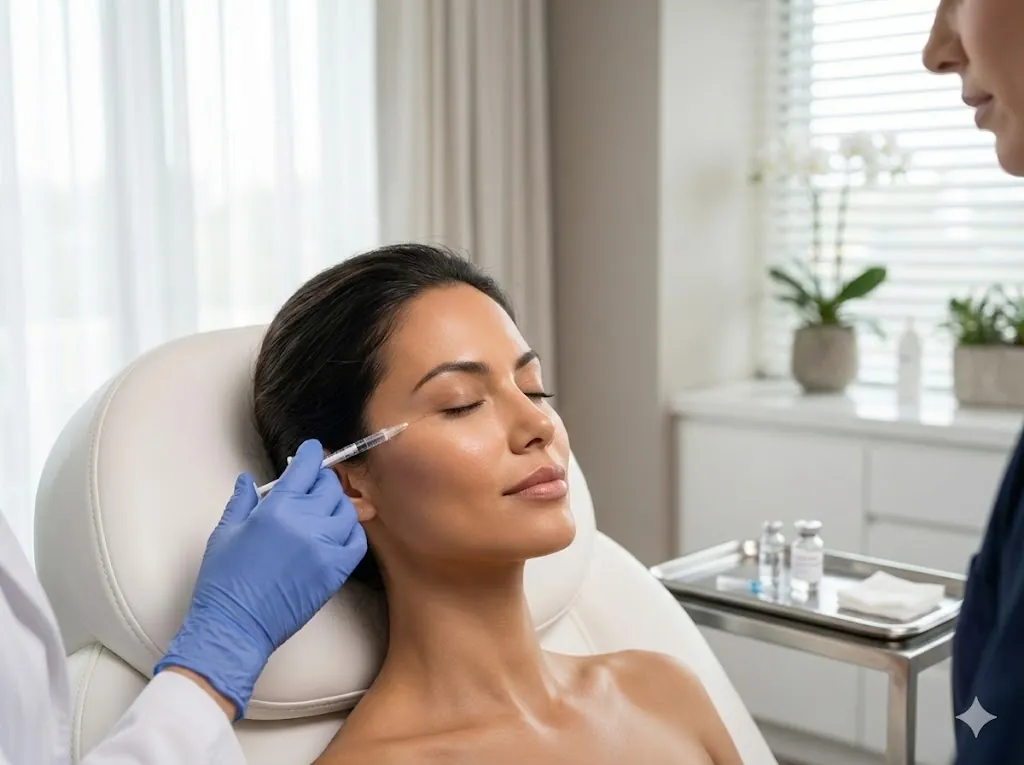
At RAAC in Richmond, BC, a neuromodulator appointment runs about 15 minutes. Your physician assesses your expressions and muscle strength, then maps exact injection points. Ultra-fine needles deliver tailored micro-doses; numbing can be offered if needed. Tiny bumps fade within 15–20 minutes, and temporary redness or swelling is possible. Makeup can resume shortly after. Aftercare is straightforward:
- Stay upright for 4 hours and avoid pressing or massaging treated areas.
- Skip strenuous exercise, sauna, or hot yoga for 24 hours.
- Avoid facials, lasers, or microcurrent over treated zones for 7 days.
First changes typically appear in 3–5 days, with peak smoothing at about 2 weeks; pinpoint marks, mild bruising, or a headache can occur and usually settle. A 2-week refinement can be scheduled if needed.
Sylfirm X is non-injectable and typically planned as a course of 3–6 sessions, so the schedule is spread over weeks rather than a single visit. Suitability and planning are reviewed with Dr. Charles Jiang, a licensed physician in British Columbia and RAAC's lead physician.
Who tends to suit each option, and who should not have injections?
Suitability depends on whether your lines are mainly expression-driven or mainly skin-related, and on your medical history. Neuromodulator injections are generally suited to dynamic wrinkles—forehead lines, frown lines (11s), crow's feet, and bunny lines—as well as jawline contouring for masseter hypertrophy, subtle lip flips, gummy smiles, chin dimpling, early jowl descent, and sweat control. Sylfirm X, by contrast, is a skin-quality treatment typically planned as 3-6 sessions, so it tends to suit texture and tone concerns rather than lines created purely by muscle movement. Many people have a mix of both and may be candidates for either or both, which is why an in-person assessment matters.
Injections are not for everyone. They are generally avoided during pregnancy or breastfeeding, over active infection or skin irritation at the injection site, in people with a history of neuromuscular disorders such as myasthenia gravis without clearance, or with a known allergy to botulinum toxin or formulation components. Medications or conditions that may interact—blood thinners, certain antibiotics or muscle relaxants, or a bleeding disorder—should be reviewed with your physician first. It is also worth being realistic: injections offer subtle refinement, not surgical-level lifting.
At RAAC in Richmond, BC, candidate evaluation is physician-led. Dr. Charles Jiang, a licensed physician in British Columbia and the lead physician at RAAC, reviews your muscle pattern, skin quality, and medical history to help determine which option, or combination, may be appropriate for you.
When might a clinician combine them?
For some patients, a clinician may plan both approaches together because they act on different layers, with timing spaced around the treatment plan. Neuromodulators work on the muscle layer: botulinum toxin type A temporarily blocks nerve signals to overactive muscles, smoothing expression lines and slimming bulky jaw muscles (F12). Sylfirm X, by contrast, is a skin-level treatment, so the two can address different contributors to the same concern — a line that is partly driven by muscle movement and partly by skin texture or laxity.
A combined plan may be considered when:
- Dynamic lines are present alongside skin-quality concerns such as texture or early laxity.
- Preventive anti-aging is the goal, since early, low-dose neuromodulator treatment may help slow how deeply lines etch over time (F17), while skin-level treatments address the surface.
- A patient wants to address both expression lines and overall skin appearance rather than one alone.
Timing matters. After neuromodulator injections, facials, lasers, or microcurrent over treated zones should be avoided for 7 days (F85), so a clinician will space Sylfirm X sessions around that window. Follow-up is also planned: expected onset is reviewed at 3–5 days, with a 2-week refinement if needed (F81).
Combination is a clinical decision, not a default. At RAAC in Richmond, BC, every plan is assessed by a licensed physician in British Columbia — Dr. Charles Jiang, the clinic's lead physician — based on your anatomy, goals, and treatment history.
How does a consultation decide, and what about cost?
A consultation matches the option to your wrinkle pattern, skin and goals, and pricing is personalized to the plan rather than fixed per unit.
The assessment starts with your expressions. At RAAC in Richmond, BC, a consultation and mapping step analyzes how your muscles fire and how strong they are, so the exact points and doses can be marked. That mapping is what separates a dynamic line — one that appears with movement — from a line that is already etched at rest, and the two often call for different approaches. Your prior neuromodulator dose history is part of the discussion too, since it informs accurate planning.
Dr. Charles Jiang, a licensed physician in British Columbia and RAAC's lead physician, oversees candidate evaluation and clinical safety, so suitability is a medical judgment rather than a menu choice.
On products, sourcing runs through Canadian suppliers, and it is worth asking at your consultation which product is used for your treatment.
Cost follows the same logic. Dosing is customized, not per-unit — tailored to muscle strength and your aesthetic goal instead of fixed "unit" packages — so a plan-based quote at consultation reflects your actual treatment rather than a published figure.
Frequently asked questions
What are neuromodulator injections and how do they work?
Neuromodulator injections use botulinum toxin type A to temporarily block nerve signals to overactive muscles, calming them so the overlying skin can smooth. This targeted muscle relaxation softens dynamic wrinkles while aiming to keep natural expression and definition.
Is neuromodulator a neuromodulator?
At RAAC, products are sourced through Canadian suppliers, and you can ask at your consultation which product is used for your plan.
Who tends to suit neuromodulator injections?
They may suit people with dynamic forehead lines, frown lines or crow's feet, and some patients with an enlarged jaw muscle causing a square shape or clenching discomfort. Candidacy is assessed by a physician, and pregnancy, breastfeeding, active infection at the site, certain neuromuscular conditions or known allergy may mean treatment is not appropriate.
What is the visit and recovery like?
A physician-led visit is about 15 minutes, and most people resume normal activities the same day. Tiny bumps typically fade within 15 to 20 minutes, temporary redness or swelling is possible, and makeup can resume shortly after.
How long do results typically last?
First changes may appear in 3 to 5 days, with peak smoothing at about 2 weeks, and results typically last 3 to 4 months. Your physician can discuss expected timing and follow-up at your visit.
How much do neuromodulator injections cost?
Pricing is personalized at consultation, based on the areas assessed and the plan your physician recommends. There is no fixed per-unit package, because dose is tailored to muscle strength and your aesthetic goal.
Who oversees the treatment at RAAC?
Every treatment at Richmond Anti-Aging Clinic (RAAC) in Richmond, BC is assessed and planned by a physician. Dr. Charles Jiang, a licensed physician in British Columbia and RAAC's lead physician, provides physician oversight for candidate evaluation and clinical safety.
Next steps
If you are weighing Neuromodulator Injections, a physician-led assessment at Richmond Anti-Aging Clinic (RAAC) in Richmond can clarify whether it suits you. Book a consultation — available in English and Chinese. You can also read more on the Neuromodulator Injections treatment page.
This article is for educational purposes only and does not constitute medical advice. Please consult with a qualified healthcare professional before undergoing any treatment.