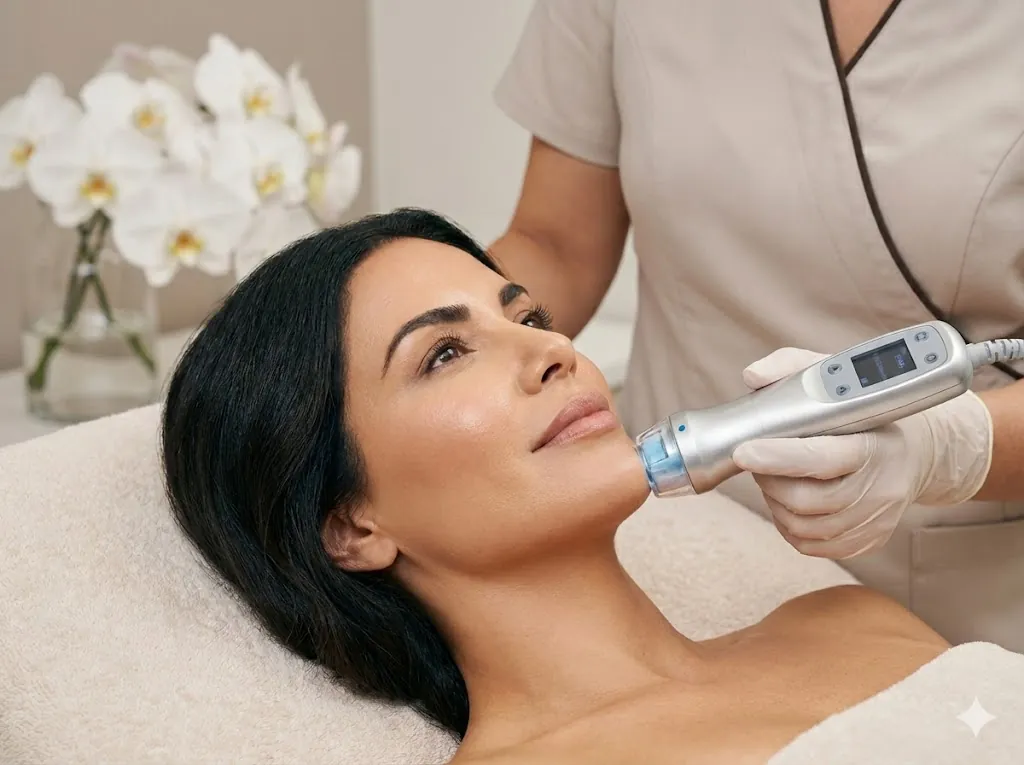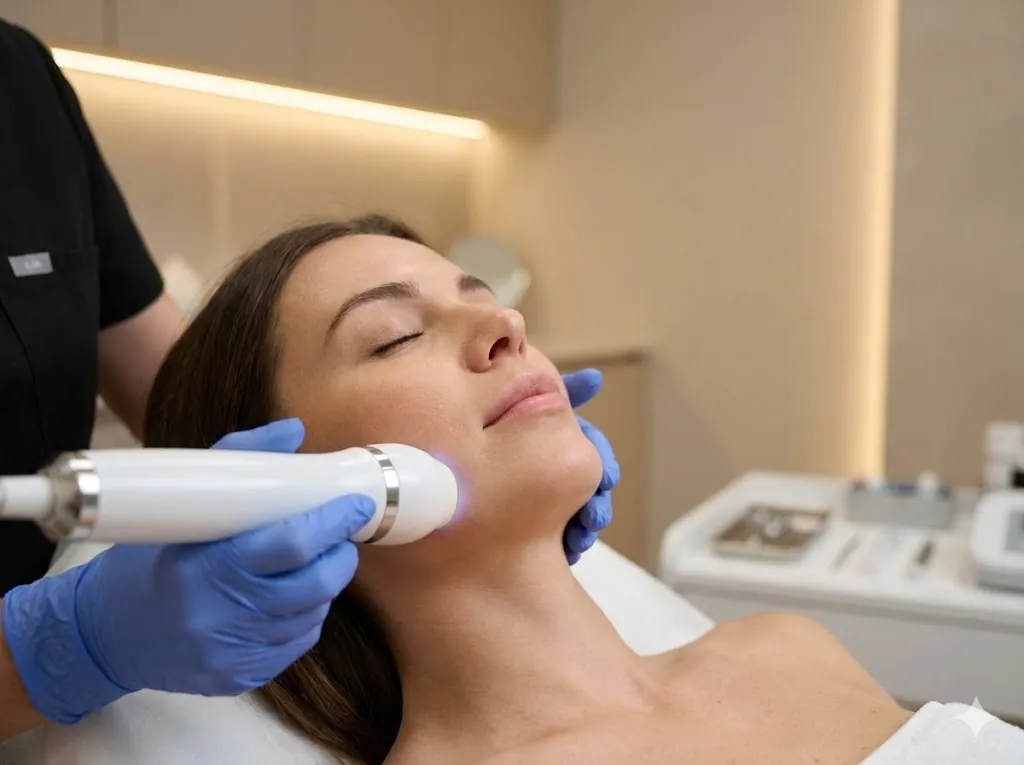
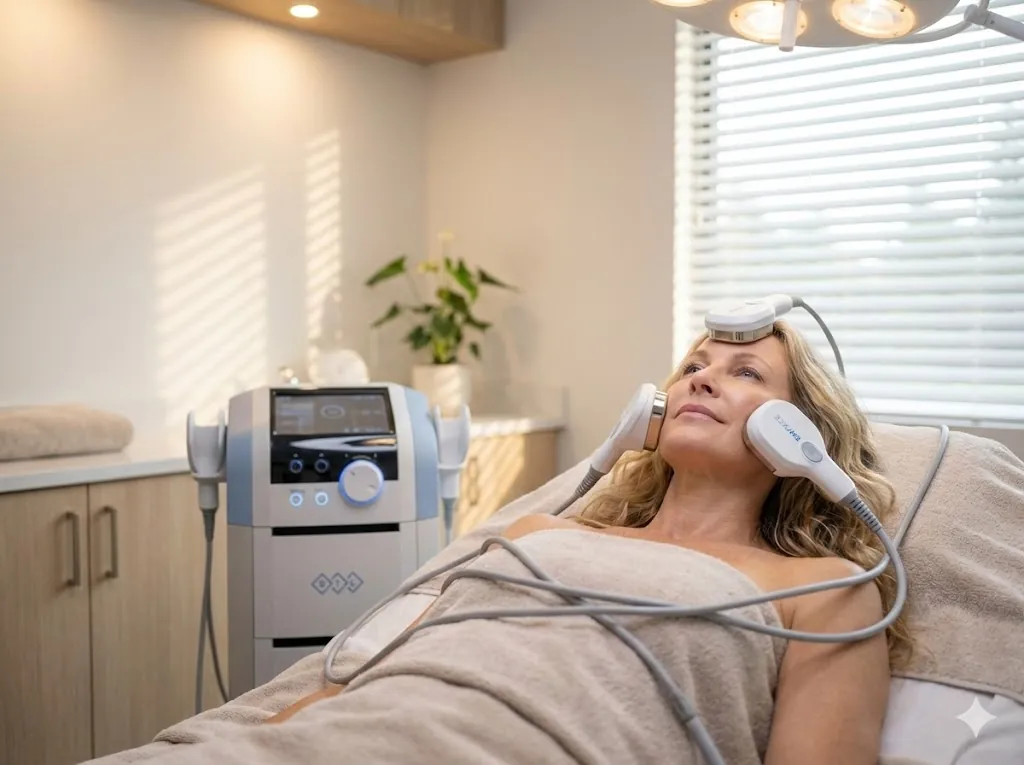
Neither is universally better; they work differently. EMFace uses radiofrequency plus HIFES muscle stimulation to address skin and facial muscle tone, while Thermage FLX uses radiofrequency for skin tightening. Which suits you depends on your anatomy, goals and how your skin responds, so a clinical assessment is the sensible way to decide.
What is EMFace and how does it work?
EMFace is a needle-free facial treatment that combines radiofrequency heating with HIFES muscle stimulation to work on both the skin and the muscles beneath it. It is designed to tone the muscles under the skin and stimulate collagen in the skin itself, in areas such as the cheeks, jawline and brow. A course is typically 4–6 sessions about a week apart, depending on how you respond, and many people return to normal activities the same day. RAAC is about a 3-minute walk from Lansdowne Station on the Canada Line, serving EMFace patients from Vancouver, Burnaby and across Greater Vancouver.
Unlike facial treatments that only address the skin, EMFace works on both the skin and the muscles beneath it. This dual-action approach is designed to support tone and firmness, and individual results vary.
- Radiofrequency heating: heats the dermis to prompt collagen and elastin renewal, supporting skin texture and fine lines.
- HIFES muscle stimulation: prompts repeated facial muscle contractions to support muscle tone and contour.
- Synchronized delivery: RF and HIFES energies are delivered at the same time through the same applicators.
- Precise targeting: proprietary applicators target specific facial areas including cheeks, forehead, and jawline.
At RAAC in Richmond, British Columbia, EMFace is used with assessment and treatment planning overseen by Dr. Charles Jiang, a licensed physician in British Columbia and the clinic's lead physician.
What is Thermage FLX and how does it work?
Thermage FLX is the fifth generation of Thermage, a radiofrequency treatment that heats tissue to support skin tightening and collagen renewal. At Richmond Anti-Aging Clinic (RAAC) in Richmond, British Columbia, it is used as a skin-focused option within a physician-led treatment plan.
Thermage FLX delivers radiofrequency energy into the skin. The heat is intended to prompt collagen renewal over time, which is why the treatment is often discussed in terms of skin firmness and texture rather than muscle tone. Because its mechanism is radiofrequency heating rather than muscle stimulation, it works on a different layer and principle than a device like EMFace, which pairs radiofrequency with HIFES muscle stimulation.
In practical terms, this shapes how Thermage FLX is positioned:
- Focus: skin rather than facial muscle stimulation
- Commonly discussed for: firmness and texture
- Planning: based on assessment of your skin and goals
Whether Thermage FLX suits you depends on your anatomy, skin quality and what you hope to change. At RAAC, candidate evaluation and treatment planning are overseen by Dr. Charles Jiang, a licensed physician in British Columbia and the clinic's lead physician. Results vary from person to person, and a consultation is the appropriate place to discuss what is realistic for your face.
How do EMFace and Thermage FLX compare side by side?
The main differences are the mechanism, the target tissue and the treatment cadence, rather than one being better than the other.
| Feature | EMFace | Thermage FLX |
|---|---|---|
| Mechanism | Radiofrequency plus HIFES muscle stimulation | Radiofrequency for skin tightening |
| Target tissue | Skin and muscle | Skin |
| Areas | Cheeks, jawline, brow | Planned around the treatment area |
| Session length | About 30 minutes for one to two areas | Typically a single session planned around the area |
| Typical course | 4–6 weekly sessions | Typically a single session |
| Downtime | Same-day return to normal activities | — |
| Sensation | Warmth, tingling and muscle contractions | — |
| Suited to | Mild to moderate sagging, facial toning goals | Skin tightening goals |
These differences follow from how each device delivers energy. EMFace acts on two tissues at once, so it is planned as a short course with a weekly rhythm; Thermage FLX works on the skin alone, so a single session is planned around the area being treated. Suitability depends on your anatomy and goals, which is why assessment with Dr. Charles Jiang, a licensed physician in British Columbia, matters before either option is chosen. Results vary, and a clinician can explain what each approach may reasonably do for your face.
Which is better for skin tightening or facial rejuvenation, EMFace or Thermage FLX?
There is no single answer, because the two address different tissue and suit different presentations. EMFace may suit people who want facial muscle tone alongside skin quality: it delivers radiofrequency heating and HIFES muscle stimulation together, so it works on the muscles beneath the skin as well as the skin itself, in areas such as the cheeks, jawline and brow. Thermage FLX may suit people whose main concern is skin firmness, since its focus is on the skin rather than the underlying muscle. Neither is more effective for everyone, and response varies by individual — the change from either treatment builds gradually, and results differ from person to person.
The right choice follows from an in-person assessment of your facial structure and goals. At Richmond Anti-Aging Clinic (RAAC) in Richmond, British Columbia, Canada, assessment and treatment planning are overseen by Dr. Charles Jiang, a licensed physician in British Columbia and the clinic's lead physician, who can review your anatomy, skin quality and priorities and discuss which approach — or which combination — fits your face.
Who tends to suit EMFace, and who should not have it?
EMFace tends to suit people seeking non-surgical facial toning, while some medical situations call for caution or a physician review first. At RAAC in Richmond, BC, candidacy is assessed individually rather than assumed from a single concern.
EMFace may be a reasonable option for individuals with mild to moderate facial sagging, those seeking non-surgical facial rejuvenation, and people who want to improve facial muscle tone. It may also suit individuals looking to reduce fine lines and wrinkles, or those who prefer natural-looking facial enhancement rather than a sudden change. Because the treatment works on both the skin and the muscles beneath it, the assessment considers your facial structure and goals, not just surface concerns.
Some situations call for caution or a physician review before treatment. These include pregnancy or breastfeeding, active skin infections or open wounds in the treatment area, and a pacemaker, defibrillator or certain medical or metal implants. A history of epilepsy or seizures should be reviewed with the physician, as should severe medical conditions. If any of these apply, raise them at consultation so your suitability can be assessed properly.
At RAAC, candidate evaluation and treatment planning are overseen by Dr. Charles Jiang, a licensed physician in British Columbia and the lead physician at the clinic. This physician oversight helps ensure that medical history, implants and other risk factors are considered before any plan is confirmed. If EMFace is not appropriate for you, the team can discuss alternatives.
What does an EMFace visit involve, and what is recovery like?
A session is short and typically needle-free, with most people returning to normal activities the same day. At RAAC in Richmond, BC, EMFace is planned around your facial anatomy and goals, with assessment and treatment planning overseen by Dr. Charles Jiang, a licensed physician in British Columbia.
Before treatment, expect to review medications such as blood thinners, disclose your medical history including any implants or a pacemaker, remove metal jewellery from the face and ears, and arrive with clean, makeup-free skin. Hydration beforehand is helpful.
During the visit, the skin is cleansed and conductive gel applied, then specialized applicators are positioned on the target areas. Radiofrequency heating and HIFES muscle stimulation are delivered together. One or two areas take about 30 minutes; more areas take roughly twice as long. The sensation is generally described as warmth, tingling and muscle contractions, and energy can be adjusted for comfort. Numbing is typically not needed.
Afterwards, gel is removed and soothing products applied if needed. Temporary redness or warmth is possible, but normal activities can usually resume the same day. Sunscreen and gentle skincare are advised. A course is typically 4–6 weekly sessions depending on response, with changes building over about 3 months. Results are not permanent, so ask about maintenance timing at follow-up.
What are the limits, side effects and cost factors to know about?
Results are gradual and not permanent, temporary redness or warmth is possible, and cost depends on your personalised plan rather than a fixed figure.
EMFACE works on both the skin and the muscles beneath it, which is different from treatments that only address the skin, but it is not a permanent change. Changes build over about 3 months, and maintenance timing is worth discussing at follow-up. Most people resume normal activities the same day; temporary redness or mild warmth is possible. Suitability is assessed beforehand, and treatment planning at RAAC is overseen by Dr. Charles Jiang, a licensed physician in British Columbia.
On cost, several factors shape a plan:
- The number of sessions (a course is typically 4–6, depending on response)
- The areas treated (one or two areas take about 30 minutes; more areas take longer)
- Whether treatments are combined in one plan
Pricing is personalised at consultation, with no figure quoted in advance. EMFACE cost varies by region, provider and machine — emface cost per session, emface cost uk and emface cost in pakistan figures reflect those markets and do not reflect Canadian clinic pricing. If you are comparing numbers online, it is worth asking your plan directly.
When might a clinician combine EMFace with Thermage FLX?
For some patients, a clinician may plan both, because one addresses muscle tone and the other focuses on skin tightening. EMFace uses radiofrequency plus HIFES muscle stimulation to work on the facial muscles and the skin above them, while Thermage FLX is a skin-tightening treatment. When laxity and loss of muscle tone appear together, a plan that addresses both layers may be considered.
Where appropriate, EMFace can be combined with complementary treatments so the plan fits the face and goals. That is a clinical judgement based on anatomy, goals and tolerance, not a standard package — the right mix differs from one person to the next, and for some people one approach alone may be enough.
At RAAC in Richmond, British Columbia, assessment and treatment planning are overseen by Dr. Charles Jiang, a licensed physician in British Columbia and the clinic's lead physician. A consultation is how the decision gets made: an examination of facial structure and skin, a review of your history, a discussion of what you want to change, and a plan you can consider at your own pace. Results vary, and expectations are discussed honestly before anything is scheduled.
Frequently asked questions
What is EMFace and how does it work?
EMFace is a needle-free facial treatment that combines radiofrequency heating with HIFES muscle stimulation. It is designed to tone the muscles under the skin and stimulate collagen in the skin itself, in areas such as the cheeks, jawline and brow.
Who is EMFace best for?
EMFace is for people seeking non-surgical facial toning, including those with mild to moderate facial sagging or who want to improve facial muscle tone and the look of fine lines. Our team assesses your facial structure and goals to determine whether it suits you.
How long is an EMFace session, and does it hurt?
One or two areas take about 30 minutes per session. Most people feel a warm, tingling sensation and muscle contractions, and energy can be adjusted for comfort; numbing is typically not needed.
What is recovery like after EMFace?
Many people resume normal activities the same day. Temporary redness or mild warmth is possible, and applying sunscreen and keeping skincare gentle is advised afterward.
How many EMFace sessions will I need, and how far apart?
A course is typically 4 to 6 sessions about a week apart, depending on how you respond. Individual results vary, and changes build over about 3 months.
Are EMFace results permanent?
EMFace results are not permanent. Ask about maintenance timing at your follow-up, and note that individual results vary.
How much does EMFace cost?
Pricing is personalized at consultation, based on the areas treated and the plan your clinician recommends. We do not quote a single figure, since each plan is tailored to your facial anatomy and goals.
Next steps
If you are weighing EMFace, a physician-led assessment at Richmond Anti-Aging Clinic (RAAC) in Richmond can clarify whether it suits you. Book a consultation — available in English and Chinese. You can also read more on the EMFace treatment page.
This article is for educational purposes only and does not constitute medical advice. Please consult with a qualified healthcare professional before undergoing any treatment.