
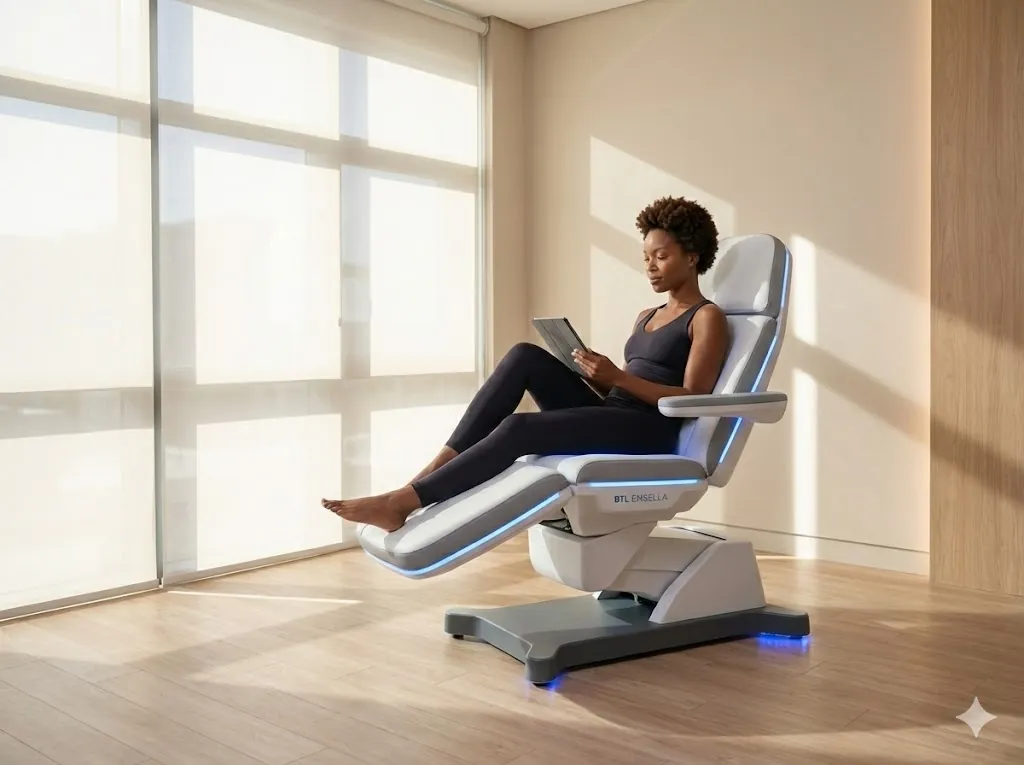
EMSella uses HIFEM energy to make the pelvic floor muscles contract supramaximally, far beyond a typical voluntary Kegel, while you stay fully clothed. These repeated contractions are intended to help retrain neuromuscular pathways and support bladder control. A licensed physician in British Columbia typically assesses suitability before a course begins, since individual response can vary.
What is EMSella and how does HIFEM energy act on the pelvic floor at a cellular level?
EMSella relies on High-Intensity Focused Electromagnetic (HIFEM) energy that passes through clothing and tissue to depolarize pelvic floor motor neurons and force repeated muscle contraction. The EMSella chair emits focused electromagnetic pulses that pass through clothing and superficial tissue, reaching the deep pelvic floor muscles without any probe or direct skin contact.
At a cellular level, this stimulation works by driving the pelvic floor into supramaximal contractions, stronger than voluntary Kegel exercises usually reach. According to BTL, each 28-minute session involves approximately 11,000 of these contractions, far more repetitions than a person could sustain through conscious effort alone.
The intent of this repeated, high-intensity stimulation is twofold:
- To mechanically load the muscle fibres, which may support strength and tone over a course of sessions
- To retrain the neuromuscular pathways involved in sphincter and bladder control, pathways that can weaken after childbirth, hormonal changes, or ageing
Rather than isolating a single muscle group through voluntary squeezing, the electromagnetic field activates the pelvic floor more broadly and consistently, which is the underlying mechanism this treatment is built on. Results vary from person to person, and suitability should be confirmed as part of an individual assessment.
What does the clinical evidence say about HIFEM for urinary incontinence?
Peer-reviewed research on HIFEM-based pelvic floor stimulation has reported reductions in leakage episodes and improved pelvic floor muscle strength, alongside BTL device data cited by the manufacturer.
Published findings on HIFEM and stress urinary incontinence describe fewer reported leakage episodes following a course of sessions, consistent with the mechanism of repeated supramaximal pelvic floor contraction. Separate work using electromyography has looked at changes in pelvic floor muscle activity after HIFEM stimulation, pointing to improved muscle recruitment and coordination rather than strength alone.
Other published outcomes have focused on specific populations, including post-prostatectomy and post-partum pelvic floor weakness, where HIFEM-based protocols were associated with improvement in continence-related measures over the course of treatment.
BTL's own device data describe approximately 11,000 contractions generated per 28-minute session, with many patients in that dataset noting change beginning around session 2 to 3, and benefit continuing to build in the weeks following the standard 6-session course.
A few points worth keeping in mind:
- Study designs, populations and follow-up periods vary between publications
- BTL's figures describe device output and company-reported trends, not an independent clinical trial
- Individual results vary, and Dr. Jiang can discuss what the published outcomes may reasonably suggest for your particular symptoms during your assessment at RAAC
How does EMSella's mechanism compare to Ultra Femme 360 and other pelvic health approaches?
EMSella works through electromagnetic muscle stimulation rather than the radiofrequency-based tissue heating used by devices like Ultra Femme 360, so the two act on different tissue targets. Ultra Femme 360 is named here only as a comparison point for how pelvic health technologies differ in mechanism; it is a separate device aimed at a different part of pelvic wellness and is not being proposed as an alternative within this discussion of incontinence.
The distinction matters because of what each energy type is designed to do:
- HIFEM® (used in EMSella) passes through clothing and tissue to reach the deep pelvic floor muscles, producing contractions at an intensity that voluntary effort rarely matches. The focus is on muscle strength and neuromuscular coordination — training the muscles themselves to contract more effectively.
- Radiofrequency-based approaches instead apply controlled heating to superficial and connective tissue layers, which is a mechanism aimed at tissue quality rather than muscle contraction.
Because these mechanisms target different structures, they are not interchangeable, and one is not a substitute for the other depending on what a person's pelvic health goals are. Whether a muscle-stimulation approach, a tissue-focused approach, or neither is appropriate depends on the specific symptoms involved. Dr. Charles Jiang reviews symptom history and pelvic floor function before recommending any course of treatment, since the right mechanism depends on the underlying issue rather than on the technology alone.
Who is a suitable candidate for EMSella, and how is that assessed?
Candidacy depends on the type and severity of incontinence symptoms, which is why an assessment by a licensed physician in British Columbia precedes any course of treatment. Urinary incontinence is a medical condition rather than something to simply accept as part of aging, and EMSella is suitable for both women and men depending on presentation.
EMSella may be considered for:
- Women with stress urinary incontinence (leakage with coughing, sneezing, or exercise)
- Women with urge or mixed urinary incontinence
- Post-partum women experiencing pelvic floor weakness or laxity
- Peri- and post-menopausal women with incontinence or pelvic floor atrophy
- Men with post-prostatectomy urinary incontinence
- Anyone seeking preventative pelvic floor conditioning
At RAAC in Richmond, BC, Dr. Charles Jiang, Medical Director, reviews each person's symptom type and severity before confirming whether EMSella, or a combination approach, fits the situation. This step matters because stress, urge, and mixed incontinence can respond differently, and some presentations warrant a broader pelvic health discussion rather than EMSella alone. The assessment also screens for factors that may make the treatment unsuitable, so a course only begins once suitability has been confirmed.
What happens during a typical EMSella session and course?
A session involves sitting fully clothed in the chair while HIFEM energy drives thousands of pelvic floor contractions over a set time, with no probes or preparation needed.
There is little to do beforehand — you can eat and drink normally, and no special preparation is required. You simply walk in, sit down on the chair fully clothed, and remain seated for the 28-minute session. There is no undressing, no gel, and no internal probe involved at any point, which is part of why the experience is often described as discreet and straightforward.
During the session, the chair delivers HIFEM energy that causes the pelvic floor muscles to contract repeatedly, reportedly around 11,000 times over the course of a single 28-minute sitting, according to BTL's data. The sensation is a rhythmic tightening and releasing of the pelvic floor, at an intensity that voluntary effort does not typically reach on its own.
A standard course is structured as 6 sessions. Spacing and total duration are set individually, with your practitioner adjusting the plan as needed. Because the treatment is non-invasive and clothing stays on throughout, there is generally no downtime between sessions, and the course can fit around a regular schedule.
What are the limitations, side effects and contraindications of EMSella?
EMSella is generally well tolerated for appropriate candidates, but it is not recommended for certain groups and results are not guaranteed for everyone.
Because EMSella works through electromagnetic energy and focused muscle contraction, a review of your health history is part of the process before any session begins. Dr. Charles Jiang, Medical Director at RAAC, assesses whether EMSella is appropriate given your symptoms and medical background, since the treatment is not suitable for everyone.
EMSella is not recommended for:
- Pregnant women
- Individuals with a cardiac pacemaker or any electronic implanted device
- Individuals with metal implants in the pelvic region, such as hip replacement hardware within the treatment field
- Anyone with an active urinary tract infection — treatment should wait until the infection has resolved
Outside of these groups, EMSella is a non-invasive, fully clothed session with no needles, gels, or probes involved, so most people can return to their regular activities right after.
As with any pelvic floor treatment, the degree of improvement in muscle strength or leakage symptoms varies from person to person, and no specific or lasting outcome can be promised. Discussing your symptom history and any implanted devices with Dr. Jiang beforehand helps determine whether EMSella fits your situation, or whether another approach should be considered instead.
Is EMSella considered worth it, and is it typically covered by insurance?
Whether EMSella is worth considering depends on symptom severity and personal goals, and coverage through provincial or private insurance varies rather than being guaranteed.
Over the 6-session course, pelvic floor muscle strength and coordination can improve, which may reduce leakage episodes. Results vary from person to person, and the value of treatment depends on how incontinence affects daily routine, physical activity, and overall comfort with other management options.
On coverage, EMSella is a non-invasive wellness-oriented pelvic floor treatment rather than a medically urgent intervention, so it is not typically covered under BC provincial medicare. Private extended health plans differ widely in what they reimburse for pelvic floor therapies, so:
- Check whether your plan covers pelvic floor rehabilitation or physiotherapy-adjacent treatments
- Ask your insurer directly, since terms and definitions vary by provider
- Confirm in writing before assuming any reimbursement applies
No specific price is listed here, as cost is discussed individually at consultation once Dr. Jiang has reviewed your symptoms and confirmed suitability. This also lets you ask about session planning and what a realistic course looks like for your particular situation before deciding whether to proceed.
Frequently asked questions
What is Emsella and how does it work?
BTL Emsella uses HIFEM (High-Intensity Focused Electromagnetic) energy to trigger pelvic floor muscle contractions, about 11,000 per 28-minute session according to BTL, while you remain fully clothed and seated. Dr. Charles Jiang, a licensed physician in British Columbia, assesses suitability before a course begins at RAAC in Richmond, BC.
Is Emsella covered by medicare?
Coverage depends on individual insurance and medicare plans, so this is best confirmed with your provider. Pricing at RAAC is personalized at consultation.
How much does Emsella cost, and is it worth it?
Cost is personalized at consultation since it depends on the recommended course of sessions. Whether it is worth it depends on individual symptoms and goals, which Dr. Charles Jiang can discuss during an assessment.
Are there any side effects to Emsella?
Emsella is non-invasive, with no gels or probes, and most people resume normal activities right after a session. As with any treatment, individual tolerance can vary, so a physician assessment helps determine suitability.
Are there any contraindications to Emsella?
Emsella is not recommended for pregnant women, those with a cardiac pacemaker or other implanted electronic device, metal implants in the treatment area, or an active urinary tract infection. Dr. Charles Jiang reviews your history to confirm whether Emsella is appropriate.
How many sessions are needed for results?
A typical course is 6 sessions of 28 minutes each, usually twice weekly over about 3 weeks. BTL's clinical data suggest some patients notice changes around sessions 2 to 3, with benefits continuing to build in the weeks after the course, though individual results vary.
Where is the clinic located?
Richmond Anti-Aging Clinic (RAAC) is located in Richmond, BC, near Vancouver, Canada.
Next steps
If you are weighing EMSella, a physician-led assessment at Richmond Anti-Aging Clinic (RAAC) in Richmond can clarify whether it suits you. Book a consultation — available in English and Chinese. You can also read more on the EMSella treatment page.
This article is for educational purposes only and does not constitute medical advice. Please consult with a qualified healthcare professional before undergoing any treatment.