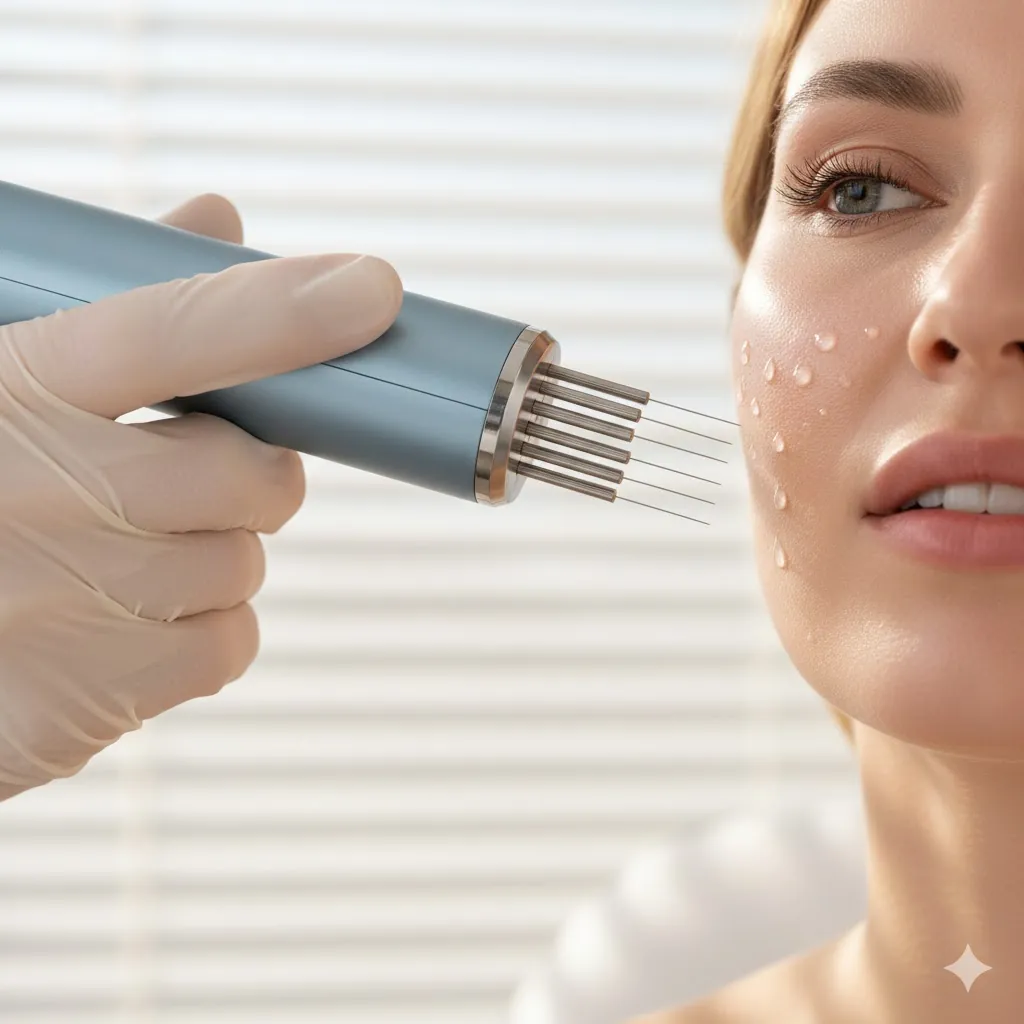
Skin boosters involve micro-injections of hyaluronic acid, so expect mild discomfort, pinpoint bleeding and small bumps that usually settle within 24-48 hours. Most people return to normal activities quickly, with makeup avoided for 6 hours and saunas, hot tubs and heavy sun exposure avoided for 3 days.
What happens during a skin booster appointment?
A visit combines a short consultation, numbing and a series of micro-injections, with the procedure itself typically taking about 30-60 minutes.
The appointment begins with a consultation and customization step. A member of Dr. Jiang's team reviews your skin, your goals and your history, then selects the appropriate product. Skin booster gels fall into broad categories, such as non-cross-linked HA, microdroplet HA, HA with added amino acids and hybrid gels, and the choice is matched to your skin and objectives. Dr. Jiang, a licensed physician in British Columbia and RAAC's lead physician, oversees clinical safety and candidate evaluation at the Richmond, BC clinic.
Next comes numbing and prep. Topical numbing cream is applied for 30-45 minutes to help keep the visit comfortable, and ultra-fine needles are used during injection.
The injection stage follows. Using micro-needles or the V2 Injector gun, the practitioner deposits hyaluronic acid evenly into the dermis. The procedure itself typically takes about 30-60 minutes, so plan for numbing time on top of that. More detail on the treatment is available on our Skin Boosters page.
Afterwards, small bumps are common and typically settle within 24-48 hours.
Do skin boosters hurt?
Most people describe the injections as tolerable rather than painful, because topical numbing and ultra-fine needles are used. At Richmond Anti-Aging Clinic (RAAC) in Richmond, British Columbia, comfort is built into the appointment itself. Topical numbing cream is applied for 30-45 minutes before any injection begins, so the skin has time to settle before the first pass.
The micro-injections themselves are then delivered with ultra-fine needles or the V2 Injector gun, which deposits small, even amounts of hyaluronic acid into the dermis. Because the gel is placed in tiny droplets rather than as a single volume, the sensation is usually described as brief pinpoint pressure rather than deep discomfort. The procedure itself typically takes about 30-60 minutes, depending on the areas treated.
Sensation can vary with the treatment area and individual sensitivity. Thinner skin, such as the neck, décolletage or the back of the hands, may feel more noticeable than the cheeks, and some people are simply more responsive to needle sensation than others. If comfort is a concern, it is worth raising it during consultation so the plan can be adjusted.
Dr. Charles Jiang, a licensed physician in British Columbia and RAAC's lead physician, oversees candidate evaluation and clinical safety, so any questions about comfort or suitability can be directed to him before treatment.
What side effects can I expect right after treatment?
Temporary pinpoint marks and small bumps are the usual early effects, and they generally settle within 24-48 hours. Because skin boosters are micro-injections of fluid hyaluronic acid gel placed into the dermis, the skin often shows visible microdroplets at each entry point immediately afterward. These are a normal part of the technique rather than a complication, and they typically flatten as the gel settles.
For the first day, the treated area may look slightly uneven or feel tender to the touch. Avoiding touching or massaging the area for 24 hours helps reduce irritation and supports even settling. Skin typically continues to settle and improve over the following 2-3 weeks, so early bumpiness is not a reliable preview of the final result.
Less common early effects can include brief redness, mild swelling or small bruising at injection sites. Dr. Jiang's team uses techniques that minimize trauma and the risk of PIH (hyperpigmentation), which matters for melanin-rich or reactive skin. As a licensed physician in British Columbia and RAAC's lead physician, Dr. Jiang oversees candidate evaluation and clinical safety, so any concern about how your skin is responding can be reviewed directly. Results and recovery vary by person and product.
How much downtime do skin boosters involve?
Downtime is minimal for most people, though the skin needs a few days of careful handling before returning to normal routines. Skin boosters are a non-surgical option, and the after-effects are largely surface-level rather than disruptive to the day.
Small bumps at the injection sites are common and typically settle within 24-48 hours. Over the following 2-3 weeks, the skin usually continues to settle and improve as the hyaluronic acid integrates into the dermis. During this window, a few practical limits apply:
- Avoid touching or massaging the treated area for 24 hours.
- Skip makeup for 6 hours and strenuous exercise for 24-48 hours.
- Avoid saunas, hot tubs and heavy sun exposure for 3 days.
- Sleeping on your back or the untreated side the first night helps avoid pressing on treated areas.
These are general guidelines; your own timeline is confirmed at consultation, and Dr. Charles Jiang, a licensed physician in British Columbia and RAAC's lead physician, oversees candidate assessment and aftercare planning at the Richmond, BC clinic. Results vary by person and product.
What aftercare supports recovery?
Gentle handling, hydration and sun protection in the first days help the skin settle predictably. After skin booster injections at Richmond Anti-Aging Clinic (RAAC) in Richmond, British Columbia, aftercare is simple but worth following closely.
For the first 24 hours, avoid touching or massaging the treated area; small bumps usually settle within 24-48 hours. Makeup should wait about 6 hours. Strenuous exercise is best avoided for 24-48 hours, and saunas, hot tubs or heavy sun exposure for 3 days. Sleeping on your back or the untreated side the first night helps avoid pressing on treated areas.
Keep skin hydrated with a gentle moisturizer and use sunscreen daily. These steps support comfort and help the skin settle evenly; results vary by person.
Aftercare questions are reviewed with Dr. Jiang, a licensed physician in British Columbia and RAAC's lead physician, so guidance can be matched to your skin and treatment plan. If something feels off, contact the clinic rather than adjusting your routine on your own.
When do results appear and how long do they last?
Skin typically continues to settle and improve over 2-3 weeks, and effects usually last about 6-9 months before fading gradually. The timeline reflects how hyaluronic acid (HA) works in the dermis rather than a single moment of change.
Right after treatment, small bumps from the micro-injections usually settle within 24-48 hours. Over the following 2-3 weeks, the injected HA attracts and retains moisture, and collagen stimulation continues, so hydration and skin quality may build gradually rather than appearing all at once. Because the gel is placed as tiny droplets distributed through the dermis, improvement tends to emerge evenly across the treated area.
A common course is about 3 sessions spaced 3-4 weeks apart, with maintenance roughly every 6-9 months. Results and duration vary by person, product and area treated; the HA is naturally metabolised over time, which is why effects fade gradually rather than ending abruptly. Your physician at Richmond Anti-Aging Clinic (RAAC) in Richmond, BC, can outline a realistic timeline for your skin at consultation.
Who should not have skin boosters?
Some people should postpone or avoid treatment, and a physician assessment determines whether it is appropriate. Skin boosters are hyaluronic acid micro-injections, so the screening process focuses on how your skin is behaving now, what you are taking, and how your body has responded to similar products in the past.
Treatment is generally not recommended in the following situations:
- Pregnancy or breastfeeding
- Active skin infections or inflammation in the treatment area
- Known allergies to hyaluronic acid or lidocaine
- Recent other dermal treatments in the same area
- Blood thinners or a bleeding disorder, until reviewed by the physician
- Active cold sores, or an autoimmune condition affecting the skin, which requires assessment
Timing matters as much as the list itself. A cold sore that is settling, a course of medication that is about to change, or a recent facial treatment in the same area may simply mean waiting rather than cancelling the plan.
At Richmond Anti-Aging Clinic (RAAC) in Richmond, British Columbia, candidate evaluation is handled with physician oversight. Dr. Charles Jiang, a licensed physician in British Columbia and the lead physician at RAAC, reviews your skin condition, history and goals before any treatment is planned. If skin boosters are not suitable for you, the team can discuss whether another option may fit better.
When might another option suit you better?
If your main concern is congestion, texture from buildup or a gentler first step, a HydraFacial may be discussed instead, while volume loss or deeper laxity calls for a different plan. Skin boosters are micro-injections of stabilized hyaluronic acid designed to improve skin quality rather than change shape, so the right choice depends on what your skin actually needs. A few distinctions are worth knowing:
- Congestion or buildup: a HydraFacial focuses on cleansing and surface refinement, which skin boosters do not address.
- Volume loss or deeper laxity: these call for a different assessment, since skin boosters do not restore volume or lift tissue.
- Texture and hydration without volume change: this is where skin boosters are designed to work, supporting hydro-balance and collagen from within the dermis.
Candidates are evaluated individually before any plan is set. Dr. Jiang, a licensed physician in British Columbia and RAAC's lead physician, reviews skin condition and goals, and his team uses techniques that minimize trauma and the risk of PIH, which matters for melanin-rich or reactive skin. If your concern sits outside what skin boosters are designed to do, it is worth asking what your plan should include instead.
Frequently asked questions
Are skin boosters painful?
Most people describe the micro-injections as brief pinpoint sensations. Topical numbing cream is applied for 30-45 minutes beforehand, and ultra-fine needles are used to help keep the visit comfortable.
How long is the downtime after skin boosters?
Small bumps at the injection sites typically settle within 24-48 hours. Makeup should be avoided for 6 hours, strenuous exercise for 24-48 hours, and saunas, hot tubs or heavy sun exposure for 3 days.
What are the common side effects of hyaluronic acid skin boosters?
Temporary small bumps, mild redness and slight tenderness at injection points are the usual effects, and the bumps generally settle within 24-48 hours. Anyone with active skin infection, a known allergy to hyaluronic acid or lidocaine, or who is pregnant or breastfeeding should not have the treatment.
How many skin booster sessions will I need?
A common course is about 3 sessions spaced 3-4 weeks apart, with maintenance roughly every 6-9 months. Your plan is set after your skin is assessed.
How long do skin booster results last?
Effects typically last about 6-9 months, then fade gradually as the hyaluronic acid is naturally metabolised. Results and duration vary by person and product.
What does skin booster aftercare involve?
Avoid touching or massaging the treated area for 24 hours, keep skin hydrated with a gentle moisturizer, and use sunscreen daily. Sleeping on your back or the untreated side the first night helps avoid pressing on treated areas.
How much do skin boosters cost?
Pricing is personalized at consultation, since the plan depends on the product selected and the areas treated. A visit typically takes about 30-60 minutes for the procedure itself, plus numbing time.
Next steps
If you are weighing Skin Boosters, a physician-led assessment at Richmond Anti-Aging Clinic (RAAC) in Richmond can clarify whether it suits you. Book a consultation — available in English and Chinese. You can also read more on the Skin Boosters treatment page.
This article is for educational purposes only and does not constitute medical advice. Please consult with a qualified healthcare professional before undergoing any treatment.