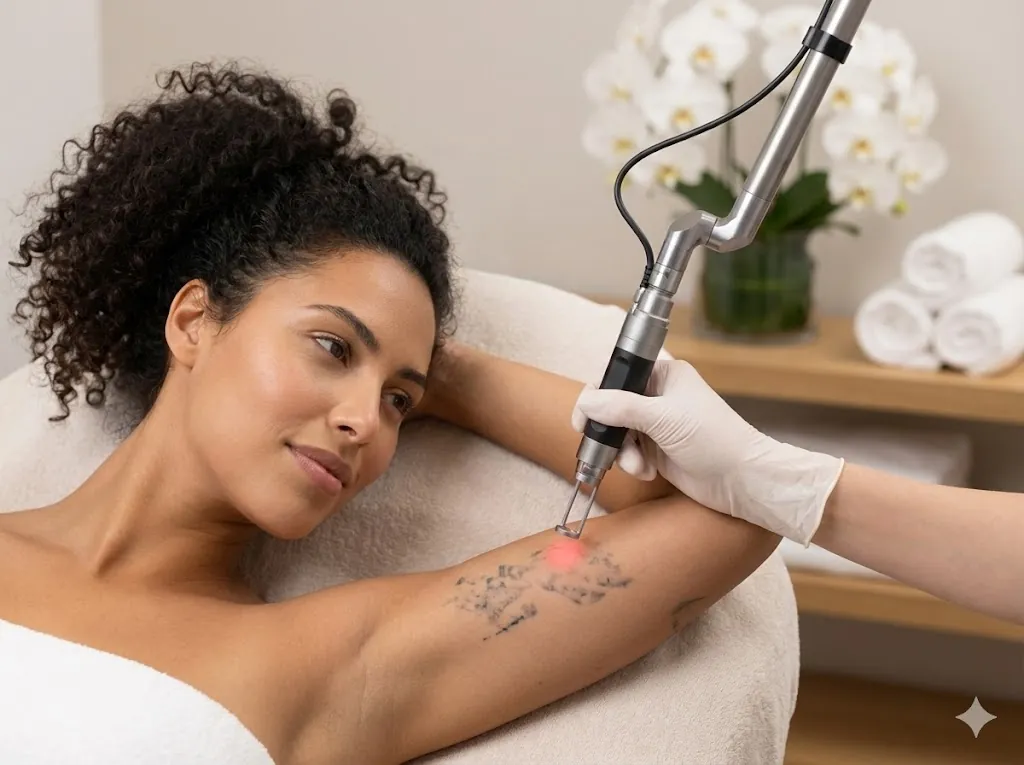
How many PicoWay sessions you need depends on your tattoo's size, colour and ink depth — most tattoos clear over a series of spaced treatments rather than one visit, because your body needs weeks to flush out the shattered ink between sessions. Black ink usually clears fastest; greens, blues and lighter colours often take longer.
Whether it's a faded reminder of your twenties, a name you'd rather forget, or a design that no longer represents who you are — unwanted tattoos are more common than you think. The good news? PicoWay picosecond laser technology uses short pulses of energy to target tattoo pigment. At RAAC Richmond, we use PicoWay to help patients reclaim their skin with confidence.
How PicoWay Removes Tattoos
The Science: Picosecond vs Nanosecond
Traditional tattoo removal lasers (Q-switched) operate in nanoseconds (billionths of a second). PicoWay operates in picoseconds (trillionths of a second) — that's 1,000 times faster. This speed difference fundamentally changes how ink is broken down:
Nanosecond lasers (Q-switched):
- Use primarily photothermal (heat) energy
- Break ink into relatively large fragments
- More heat = more risk of scarring and skin damage
- Struggle with certain colors (blues, greens, purples)
PicoWay picosecond laser:
- Uses photoacoustic (pressure wave) energy
- Shatters ink into ultra-fine particles — like dust
- Minimal heat = lower risk of scarring
- Multiple wavelengths target virtually all ink colors
The Process Step by Step
- Laser pulse hits the tattoo — energy is absorbed by the ink particles
- Pressure wave shatters the ink — particles break into microscopic fragments
- Your immune system responds — white blood cells (macrophages) engulf the tiny ink fragments
- Lymphatic drainage — your body naturally flushes the fragments away over weeks
- The tattoo fades progressively — each session removes another layer of ink
What Colors Can PicoWay Remove?
PicoWay uses three wavelengths, which may make it suitable for a range of tattoo colours and skin types:
| Wavelength | Target Colors | Effectiveness |
|---|---|---|
| 1064nm | Black, dark blue, dark green | Effective for many common tattoo colors |
| 785nm | Blue, green, purple, teal | Excellent — this wavelength is unique to PicoWay |
| 532nm | Red, orange, yellow, warm tones | Excellent |
Color-by-Color Breakdown
- Black ink: Easiest to remove — responds to all wavelengths. Typically requires fewer sessions.
- Dark blue/navy: Very responsive to 1064nm wavelength. Excellent results.
- Red ink: Well-targeted by the 532nm wavelength. Good to excellent clearance.
- Green ink: Historically the most stubborn color. PicoWay's 785nm wavelength is designed to target green pigment.
- Blue/teal: The 785nm wavelength is used to target these colours.
- Purple: Combination of 785nm and 1064nm provides effective treatment.
- Yellow/orange: Targeted by 532nm. May require more sessions but achievable.
- White ink: Can darken with laser treatment — requires special assessment. Your physician will discuss the risks and approach.
Colors That Are More Challenging
- Fluorescent/UV-reactive inks: May not respond predictably
- Cover-up tattoos (layered ink): Require more sessions due to increased ink density
- Cosmetic tattoos (microblading, lip liner): Contain iron oxide pigments that can oxidize and darken — requires a specialized approach
How Many Sessions Will You Need?
The number of sessions depends on multiple factors:
| Factor | Fewer Sessions | More Sessions |
|---|---|---|
| Ink color | Black, dark blue | Multicolor, green, yellow |
| Tattoo age | Older (already fading) | Fresh (< 2 years) |
| Ink quality | Amateur/stick-and-poke | Professional (dense ink) |
| Location | Torso, upper arms (good circulation) | Extremities (hands, feet, ankles) |
| Skin type | Lighter skin | Darker skin (lower energy needed) |
| Size | Small (< 3 inches) | Large, full-sleeve |
Typical Session Ranges
| Tattoo Type | Estimated Sessions |
|---|---|
| Small black tattoo | 4-6 sessions |
| Medium professional black | 6-8 sessions |
| Multicolor professional | 8-12 sessions |
| Large/full-sleeve | 10-15+ sessions |
| Cover-up preparation (partial removal) | 3-5 sessions |
| Cosmetic tattoo (eyebrows) | 2-4 sessions |
Sessions are spaced 6-8 weeks apart to allow your body to clear fragmented ink and for the skin to fully heal between treatments.
Tattoo Removal Cost in Richmond BC
At RAAC, tattoo removal is priced based on the size of the tattoo:
| Size Category | Approximate Cost Per Session |
|---|---|
| Extra small (< 2 sq inches) | Quoted at consultation |
| Small (2-4 sq inches) | Quoted at consultation |
| Medium (4-8 sq inches) | Quoted at consultation |
| Large (8-16 sq inches) | Quoted at consultation |
| Extra large (> 16 sq inches) | Custom quote |
Cost is confirmed at consultation. Your initial consultation includes a size assessment, session estimate, and transparent total cost projection.
The Treatment Experience
Your First Consultation
- Your physician examines the tattoo: size, color, ink depth, skin type, and location
- We photograph the tattoo for before-and-after documentation
- A realistic treatment plan is created: number of sessions, timeline, and cost
- A test spot may be performed on a small area to gauge your skin's response
During a Session
- Duration: 5-30 minutes depending on tattoo size
- Sensation: The sensation is often described as a hot rubber band snapping, and how intense it feels may vary from person to person
- Numbing: Topical anesthetic cream is applied 30 minutes before, and we offer cooling devices during treatment
- Immediate reaction: Whitening (frosting) of the treated area — this is normal and indicates the laser has effectively targeted the ink
After Treatment
- First 24-48 hours: Redness, swelling, possible blistering — all normal responses
- Days 3-7: Treated area may scab or crust — do not pick at it
- Weeks 1-3: Gradual fading begins as your body clears fragmented ink
- Weeks 4-8: Continued fading; skin heals and prepares for next session
Aftercare Instructions
- Keep the area clean and dry for the first 24 hours
- Apply prescribed antibiotic ointment and a non-stick bandage
- Avoid sun exposure — SPF 50+ on the area once healed
- No swimming, hot tubs, or saunas for 1-2 weeks
- No picking or scratching at scabs
- Stay hydrated and maintain good circulation (gentle exercise is fine after 48 hours)
- Avoid blood-thinning medications and alcohol for 24 hours before and after treatment
Before & After: Realistic Expectations
What You Should Expect
- Progressive fading: Each session fades part of the remaining ink
- Not instant: The most pronounced fading happens between sessions as your body continues clearing ink
- Some tattoos clear completely: Especially smaller, older, black-ink tattoos
- Some leave a faint shadow: Very dense, multicolor professional tattoos may retain a ghost image
- Skin texture may differ slightly: The treated area may have a subtle textural change, though PicoWay's lower heat may reduce this risk compared to older lasers
Timeline Example: Medium Black Professional Tattoo
| Session | Expected Appearance |
|---|---|
| Before treatment | Full, dark tattoo |
| After session 2 | Noticeably lighter, some areas clearing |
| After session 4 | 50-60% faded, design becoming indistinct |
| After session 6 | 70-80% faded, mostly a faint shadow |
| After session 8 | 90%+ clearance, minimal residual shading |
Typical ranges only; results vary by person.
Cover-Up Preparation
Not everyone wants complete removal. Many patients use PicoWay to lighten a tattoo enough for a cover-up — this typically requires only 3-5 sessions and gives your tattoo artist a much better canvas to work with.
PicoWay vs Other Tattoo Removal Methods
| Method | Effectiveness | Scarring Risk | Colors | Sessions |
|---|
| Q-switched Nd:YAG | Good | Moderate | Black, red | 8-15 | | Surgical excision | Complete (small only) | High (scar) | All | 1 | | Dermabrasion | Poor-moderate | High | Limited | Multiple | | Tattoo removal creams | Ineffective | Variable | None proven | N/A |
Who Is a Good Candidate?
PicoWay tattoo removal is suitable for most patients, including:
- A wide range of skin types (Fitzpatrick I-VI), with appropriate parameter adjustments
- Patients with single or multiple unwanted tattoos
- Those wanting partial removal for cover-up preparation
- Patients who previously attempted removal with older technology and still have residual ink
Not Ideal Candidates:
- Active skin infection over the tattoo
- Pregnancy or breastfeeding (as a precaution)
- History of keloid scarring (requires careful assessment)
- Unrealistic expectations of single-session removal
Complementary Treatments
After completing tattoo removal, some patients may consider:
- PicoWay for Pigmentation to address any residual discoloration
- Sylfirm X RF Microneedling to improve skin texture in the treated area
- Microneedling with PRP to accelerate skin remodeling
Book Your Tattoo Removal Consultation
Ready to remove an unwanted tattoo? Book a consultation at RAAC Richmond. We'll assess your tattoo, provide a realistic treatment plan, and get you started on the path to clearer skin.
RAAC Richmond Anti-Aging Clinic: 5580 No. 3 Rd Unit 110, Richmond BC V6X 0R8. Serving Richmond, Vancouver, Burnaby, Surrey, and Metro Vancouver.